
AN APPEAL FOR SUPPORT
- We are in need of support to meet expenses relating to some new and essential software, formatting of articles and books, maintaining and running the journal through hosting, correrspondences, etc. If you wish to support this voluntary effort, please send your contributions to
M. S. Thirumalai
6820 Auto Club Road Suite C
Bloomington
MN 55438, USA.
Also please use the AMAZON link to buy your books. Even the smallest contribution will go a long way in supporting this journal. Thank you. Thirumalai, Editor.
BOOKS FOR YOU TO READ AND DOWNLOAD
- COMMUNICATION VIA EYE AND FACE in Indian Contexts by
M. S. Thirumalai, Ph.D. - COMMUNICATION
VIA GESTURE: A STUDY OF INDIAN CONTEXTS by M. S. Thirumalai, Ph.D. - CIEFL Occasional
Papers in Linguistics,
Vol. 1 - Language, Thought
and Disorder - Some Classic Positions by
M. S. Thirumalai, Ph.D. - English in India:
Loyalty and Attitudes
by Annika Hohenthal - Language In Science
by M. S. Thirumalai, Ph.D. - Vocabulary Education
by B. Mallikarjun, Ph.D. - A CONTRASTIVE ANALYSIS OF HINDI
AND MALAYALAM
by V. Geethakumary, Ph.D. - LANGUAGE OF ADVERTISEMENTS
IN TAMIL
by Sandhya Nayak, Ph.D. - An Introduction to TESOL:
Methods of Teaching English
to Speakers of Other Languages
by M. S. Thirumalai, Ph.D. - Transformation of
Natural Language
into Indexing Language:
Kannada - A Case Study
by B. A. Sharada, Ph.D. - How to Learn
Another Language?
by M.S.Thirumalai, Ph.D. - Verbal Communication
with CP Children
by Shyamala Chengappa, Ph.D.
and M.S.Thirumalai, Ph.D. - Bringing Order
to Linguistic Diversity
- Language Planning in
the British Raj by
Ranjit Singh Rangila,
M. S. Thirumalai,
and B. Mallikarjun
REFERENCE MATERIAL
- Lord Macaulay and
His Minute on
Indian Education - In Defense of
Indian Vernaculars
Against
Lord Macaulay's Minute
By A Contemporary of
Lord Macaulay - Languages of India,
Census of India 1991 - The Constitution of India:
Provisions Relating to
Languages - The Official
Languages Act, 1963
(As Amended 1967) - Mother Tongues of India,
According to
1961 Census of India
BACK ISSUES
- FROM MARCH 2001
- FROM JANUARY 2002
- INDEX OF ARTICLES
FROM MARCH, 2001
- JUNE 2004 - INDEX OF AUTHORS
AND THEIR ARTICLES
FROM MARCH, 2001
- JUNE 2004
- E-mail your articles and book-length reports to thirumalai@bethfel.org, or send your floppy disk (preferably in Microsoft Word) by regular mail to:
M. S. Thirumalai
6820 Auto Club Road, Suite C.,
Bloomington, MN 55438 USA. - Contributors from South Asia may send their articles to
B. Mallikarjun,
Central Institute of Indian Languages,
Manasagangotri,
Mysore 570006, India or e-mail to mallikarjun@ciil.stpmy.soft.net - Your articles and booklength reports should be written following the MLA, LSA, or IJDL Stylesheet.
- The Editorial Board has the right to accept, reject, or suggest modifications to the articles submitted for publication, and to make suitable stylistic adjustments. High quality, academic integrity, ethics and morals are expected from the authors and discussants.
Copyright © 2004
M. S. Thirumalai
STRATEGIES IN THE FORMATION OF COMPOUND NOUNS IN TAMIL
S. Rajendran, Ph.D.
1. INTRODUCTION
Noun compounding is a very productive and most commonly used word formation mechanism in Tamil. In Tamil nominal compounds may consists of either a noun plus noun or an adjective plus noun. However a noun invariably dominates the category of the head. Theoretically, though there is no restriction on the number of constituents in a noun compound, the upper limit on the number of constituents depends on the memory limitations of the native speakers of Tamil.
For example, the Tamil noun compound like uzhavar munneeRRa cangkat talaivar teertal 'the election for the post of president of the peasant's development association' can be extended further.
This word formation mechanism is a very handy technique and frequently used in the areas of journalism, in the translation of scientific and technical texts, and in advertising. The fact that neither of the stems in a noun compound is argument taking, and consequently there will be fewer syntactic restrictions imposed on the combination that accounts for the popularity and frequency of the noun compounds.
An attempt is made here to explore the different studies that have been already made on nominal compounds in Tamil as well as different frameworks and approaches by which the problems can be studied.
2. DIFFERENT APPROACHES TO NOMINAL COMPOUND FORMATION
Here, instead of taking up a particular framework and explaining the formation of compound nouns, it is decided to explore the different ways of approaching compound noun formation in Tamil, along with the different studies already made on this topic.
It appears that each study contributes to the proper understanding of compound noun formation in Tamil.
The major studies on nominal compounds can be broadly classified under the following heading.
- Traditional Approach
- Generative Approach
- Knowledge-based Approach
2.1. Traditional Approach
It will enhance our conceptualization of nominal compounds when we explore how the traditional grammarians approached the problem of nominal compounds in Tamil. They called nominal compounds by the name tokai. The tokai cannot be said as exactly similar to the nominal compounds, though in some aspects they are one and the same. For the sake of convenience tokai is translated as nominal compound here.
Traditional grammarians of Tamil look at nominal compound formation in Tamil from two points of view:
- Compound nouns are derived from phrases by the deletion of elements like case suffixes, comparative particles, tense suffixes, co-ordinate particles, and predicative elements.
- Compound nouns are derived only by the juxtaposition of words, and, only for the interpretation of meaning, they have to be expanded with the help of elements mentioned above.
The modern approaches, whether they represent the lexicalist approach or the generative approach, are not totally different from the traditional viewpoints on nominal compounds.
Under this heading, the traditional grammarians' approach, commentators' approach and Maramalai's (1984) approach have been dealt with. They have been dealt under the following heads:
- Tolkappiyar's approach
- Commentators' approach
- Nannul's approach
- Maramalai's approach
2. 1. 1. Tolkappiyar's Approach
Tolkaapiyar lists six types of nominal compounds in the cuuttiram 466.
veeRRumait tokaiyee uvamat tokaiyee
vinaiyin tokaiyee paNpin tokaiyee
ummaittokaiyee anmozhit tokaiyenRu
avvaa Renpa tokaimozhi ndilaiyee
'Casal compounds, compounds of comparisons, verbal compounds, adjectival compounds, conjugational compounds, and anmozhi compounds are the six occurrences where there are word gaps.'
The six types of nominal compounds are listed below:
- veeRRumaittokai 'casal compound'
- uvamaittokai 'compound of comparison'
- vinaittokai 'verb attributing nominal compound'
- paNputttokai 'compound of quality'
- ummaittokai 'coordinate nominal compound'
- anomozittokai 'bahuviihi compound.
veRRumaittokai 'casal compound'
Tolkappiyar discusses the casal compound from cuttiram 407 to 412. He defines the casal compound as follows:
veeRRumait tokaiyee veeRRumai iyala
'Casal compound is as that of casal.'
His statement can be interpreted as meaning that the structure of casal compound is as that of the casal phrase. Accordingly we can think of six casal compounds:
1. Second casal compound in which the second case markers ai does not appear.
| Compound without case marker | Parallel phase with case marker |
| ndiir cindt-in-aan water spill_PAST_he 'He spilled water.' |
ndiir-aic cind-in-aan water_ACC spill_PAST_he 'He spilled water.' |
2. Third casal compound in which the third case marker oTu does not appear.
| Compound without case marker | Parallel phase with case marker |
| taay muuvar mother three persons 'mother with three persons' |
taay_oTu muuvar mother_with three persons 'mother with three persons' |
3. Fourth casal compound in which the fourth case maker ku does not appear.
| Compound without case marker | Parallel phase with case marker |
| karumpu veeli sugar cane fence 'fence for sugar cane' |
karumpu-kku veeli sugar cane_CM fence 'fence for sugar cane' |
| Compound without case marker | Parallel phase with case marker |
| karuvuurk kizhangku Karuvur root 'root form Karuvur' |
karuvuur-in kizhangku Karuvur_CM root 'root form Karuvur' |
5. Sixth casal compound in which the sixth case marker (atu, etc.) does not appear.
| Compound without case marker | Parallel phase with case marker |
| murukan pukazh 'fame of Lord Murugan' |
murukan-atu pukazh Murugan_CM fame 'fame of Lord Murugan' |
6. Seventh casal compound in which the seventh case marker does not appear.
| Compound without case marker | Parallel phase with case marker |
|
manRap peN ‘woman in dancing hall’ |
manR-in kaN peN hall_OBL CM woman_CM ‘woman in dancing hall’ |
uvamaittokai 'Compounds of comparison'
Tolkappiar describes uvamaittokai in as given below:cuuttiram 408:
uvamait tokaiyee uvama iyala
'Compounds of comparisons are comparisons'
The example given in the following table illustrates the statement.
| Compound without comparative element | Parallel phase with comparative element |
|
mazhai vankai rain hard hand ‘rain similar to hard hand’ |
mazhai anna vankai rain similar hard hand ‘rain similar to hard hand’ |
According to him, compounds of comparisons are like comparative constructions. It can be interpreted that Tolkappiyar realizes the similarity between the underlying phrase involving comparison and the surface compound that appears without a comparative marker. It should be mentioned here that in the third part of his grammar (entitled as poruLatikaaram 'chapter on content'), he describes in details the different types of comparisons involving different comparative elements.
vinaittokai 'Verbal compounds'
Tolkappiyar describes vinaittokai in the following fashion in cuuttiram 409.
vinaiyin tokuti kaalat tiyalum 'Verbal compounds are of the time indicated.'
According to him, the verbal compounds can be expanded with tense. The example given in the following table illustrates the statement.
| Compound without tense element | Parallel phrases with tense elemets |
|
puNar pozhutu combine time ‘combining time’ |
puNar-ndt-a pozhutu combine_PAST_RP time puNar-kinR-a pozhtu combine_PRES_ RP time puNarum pozhutu combine_FUT time |
paNputtokai 'Compound of quality'
Tolkappiyar describes about the comparison of quality in cuuttiram 410.
vaNNattin vaTivin aLavin cuvaiyinenRu
anna piRavum atankuNam ndutali
inna tituvena varuuu miyaRkai
enna kiLaviyum paNpin tokaiyee.
vaNNattin vaTivin aLavin cuvaiyinenRu
'Words expressing qualities of colour, shape, measure and taste and the like taking the words of the object of these qualities immediately after are the compounds of quality'
According to him the qualifying words of colour, shape, measure, and taste combine with the words that are qualified without the elements marking the relation of quality. The following table illustrates the four sub-types of compounds of quality.
| Sub-types of compounds of comparison | Compounds of quality | Parallel phrases containing the elements of quality |
| Compound of colour | karungkutirai ‘black horse’ | karumaiy-aana kutirai 'black_COM horse' ‘the horse which is black’ |
|
Compound of shape |
vaTTappalakai ‘round plank’ |
vaTTam-aana palakai round_COM plank ‘plank which is round in shape’ |
|
Compound of measurement |
kuRungkool ‘short stick’ |
kuRukal-aana kool short_COM stick ‘stick which is short’ |
|
Compound of taste |
tiingkarumpu ‘sweet sugar cane’ |
tittipp-aana karumpu sweet_COM sugar cane’ ‘sugar cane which is sweet’ |
The traditional grammarians of Tamil classify the compound nouns into six types based on the semantic interpretation or the recoverability from the presumed sources:
- veeRRumaittokai 'casal compound',
- uvamaittokai 'compound of comparison',
- vinaiyin tokai 'verbal compound',
- paNpin tokai 'compound of quality',
- ummaittokai 'compound involving um,' or
- co-ordinate compound and anmozhittokai 'bahuvriihi compound'.
According to one interpretation, nominal compounds are considered as reduced forms of phrases in which the elements like case suffix, comparative particles, tense, particles of quality, co-ordinate particles, etc. are dropped. According another interpretation, it is not that the compounds are derived from phrases, but only for interpretation of meaning they are expanded into phrases. The table given below will exemplify the above-mentioned traditional view on nominal compounds:
|
Sl. No. |
Compound |
Possible expansion |
The type base on the deleted or recoverable element |
|
1. |
makrandtappai |
makarandtattaiyuTaiya pai ‘bag which contains pollen grains’ |
Casal compound in which the second case suffix -ai is recovered or deleted |
|
2. |
maNal
meeTu |
maNalaal amaindta meeTu ‘elevated place made up of sand’ |
Casal Compound in which the third case suffix -aal is recovered or deleted |
|
3. |
makkaL kalvi ‘education for people’ |
makkaLukku kalvi ‘education to the people’ |
Casal compound in which the fourth case suffix -ku is recovered or deleted |
|
4. |
mara
eNNey |
marattiliurntu
eTukkappaTTa eNNey |
Casal compound in which the fifth case suffix -illiruntu is recovered or deleted |
|
5. |
mazhai aLavu ‘amount of rain fall’ |
mazhaiyatu
aLavu |
Casal compound in which the sixth case suffix -atu is recovered or deleted |
|
6. |
marappuzhu ‘wood-worm’ |
marattinkaN
vaazhum puzhu |
Casal compound in which the seventh suffix -kaN is recovered or deleted |
|
7. |
cuTundiir |
cuTTandiir/
cuTukinRa ndiir/ cuTum ndiir |
Verbal compound in which the past tense suffix -T + a or the present tense suffix -kinR + a or future tense suffix -um is recovered or deleted |
|
8. |
karungkal |
karumaiyaana
kal |
Compound of quality in which the suffix -mai and the paticle -aana are recovered or deleted |
|
9. |
kuzhal viLakku ‘tube-light’ |
kuzhal poonRa viLakku `tube like lamp’ |
Compound of comparison in which the comparative particle poonRa is recovered or deleted |
|
10. |
varavu celavu ‘expenditure’ |
varavum
celavum |
Co-ordinate compound in which the co-ordinate element -um is recovered or deleted |
|
11. |
koTiyiTai |
koTi
poonRa iTaiyai uTaiya peN |
Bahuvriihi or exocentric compound in which the
comparative particle |
ummaittokai 'Coordinate compounds'
Tolkappiyar discusses about ummattokai in the sutra 411 given below:
irupeyar palpeyar aLavin peyaree
eNNiyaR peyaree ndiRaippeyar kiLavi
eNNin peyaroo TavvaRu kiLaviyum
kaNNiya ndilaittee yummait tokaiyee
"Coordinate compounds occur in the following six instances: two names, many names, names of measures, names indicated by numbers, names of weights and names of numerals."
Tolkappiyar identifies six types of coordinate compounds. The following table lists them with examples:
|
No. |
Compound type |
Compound |
Expanded phrase |
|
1 |
Compound which have two nouns as their constituents |
kapilaparaNar ‘Kapilar and Paranar’ |
kapilarum paranarum ‘Kapilar and Paranar’ |
|
2 |
Compound which have more than two nouns as their constituents |
puli vil keNTai ‘Tiger, bow and fish’ |
puliyum villum keNaiyum ‘Tiger, bow and fish’ |
|
3 |
Compounds which have measurement as their constituents |
tuuNippatakku ‘six maracals’ |
tuuNiyum patakkum ‘four maracals and six maracals’ |
|
4 |
Compounds which are formed from numerals as their constituents |
patinaivar ‘fifteen persons’ |
patinmarum aivarum ‘fifteen persons and five persons’ |
|
5 |
Compounds which have nouns denoting weights as their constituents |
toTiyarai ‘half toTai’ |
toTiyum araiyum ‘toTai and half’ |
|
6 |
Compounds which have numerals as their constituents |
patinonRu ‘eleven’ |
pattum onRum ‘ten and one’ |
It should be noted that in all the above-mentioned type of compounds not only the suffixes and particles, but also verbal elements are recovered or deleted for the interpretation or derivation of the compound nouns. The comparative element poonRa `as if/like' and the quality element aana can be interpreted as verbal element. Even in the examples like makkaL kalvi `education for people' and mazhai aLavu `amount of rain fall' where it appears as if only the case suffixes have to be recovered or deleted, we can posit verbal element like uriya `belonging to'. It is clear from the above-mentioned outlook of traditional grammarians that certain elements have to be recovered for the semantic interpretation of nominal compounds and the most important of them is verbal element.
It should be remembered here that the elements, especially the predicative or verbal elements, to be recovered for the interpretation of meaning can be predicted by native speakers, though the predictable variables may be numerous. A theory, which generates compounds from underlying representations, does allow variables in the recovery of the compounds. But the stand that the compound nouns are derived by mere juxtaposition of nouns and that the validation of the possible combinations are left to the decision of mental lexicon which interprets the meaning, can incorporate variables. But here also the native speakers' intuition allows only a few variables, which can be interpreted as synonyms belonging to a semantic area. [Note down the similarity of this position with that of Levi (1978), Allen (1979) and Leiber (1980).]
2. 1. 2. Views of Commentators of Tolkappiyam
It is also worth exploring the commentators of Tolakappiyam about nominal composition. Under this the views of the following commentators of Tolkappiyam are dealt with.
- Ilampuranar's approach
- Chenavaraiyar's approach
- Nachinarkiniyar's approach
2. 1. 2. 1. Ilampuranar's approach
Among the commentators, it is Ilampuranar whom we come across first. He belongs to 12th century BC. That means, we get the comments about Tolkapiyam after 15 years from the time of Tolkappiyam. So it is natural that he could not give the correct explanation in many places. His views on nominal composition can be grouped into two: formation of nominal compounds and semantic interpretation of the nominal compounds.
Formation of nominal compounds
Ilampuranar takes nominal composition as one among three types of compositions. According to him, when two words come together, they may occur as a compound, coordinate construction or in subject-predicate relation. In Tamil compounds are formed by the combination of a noun with a noun or a noun with a verb. For example, ndilam kaTandtaan 'he who crossed the land' is a combination of a noun and a verb. Chenavaraiya does not take a noun + verb combination as compound. But others take this technically as a compound, which behaves as a noun taking case signs and recurs as subject-predicate construction.
Ilampuranar opines that some may take verb+noun combination as a compound. He is of the opinion that the vinaittokai is a combination of peyareccam 'adjectival form of verb' + noun. Chenavaraiyar holds the view that vinaittokai is a combination of verb root and noun and that the verb root is a verbal noun with the tense force as it does not express imperative mood. He favours verbal noun + noun combination rather than peyareccam (i.e. adjectival form of verb) + noun combination. Naccinarkiniyar holds the view that there is peyareccam by meaning, but not peyareccam by form.
Ilampuranar identifies the relation between compounds and the corresponding phrases. He is of the opinion that the compounds are formed form their corresponding phrases by deletion. For example, kutiraitteer 'horse chariot' is derived form kutiraiyaaR puuTTappaTTa teer 'chariot yoked with horse' by the deletion of the instrumental aal and also the adjectival form puuTTappaTTa
Ilampuranar while explaining the tolkappiya cuutiram 407, says that some interpret the compounds such as ndilam kaTandtaan as combination of nouns without case suffixes (i.e. without taking into consideration that the case suffix is not overtly expressed) and that others do not agree with this view.
Interpretation of meanings of compounds
Ilampuranar is of the opinion that the casal compounds have to be interpreted as combination of nouns with case suffixes and that in the formation of the compounds the case suffixes are deleted.
While talking about the interpretation of uvamaittokai 'compound of comparison', he raises some interesting questions. He points out that not only comparative elements but also case suffixes surface out while expanding this type of compounds. For example, while explaining the expansion of compound, tuTindaTu 'thin waist (of a girl)' into tuTiyai okkum ndaTu 'waist resembling a kind of drum', he questions whether to take it as casal compound as the case suffix surfaces out during the expansion, or as uvamaittokai as the comparative element okkum surfaces out during the expansion. He also points out that though both case suffixes and element of comparison are hidden, some will take it as uvamaittokai as the comparative meaning is vital to it.
Chenavaraiyar points out that the particles of comparison such as aana do not co-occur with second case suffix ai, and so there is only the relation of comparison rather than the case relation.
But Nacinarkiniyar differs form this opinion. He points out that all the particles of comparison behave like eccam, and so functions as the predicate of an object. According to him there is casal relation; however, thereafter there is comparison or relation of comparison which sets aside this kind of compound.
We have already seen the opinion of Ilampuranar regarding vinaittokai. He talks about the partial deletion of verbal form in the formation of vinaittokai. For example, the compound kol yaanai is formed from kollum yaanai by the deletion of um and retaining the verb kol.
While talking about paNputtokai, Ilampurnar argues that one portion of the attributive word is retained while the other portion is deleted. For example, in the formation of karungkutirai 'black horse' from its expanded form kariyatu kutirai 'the horse is black', the suffix atu is deleted while the portion kar 'is retained'. And so it is called paNputtokai.
Ilampuranar's observation about ummaittokai is important. He points out that in the formation of kapila paraNar by the combination of the proper names kapilan and paraNan, n (which is singular) is deleted as kapila paraNan is ungrammatical . He points out Tolkappiyar's opinion that in this type of compound formation only plural suffix will occur (as in kapila paraNar).
While talking about the formation of anmozhittokai, Ilampuranar talks about the intonation pattern of this type of compound. He points out that as the meaning lies outside the constituent words in this kind of compounds, the compound will be pronounced with a falling intonation (paTuttal oocai). Tolkapiyar is of the opinion that anomozhittokai is formed behind veeRRumaittokai, paNputtokai and ummaittokai. But Ilampuranar points out that anmozhittokai can be formed even on the basis of the other two compounds viz. uvamaittokai and vinaittokai.
2. 1. 2. 2. Chenavaraiyar's approach
After Ilampuranar, Chenavaraiyar is considered prominent. He is logical in his approach. He is well versed both in Tamil and Sanskrit. His commentary is influenced by his Sanskrit knowledge. While comparing with other commentators, it can be said that he is giving more arguments about the theory of compounding and interpretation of compounds. The other commentators such as Nachinarkiniyar, Deyvaccilaiyar and Kalladar either follows Ilampuranar or Chenavaraiyar. According to Chenavaraiyar, the compounds are formed not by the deletion of suffixes.
Chenavaraiyar points out two types of theories on compounds, which groups the grammarians into two. Those belonging to one group are of the opinion that compounds are formed by the deletion of case suffixes, comparative particles, coordinate particles, particles of quality or finite suffixes. And those belonging to the other group are of the opinion that simply combining two or more words without any pause or hiatus forms compounds, which are well knit units expressing some relevant meanings. Chenavaraiyar takes the points of view of the second group. He points out that in the examples, veezhakkarumpu, keezhar panRi, there is no deletion of suffix, but they function as compounds. He argues that Tolkappiyar too holds this opinion. He also points out that a compound function as a simple word. He is of the opinion that there may be phrases function as a simple grammatical unit. That is why he gives importance to the intonation pattern and hiatus in the case of compounds.
Chenavaraiyar argues that the compound of quality formed from the combination of two nouns (irupeyroTTu paNputtokai) such as keeLar panRi do not involve deletion of any of element and so taking deletion as the criteria for the compound formation is not acceptable.
2. 1. 2. 3. Nachinarkiniyar's approach
Nachinarkiniyar who comes after Chenavaraiyar refines the 'non-deletion theory' so as to gives answers to Chenavaraiyar's objections. He holds the opinion that in all compounds there could be the deletion of one or more suffixes, enclitics, or words. Both Chenavaraiyar and Nachinarkiniyar admit the deletion or hiding of case suffixes, enclitic um, the suffixes in vinaittokai and paNputtokai and words in anmozhittokai. Nachinarkiniyar points out that in irupeyaroTTu paNputtokai, (Ex. caaraippaampu 'rat snake'), there is no deletion of morpheme or word. He also points out that even there, the morph aakiya will occur between the constituent elements to show the determiner-determined relation. Chenarvaraiya interprets the word toka found in Tolkappiyam cuuttiram 412 as 'occur as compound', whereas others interprets it denoting the meaning 'when a morpheme is deleted.
Nacchinarkiniyar points out that in vaTTappalakai 'round wooden plank' there is deletion of the final m of the first word vaTTam. This view of taking even deletion of m due to sandhi as a consequence of compounding is interesting. It appears that he holds the view that compounds are formed due to the well-knit combination of two words without any pause. Even here he observes the deletion of aakiya which denotes the determiner-determined relationship between the constituents of the compounds.
2. 1. 3. Nannul's approach
Panvananthi wrote the famous grammar book entitled ndannuul in the 13th century. It appears that he has followed the commentary of Pavananthi on Tolkapiyam. His cuuttirams (cuttiram 361 to cuuttiram 373) on compound is dealt in collatikaaram 'chapter on word'. He gives explanation about compound in cuuttiram 361 which reads as follows:
peyaroTu peyarum vinaiyum veeRRumai
mutaliya poruLi navaRRi nurupiTai
ozhiya viraNTu mutalaat totarndtoru
mozhipoo naTapana tokaindilait toTarccol
According to him, the nouns combines with nouns and verbs into six types of meaning combination; while doing so the suffixes which occur in between get deleted so as to function as a single unit. It appears that Panvananthi belongs to the team of grammarians who explain that deletion of the suffixes is the criterion for the formation of compounds. Ilampuranar takes this view only. It appears that Pavananthi is influenced by Ilampurnanar.
In line with Tolkappiyam, Nannul lists six types of compound viz. the casal compound, the verbal compound, the compound of quality, the compound of comparison, the coordinate compound and the bahuvriihi compound (i.e. anmozhittokai).
cuuttiram 362
veeRRumai vinaipaN puvamai yummai
anmozhi yenavat tokaiyaaRaakum
Following Tolkappiyar, he defines the each tokai in the following fashion: According to him the casal compounds are those where the case suffixes are not overtly expressed.
cuuttiram 363:
iraNTu mutalaa miTaiyaa Rurupum
veLippaTa lillatu veeRRumait tokaiyee
vinaittokai too is based on Ilampuranar's view. Pavananthi explains that vinaittokais are relative participle forms with the tenses being dropped.
cuuttiram 364:
kaalang karandta peyareccam vinaittokiyee
He opines that paNputtokais are of two types: the compounds where the suffixes explaining the qualities are deleted and the compounds where the two nouns combine into one.
cuuttiram 365:
paNpai viLakku mozhitok kanavum
oruporuT kirupeyar vandtavung kuNattokai
According to him uvamaittokai are compounds which do not contain the particle of comparison.
cuuttiram 366:
umam vurupila tuvamat tokaiyee
Pavanathi gives a list of particles of comparison which are deleted in the process of compound formation. They are poola, puraiya, oppa, maana, kaTuppa, iyaiya, veeyppa, ndeera, ndikara, anna and inna.
cuuttiram 367:
poolap puraiya voppa vuRazha
maanak kaTuppa viyaiya veeyppa
ndeera ndikara vanna vinna
enpavum piRavu muvamat turupee
He is of the opinion that coordinate compounds are formed by the deletion of the coordinator um. According to him there are five types of coordinate compounds: coordinate compounds of counting, coordinate compounds of weighing, coordinate compounds of measuring of volume, and coordinate compounds of measuring of length.
cuuttiram 368:
eNNa leTuttatan mukatta niiTTalv enundaan kaLavaiyu Lummila tattokai
According to Pavananthi bahuvriihi compounds are formed on the basis of the other five types of compounds enumerated and explained already. Tolkaappiyar has given only three types of compounds for the formation of anmozhittokai. Ilampuranar has included the other two also. Pavananthi shares the view of Ilampuranar.
cuuttiram 369 aindtokai mozhimeeR piRatoka lanmozhi
In line with Tolkappiyar, he too explains that there are four places in which the meaning of the compound will be prominent:
cuuttiram 370:
munmozhi pinmozhi panmozhi piRamozhi
enunaan kiTattunj ciRakkund tokaipporuL
Following Ilampuranar, Pavananthi too talks about the morphophonemic rules in compounds.
cuuttiram 371:
valloRRu varinee yiTattokai yaakum
melloRRu varinee peyartokai yaakum
According to him, two kinds of changes may occur when the nouns come together. In one instance the plosive of the second noun will geminate to denote compound of location and in the other one, instead of geminating, the final consonant of the first word will become the homorganic nasal of the following plosive to denote nominal compound.
Examples:v vaTuka + kaNNan > vaTukak kaNNan
vaTukan + kaNNan > vaTukang kaNNan
Pavananthi talks about the ambiguity in compounds in cuuttiram 373:
tokkuzhi mayangkunda viraNTu mutaleezh
ellaip poruLin mayangku menpa
According to this statement, the compounds will be ambiguous as the relevant element in the source phrase is deleted. For example, teyva vaNakkam 'worshiping of god' can be interpreted either as teyvattiRku vaNakkam 'worship to god' (i.e. as the deletion of 4th case suffix) or teyvattai vaNangkum vaNakkam 'worship of the god' (i.e. as the deletion of 2nd case suffix). Tolkappiyar deals about this kind of ambiguity in veeRRumai mayangkiyal 'chapter on casal ambiguity'.
2. 1. 4. Maraimalai's approach
Maraimalai (1984), based on his data on administrative terminology, makes interesting observation about the formation of nominal compounds. His typological treatment of compound noun formation is worth mentioned here. He classifies the combination of nouns into following three types:
- Composition of two nouns
- Combination of many nouns
- Compound formation
It is to be noted here that Maraimai makes a distinction between tokai 'composition' and kuuTTu 'compound'. That is he makes a distinction between kuuTTuccol 'compound word' and tokaiccol 'composite word'. (Kindly note here that such as distinction is maintained in this section which deals about Maraimalai's approach on Nominal Composition.
2. 1. 4. 1. Composition of two nouns into one
Maraimalai explains the formation of nouns from nouns by following the traditional approach to nominal composition. He bases his research on administrative terms. He observes that words of veeRRumaittokai 'casal composite', paNputtokai 'quality composite' and vinaittokai 'verbal composite' are more in number than the words of uvamaittokai 'comparative composite' and ummaittokai 'co-ordinate composite' and that anmozhittokais 'bahuvriihi compoites' are not exploited in coining administrative terms.
Examples:
|
Composite type |
Composite |
Expanded phrase |
|
Composite of second case |
makaradntappai 'pollen' |
makarndtatt-ai uTaiya pai 'bag containing pollen grains' |
|
Composite of third case |
maNal meeTu 'sand hill' |
maNal-aal amaindta meeTu ‘hill made up of sand' |
|
Composite of fourth case |
makkaL kalvi 'education for people' |
makkaL-ukkuk kalvi education for people' |
|
Composite of sixth case |
mazhai aLavu 'quantity of rain' |
mazhaiyatu aLavu 'quantity of rain' |
|
Composite of seventh case |
marappuzhu 'tree worm' |
marattin kaN vaazhum puzhu 'worm living in tree' |
|
Composite of quality |
karungakal ‘black rock’ |
karumaiy-aana kal ‘black stone’ |
|
Composite of comparison |
kuzhal viLakku 'tube light' |
kuzhal poonRa viLakku ‘tube like light’ |
|
Composite of Co-ordination
|
varavu celavu 'income and expenditure' |
varav-um celav-um ‘income and expenditure’ |
Generally speaking all composite nouns are ambiguous. For example kaNNan paaTTu can be interpreted as kaNNanaip paRRiya paaTTu 'song about Kannan' and kaNNanaal paaTappeRRa paaTTu 'song sung by Kannan' and kaNNanuTaiya paaTTu 'Kannan's song'. The composites will give the correct meaning if expanded according to context.
Examples:
kappal vaNikam 'business by ship'
kappal viLakku 'light of ship'
It is not possible to set the meaning for the above-mentioned composites; it is only the context that decides the meaning.
Constituents of the nominal composites
Based on the constituents of the nominal composition, the composites are classified as follows:
|
No. |
Structural Types |
Example |
|
1 |
Noun + Noun |
|
|
1.1. |
Simple word + Simple word |
puyal + kaaRRu > puyal kaaRRu ‘storm’ poor + karuvi > poorkkaruvi 'armaments' paacanam + tiTTam > paacanattiTTam 'irrigation plan' |
|
1.2 |
Simple word + Derived word
|
kaLa + utaviyaaLar > kaLa utaviyaaLar ‘field assistant’ aavaNam + kaappaaLar aavaNakkaappaaLar ‘file keeper’ |
|
1.3 |
Derived word + Simple word
|
aracinar + maaLikai > aracinar maaLikai tozhilaaLar + caTTam > tozhilaaLar caTTam 'labour law' aavaNam + kaappaaLar > aavaNakkaappaaLar 'file keeper |
|
1.4. |
Derived word + Derived word |
1.anjcalakam + kaNkaaNippaaLar > anjcalakak kaNkaaNippaaLar 'postal superintendent' aluvalakam + utaviyaaLar > aluvalaka utaviyaaLar 'office assistant' |
|
2.
|
Verb base + Noun |
|
|
2.1. |
Simple verb base + Noun |
eri 'burn' + poruL 'thing' eriporuL 'fuel' |
|
2.2. |
Compound verb base + Noun |
karuvuvRu + viitam > karuvuRuviitam |
Composites in which aaka is deleted
In tune with Porko (1973), Maramai assumes that the following composites are casal composites of seventh case in which the element aaka is deleted.
| Composite |
Expanded phrase |
|
aTippaTaik kalvi 'fundamental education' |
aTippaTai aaka viLangkum kalvi 'the education which is fundamental' |
|
azhaippitazh 'invitation' |
azhaippaaka viLangkum itazh 'the invitation which is meant for inviting' |
|
taTuppuccuvar 'separating wall' |
taTuppaaka viLangkum cuvar 'the wall which is meant for separation' |
|
taTaiccuvar 'obstructing wall' |
taTaiyaaka viLangkum cuvar 'the wall which is meant for obstructing' |
|
kuRukkuccaTTam 'cross frame' |
kuRukkaaka amaindta caTTam 'the frame which is crosswise' |
vinaittokai 'verbal composite'
In line with Porko, Maraimalai (1984) argues that vinaittokai 'verbal composite' does not have the structural description peyareccam (relative participle form) + peyar (noun). The peyreccam in this instance is not in relative participle form, but in verbal noun form. So it is better to take vinaittokai as having the structure description verbal noun + noun. Porko puts forward the following arguments as reasons to consider vinaittokai as verbal noun (1981:1-10).
- The first part of the vinaittokai is not a relative participle form; kolyaanai can be interpreted as kollavalla yaanai 'the elephant that can kill' and kollum iyalpinai uTaiya yaanai 'the elephant that has the character to kill; it cannot be interpreted as konRa yaanai 'the elephant which killed' or kollum yaanai 'the elephant that will kill'. If kollum yaanai 'the elephant that will kill' is reduced to kolyaanai, then why it is not possible to reduce ndaTakkum yaanai 'the elephant that will walk' into *ndTayaanai.
- The first part of vinaittokai is not root; not all roots cannot occur as the first part of vinaittokai. For example, the root such as caa 'die', paar 'see' do not form part of vinaittokai. In the compound varuttu tozhil, payiRRuttiRan, varuttu and payiRRu are not roots. So it is possible that the verbal forms which are not roots can come as the first part of the vinaittokai.
Maraimalai also puts forward the following arguments based on administrative terminology.
1. The first part of the vinaittokai is not kaalangkarandta peyareccam 'the relative participle form without tense'. For example, eriporuL 'fuel', cannot be interpreted as erindta poruL 'the thing which burned', erikiRa poruL 'the thing which is burning' and eriyum poruL 'the thing which will burn'. Similarly, the compounds such as izhukampi 'pulled wire', izhukayiRu 'pulled coir', izhupaalam 'pulled bridge', izhuvalai 'pulled net', and eeRukuTal 'ascending intestine' cannot be expanded with the first part as the relative participle form.
2. It expresses case without taking case suffix.
Examples:
|
Composite form |
Expanded phrase |
|
uRinju kuzhaay 'sucking tube' |
uRinjcuvataRku payanpaTum kuzhaay ' the tube useful for sucking' |
|
uutukuzhal 'blowing tube' |
uutuvataRku paynpaTum kuzhal 'the tube useful for blowing' |
|
ezhutu poruL 'stationaries' |
ezhutuvataRku payanpaTum poruL 'the things useful for writing' |
|
ooTu paatai 'running path' |
ooTuvataRkup payanpaTum paatai 'the path useful for running' |
|
aaTalarangku dancing stage' |
aaTuvataRkup payanpaTum arangku 'the stage useful for dancing' |
|
ndiiraaTu tuRai 'bathing place' |
ndiiraaTuvataRkup payanpaTum tuRai 'the place useful for bathing' |
|
kalandtaRi kaTTaNam ‘consultation fee’ |
kalandtaRivataRku kaTTaNam ‘the fee for consultation’ |
|
craNTu karuvi 'scrapper' |
curaNTuvataRku utavum karuvi 'the instrument useful for scrapping' |
3. vinaittokai sometimes expresses passive meaning.
Example:
|
Composite form |
Expanded Phrase |
|
kaipaRRu ndilam 'confiscated land' |
kaipaRRappaTum ndilam 'the land which is confiscated' |
|
taLLu vaNTi 'pull-cart' |
taLLappaTum vaNTi 'the cart which is pushed' |
|
utaipandtu 'kick-ball' |
utaikkappaTum pandtu 'the ball which is kicked' |
4. The above composites can be interpreted having the following deep structure.
Examples:
|
Composite |
Deep Structure |
|
kaipaRRu ndialam 'confiscated land'
|
nilattai kaippaRRu kiRaarkaL 'somebody confiscates the land' |
|
taLLu vaNTi 'push-cart'
|
vaNTiyait taLLukiRaan 'somebody pushes the cart' |
|
utaipandtu 'kick-ball'
|
pandtai utaikkiRaan ' somebody is kicking the ball' |
eRipandtu 'thrown ball', ndukarporuL 'things for consuming', putaiporuL 'buried things' are few other examples of this type.
4. vinaittokai is similar to paNputtokai in some context.
Examples:
|
Composite |
Expanded phrase |
|
caaykuurai 'leaning roof' |
caayvaana kuurai 'leaning roof' |
|
caaytaLam 'leaning floor' |
caayvaana taLam 'leaning floor' |
|
aTar karaical 'thick solution' |
aTarttiyaana karaical 'thick solution' |
|
akal caalai 'wide road' |
akalamaana caalai 'wide road' |
irupeyaroTTup paNputtokai 'binominal composite of qualtiy'
Maraimalai (1984) is of the opinion that in the administrative word glossaries, the structure of irupeyaroTTup paNputtokai 'composite of quality formed by two nouns' changes in course of time. For example, the work kalluuri 'college' which was a common noun has lost its commonness because of the word which follows it and changed into proper noun as found in compound words such as maruttuvakkalluuri 'medical college', poRiyaRkalluuri 'engineering college', veeLaaNmai kalluuri 'agriculture college', kaalndaTaik kalluuri 'veterinary college', camaiyaRkalluuri 'catering college'. They are different from the traditonal irupeyaroTTup paNputtokai such as caaraippaampu 'rat snake' which can be expanded as caarai aakiya paampu 'snake which is rat snake' . According Maraimalai the compounds such as pekmaTaiT paaRai, perciimpul, permiyan kaalam, piTTiyuuTTari curappi, paak virikuTaa, mannaar vaLaikuTaa, haarnpileNT takaTu, lampraa valai are structured on the combination the proper nouns of foreign language + common noun. Therefore, the combinatory patterns such as proper noun + proper noun and proper noun of foreign language + common noun are to be taken as irupeyaroTTup paNputtokai considering them as development in course of time.
2. 1. 4. 2. Composites of multiple nouns
Maraimalai points out the classification of composites by Naccinakkiniyar and Teyvacilaiyar into two: phrases of two words and phrases of multiple words. The author of ndannduul viruttikaiyurai classifies the nominal compounds into oru toTart tokaic col 'composite word of simple phrase' and pala toTart tokaic col 'composite word of multiple phrase' and gives pulikol yaanai and kurangkeeRi viLangkaay as three way ambiguous multiple phrasal composite words. Maraimalai is of the opinion, except co-ordinate composites, other multiple nominal composites can be included under composites of two words.
According to Maraimalai most of the examples quoted by traditional grammarians and commentators are binominal composite (irupeyart tokai) only. Composite of quality (paNputtokai), casal composite (veeRRumaittokai) and verbal composite (vinaittokai) combines with nouns with casal meaning. Anmozhittokai and ummaittokai are not found in glossary of administrative terms. There are nouns of quality which combines with compoite words to form palpeyar pa.Nputtokai 'multi noun composite of quality'. Simple verb base or compound verb base combines with tokaiccol or kuuTTuccol to form palpeyar vinaittokai 'multi noun verbal composite'. ummaittokai combines with nouns to form veRRumai ceer ummaittokai 'co-ordinate composite with case'.
Maraimalai's taxonomy of nominal composition is given below:
|
Sr.no |
Type/Structure |
Example |
|
1 |
palpeyar veeRRumaittokai ‘Multiple noun Casal composite |
|
|
1.1. |
Composite word + Noun |
|
|
1.1.1. |
Composite of quality + Noun
|
ndeLi kuzhaayt tuTaippaan < ndeLikuzhaaykku uriya tuTaippaan 'the wiper meant for bent tube' uuTTa uNavuttiTTam < uuTTa uNavukku utiya tiTTam 'nutritious meal plan' ndaTuttara varuvaay vakuppu < nadTuttara varuvaay uLLa vakupu 'middle class income group' |
|
1.1.2. |
Casal Composite + Noun |
kaaTcikkuuTak kaavalar < kaaTcikkuTattinuTaiya kaavalar 'the watchman of exhibition' kaalndaTai maruttuvakkalluuri < kaalndaTai maruttuvattai payiRRuvikkum kalluuri 'the college which teaches veterinary' koozhippaNNai utaviyaaLar < koozhippaNNaiyil paNiyaaRRum utaviyaaLar 'the worker in poultry farm' |
|
1.1.3. |
Verbal composite + noun |
putaiyuyiri taTam < putaiyuyirinuTaiya taTam 'imprint of fossils' cuzhal veekamaani < cuzhal veekattai aLakkum maani 'the instrument meant for measuring rotating speed' veTiporuL kiTangku < veTiporuLukkuriya kiTangu 'go down meant for explosives' |
|
1.1.4. |
Noun + Composite of quality |
ndiRam aTar paTalam < ndiRattin aTar paTalam ' thick film of colour' ndiRuvana viLakkappaTam < ndiRuvanttaip paRRiya viLakkappaTam 'the explanatory picture of the institution' |
|
1.1.5. |
Noun + Casal composite
|
vaNika tuutukuzhu < vaNika ndimittam tuutukuzhu 'the delegation meant for business' maavaTTac campaLaccurukkam < maavaTTattinduTaiya campaLac curukkam 'the short account of the salary of district' |
|
1.1.6. |
Noun +Verbal composite |
nderukkaTi otukku nditi ' fund allotted for emergency ' iyandtirac ceymuRai 'mechanical process' |
|
1.2. |
Composite word+ Composite word |
|
|
1.2.1. |
Verbal composite + Verbal composite |
uRinjcukuzhaayt tirukukool < uRinnjcuk kuzhaayinuTaiya tiruku kool 'the stick meant for sucking tube' toRuindooy otukkiTam < toRRundooykku uriya otukkiTam 'separate plate allotted for patients of communicable disease' |
|
1.2.2. |
Casal composite + Casal composite
|
veelaivaaypput takavalakam < veelaivaayppup paRRiya takavalakam 'the office giving details of employment opportunity' maruttuvac celavup pativeeTu < maruttuvac celavu paRRiya pativeeTu 'the register giving details of medical expenditure' |
|
1.3. |
Noun + Noun + Noun
|
viTuppu kaNakkup paTivam 'copy of the leave account' vaTTaarap pookkuvarattu aluvalar 'officer of the local transport' nditi vitit tokuppu 'collection of finance rules' |
|
1.4. |
Composite + noun + Noun
|
|
|
1.4.1. |
Casal composite + Noun + Noun
|
ooyvuutiya urimai maaRRam 'change of pension claim' ndiitimanRak kaTTaNa villai 'court fee stamp' |
|
1.4.2. |
Verbal composite + Noun + Noun |
ezhutu poruL kooppu aTTai 'card of stationary file' ceypaNi ndinaivuk kuRippu 'diary of work schedule' |
|
1.5. |
Noun + Composite + Noun
|
|
|
1.5.1. |
Noun + Casal composite + Noun |
vaTakkup paNimanaik kaappaaLar 'northern workshop warden' |
|
1.5.2. |
Noun + Verbal composite + Noun |
vicai mitivaNTi munpaNam 'motorcycle advance' vaaTakai mitivaNTi ndilaiyam 'stand for hiring bicycle' ndakara makkurat tiTTam 'town plan for organic fertiliser' |
|
2. |
palpeyar paNputtokai ‘Multiple noun composite of quality’
|
vaTTat takarak kalan 'round tin pot' vaLaivu ndirkkuzhaay 'bent water pump' ndeervaraimuRait teervu 'straight test' ndeerviita camam 'direct proportion' ndaTuttara uurti vakaikaL 'middle class vehicle types' taRkaalika aracup paNiyaaLar 'temporary government servant' ciRappu aNivakupp 'special procession' ciRutokaik kuRippeeTu 'diary of small amount' |
|
3. |
palpeyar vinaittokai ‘Multiple noun Verbal composite’ |
|
|
3.1. |
Verb base + Composite word
|
cuzhal kaNkaaTci 'circular exhibition' iyngku paTak kaaTci 'operating film' oTTu muttiraittaaL 'stuck stamp paper' cuzhal accuppoRi 'circulating printer' |
|
3.2. |
Verb base + Compound word |
uRinjcu kaaRRuppookki 'sucking ventilator' miti kaaRRaaTi 'pedal fan' |
|
3.3. |
Noun + Verb base + Noun
|
ndaaTaaLumanRam < ndaaTTai aaLum manRam 'parliament' tiivanap perukku aluvalar < tiivanattaip perukkum aluvalar 'officer who enhances food' aaT koNar aaNai < aaLaik koNarvatiRkuriya aaNai 'the order to bring person' ndiiti vazhangku vangki < nditiyai vazhangkuvataRkuriaya vangki 'the bank meant for giving justice' mai oRRu taaL < maiyai oRRum taaL 'blotting paper' aiya viLai ndilam < aiyattaal viLaiyum ndilam 'land |
|
3.3.1. |
Noun +Compound Verb + Noun |
aavi uNTakku karuvi <aaviyai uNTakkum karuvi ‘steam producing instrument’ tozhil virivaakku aluvalar < tozhilai uruvaakum aluvalar ‘offiecer for job expansion’ tiirvai kaNakkiTu karuvi < tiirvaiyai kaNakkiTum karuvi 'instrument which calculates tax' kaalndaTaik karuvuuTTu ndilaiyam <kaalndaTaiyaik karuvuuTTum ndilaiyam ‘the office meant for impregnating cattle’ |
|
3.3.2. |
Compound noun + Verb + Noun |
ooyvuutiya vazhangku aaNai <ooyvuutiayattai vazhangkutaRku aaNai ‘the order for distributing pension’ ndeer kooTu varai karuvi <ndeer kooTTai varaitaRku karuvi‘the instrument for drawing straight line’ uNavupporuL vazhangku tuRai 'department for issuing food materials' kuTicaippakuti maaRRuvaariyam 'board for changing hutment' nduraiyiiral uRai ciizh 'puss of lower cover of lung' ndizhaRpaTa oTTu pacai 'gum for sticking photos' |
|
3.3.3. |
Compound noun + Compound Verb + Noun |
varaTci virivaakku aluvalar ‘officer for famine expansion’ |
|
3.3.4. |
Noun + Verb base + Compound Noun |
ndiir vaazh uyirinam ‘organisms living in water’ |
|
3.3.5. |
Noun + Verb base + Verbal composite |
ndiir piTi vaTikaal ‘outlet for fetching water’ |
|
3.3.6. |
Verbal composite + Verb base + Noun |
makku erup perukku aluvalar ‘officer for enhancing decay-fertilizer’ eriporuL uuTTu itazh |
|
4. |
ummaittokai ‘Co-ordinate Composite’ |
|
|
4.1. |
palpeyar ummaittokai ‘Multiple noun co-ordinate composite’
|
ceera coozha paaNTiyar 'Cheras, Cholas and Pandiays' iyal icai ndaaTakam |
|
4.2. |
veeRRumai ceer ummaittokai ‘Co-ordinate composite with case’ |
|
|
4.2.1. |
Co-ordinate composite + Noun |
oli oLi kalvi < oliyaalum oLiyaalum aLikkappaTum kalvi 'audio visual education' |
|
4.2.2. |
Twin noun co-ordinate composite + Noun
|
varavu celavu tiTTam < varavaiyum celavaiyum paRRiya tiTTam 'income and expenditure plan' varavu celavu matippiiTu < varavaiyum celavaiyum paRRiya matippiiTu ‘evaluation of income and expenditure’ taTpa veppa kaTTuppaaTu < taTpattin miitum veppattin miitum celuttappaTum kaTTuppaaTu 'controlling climate (i.e. cold and heat)' ndeTunjcaalai uurakap paNittuRai < ndeTunjcaalaikkum uurakppaNikkum uriya tuRai ‘Highways and Rual Works Department’ ndakaraaTci uLLaaTcikkazhaka aayvaaLar < ndakaraaTci manRattiRkum uLLaaTcik kazhakattiRkum uriya aayvaaLar 'inspector for municipality and local self government body' paal uRpattik kaalndaTai meempaaTTu aaNaiyar < paal uRpattikkum kaalndaTai meempaaTTiRkum uriya aaNaiyar 'commissioner for milk production and cattle development' ilavacak kaTTaayak kalvi < ilavacamaakavum kaTTaayamaakavum aLikkappaTum kalvi ‘free and compulsory education’ |
|
4.3. |
Other type of structural patterns |
|
|
4.3.1. |
Co-ordinate composite with case + Noun(s)
|
inditya kaNakku taNikkaip paNiyaaLar tokuti < indtiya aracinuTaiya kaNakkiRkum taNikkaikkum uriya paNiyaaLaratu tokuti ‘Indian Audit and Accounts Service’ makkaL piRappu iRappup puLLivivarangkaL < makkaLuTaiya piRappaiyum iRappaiyum paRRiya puLLivivarangkaL 'statistics of death and birth of people' tamizhndaaTu tarai kaTal vimaanap paTaiviirar ndalak kazhakam < tamizhndaaTTiRkuriya taraiyilum kaTalilum vimaanattilum paNiyaaRRum paTaiviirarkaLuTaiya ndalattiRkena amaindta kazhakam ‘Madras Soldiers Sailors and Airmen’s Board’ |
|
4.3.2. |
Verb base + Verb base + Noun |
vaLarcitai maaRRam ‘metabolism’< vaLarcciyyaalum citaivaalum eeRpaTum maaRRam 'change due to growth and decay' eeRRumati iRakkumati nditi < eeRRuvataRkum iRakkuvataRkum uriya nditi 'finance meant for exporting and importing' |
He makes the following concluding remarks: He agrees with Chenavaraiyar who opines that tokai is a word formed form combination of multiple nouns. It is difficult to say how composite words are formed and by dropping which elements. The process of word formation indicates the interpretation of the meanings of composite words. The combinations are meant for interpretation of meaning. Combining words into one is first stage; grouping the combinations based on the interpretable elements or meanings is second stage. Various types of combinations make composite words; it need not be the case that only certain types of patterns are to be followed for the formation of composite words.
2. 1. 4. 3. Compound formation
Maraimalai distinguishes formation of compound words dealt under this heading from different types of nominal composition (tokai) dealt in the previous paragraphs. According to him these compounds are different form those formed by suffixation and tokai-word formation.
paRRaakuRai 'deficiency'
kuuTTucceeraakkoLkai 'non-aliened policy'
vaTTiyilaakkaTan 'loan without interest'
tolaindookki 'telsescope'
They cannot be called tokai. According to Maraimalai as the words are formed by the combination of relative participle with nouns and nouns with verb bases and i suffix, they cannot be called as word derived by affixation or tokaiccol 'word formed by tokai'. So he wants to include them under a third class called compound word. The compound of negative relative participle form + noun have been lexicalized to the extent they cannot be analysed into words.
Examples: vaazhaaveTTi 'woman deserted by her husband' aTangkaapiTaari 'adamant woman' viTiyaamuunjci 'woman of dark complexion'
They stand in opposition to tuungku muunjci 'dull faced person' which is a verbal compound. Maraimalai's taxonomy of compound words is given below:
|
Sr.no |
Type |
Example |
|
1 |
Words of the type paRRaakuRai ‘deficiency’ |
|
|
1.1. |
ceyyaa type of relative form of simple verb + Noun |
pakaakkaaraNi ‘indivisible factor’ paRRaakuRai 'deficiency' iiTTaa viTuppu 'unearned leave' toTaraa maaniyam 'non-continued financial assistance' toTaraac celavu 'non-continued expenditure' iyangkaak kappi 'non-operated pully' kaNaak kuRiyiiTu 'invisible mark' |
|
1.2. |
ceyaa type relative participle of compound verb + Noun |
etirpaaraac celavukaL 'unexpected expenditure' etirpaaraac celavukaNakku 'unexpected expenditure account' muTivuRaa veelaikaL 'unfinished works' muTivaakaac caTTamuulam 'non-finalised law source' iTam peyaraac cottu 'stationary property' utavipeRaap paLLi 'non-aided school' oLimaaRaat tanmai 'property of not changing light' uTanceeraap paaRai veLi 'non-united rock cleavage' etirpaaraac campaLam 'unexpected salary' inRiyamaiyaa iruppu ‘important savings’ eeRpuRaat tokai 'unreceived money' tiTTamiTaa aayvu 'unplanned research' pataniTaat tool 'non-tanned leather' pativuRaa ndiRuvanam 'unregistered organisation' tiiraap pizhaikkuRi 'mark indicating unsolved mistake' |
|
1.3. |
Negative passive relative participle form + noun |
uTukkuRi iTaipaTaa vinaa 'the question unmarked for asterisk' payanpaTuttaak kaaraNi 'unused factor' koTukkappaTaac campaLap pativeeTu 'register for unpaid pay' |
|
2. |
Words of the type kuuTTucceeraa koLkai 'non-aligned policy' |
|
|
2.1. |
Noun + relative participle form of ceyyaa type |
aracitazh pativuRaa aluvalar < aracitazhin kaN pativuRaa aluvalar 'non-gazetted officer' uLndaaTTu vaRRaa ndiirndilai < uLndaaTTil amaindta vaRRaa ndiirndilai 'Non-exhaustive water resource in inland' aLavu vinjcaa viLaivu < aLavinai vinjcaa viLaivu 'produce not exceeding the limit' opputal peRaa varaamai < opputalai peRaa varaamai 'absence without permission' |
|
3 |
Word of the type vaTTiyillaakkaTan 'loan without interest' |
|
|
3.1. |
Noun + illaa/ilaa + noun |
vaTTiyillaak kaTan 'loan without interest' ndaaLmillaac curappi 'ductless grland' kappiyillaat tandti 'wireless telegram' aaLillaa cottu 'property without claimant/inheritor' campLamillaa viTuppu 'leave without of pay' aaracitazhp pativillaa aluvalar 'non-gazetted offer' cungkavariyillaa vaNikam 'business without customs duty' varampillaa urimai 'ownership without limit' vangkiyillaa karuvuulam 'treasury without bank' |
|
4. |
Words of the type tolaindokki 'telescope' |
|
|
4.1. |
Noun + verb base + I |
paLutuukki – paLuvaittukkum karuvi 'instrument to lift load' veppam taangki – veppattait taangkum karuvi ' the instrument which can bear heat' ticaikaaTTi - ticaiyaikkaaTTum karuvi 'the instrument which shows directin' paTi peRukki – paTiyaip perukkum karuvi 'the instrument which increases copy' pukai pookki 'out let for smoke' puuccik kolli 'insecticide' min iyakki 'electric starter' paal vaTikaTTi 'milk filter' min kaTatti 'conductor of electricity' min tuuNTi 'electric fishing rod' ciir veTTi < ciiraaka veTTungk karuvi 'instrument which cut uniformly' cam cetukki < camamaaka cetukkum kavuvi 'instrument which cut equally' kaaRRazhutti ' that which presses air' |
|
|
Compound noun + verb base + I |
minaaRRal maaRRi 'converter of electric power' minooTTa maaRRi 'converter of electric current' kaandta icai iyakki 'magnetic music starter' minnaaRRal curukki 'instrument to reduce electric power' iTaindilai ndiirttaakki mincaara kuppi kuRukki 'electric bottle reducer' |
2. 2. Generative approach
Under this head, Vijayavenugoal's (1979) approach influenced by the insights of Lees (1960, 1970), Botha (1968), Reibel (1963) and Fillmore (1968) and Rajendran's (1995) approach influenced by Levi (1978) have been discussed along with discussion on other modern approaches.
2. 2. 1. Vijayavenugopal's approach
Vijayavenugopal (1979) has taken up transformational generative grammarian's view of his time. According to him nominal compounds in Tamil are derived from their deep structure representations by transformation. For example the compound, maNpommai 'earthen-toy' is derived from the underlying sentence oruvan pommaiyai maNNaal ceytaan 'somebody made the toy in earth'. Accordingly he has classified the compounds into ten types out of which the 6th one is miscellaneous, 7th one consists of co-ordinate compounds, 8th one consists of figurative nominal compounds, 9th one consists of idiomatic nominal compounds and 10th one consists of multi nominal compounds.
Here we are interested in his first six types of nominal compounds. As for as these compounds are concerned he takes the position that the constituents of a compound are related to each other by certain relations (which include case relations) established by an underlying verb. In the first class of nominal compounds, the second member is a subject and the first member is any one of the following: subject, ablative, instrument, purposive, locative, temporal, adverb, and verb.
In the second class of nominal compounds, the second member is a cognate object and the first member is a subject or object or instrumental.
In the third class of nominal compounds the second member is subject and the first member is any one of the following: object, sociative, dative, ablative, locative, temporal, adverb, cause and predicate.
In the fourth class of nominal compounds the second member is locative and the first member is subject or object.
In the fifth class of nominal compounds the second member is temporal and the first member is subject or object. The sixth class of nominal compounds contains the following subtypes: specific + generic, object + verb + (subject) -i, locative + verb + (subject) -i + verb and object + verb + (instrument) -i. The following table will exemplify his classification:
|
Sr. No |
Class & Subclass |
Compound (example) |
Expansion of compound |
|
1.1 |
Subject + Object |
kaakkak kuuTu ‘nest of crow’ |
kaakkaa kuuTu kaTTiyatu ‘crow built nest’ |
|
1.2 |
Instrument + Object |
maN pommai ‘clay doll’ |
oruvan pommaiyai maNNaal ceytaan ‘somebody made doll by clay’ |
|
1.3 |
Ablative + Object |
karumpuccaaRu ‘sugar-cane juice’ |
oruvan karumpiliruntu caaRRai eTukkiRaan ‘someone extracts the juice from the sugar- cane’ |
|
1.4 |
Purposive + Object |
tuNippai ‘cloth bag’ |
oruvan tuNivaittuk koLvataRkaaka piyai vaittirukkiRaan ‘someone is keeping a bag in order to keep cloth’ |
|
1.5 |
Locative + Object |
ndeRRiccuTTi ‘ornament (worn) on the fore-head’ |
orutti ndeRRiyil cuTTi kaTTukiRaaL ‘someone (a woman) ties an ornament on the fore-head’ |
|
1.6 |
Temporal + Object |
matiya uNavu ‘noon meals’ |
avarkaL matiyattil uNavaik koTukkiRaarkaL ‘they give meals in the noon’ |
|
1.7 |
Adverb + Object |
tappukkaNakku ‘wrong calculation’ |
oruvan kaNakkut tappaakap pooTTaan/ceytaan ‘someone did the calculation/sum wrongly’ |
|
1.8 |
Verb (predicate) + Object |
kuTi taNNiir ‘drinking water’ |
oruvan taNNiir kuTikkiRaan ‘someone drinks water’ |
|
2.1 |
Subject + Cognate object |
karaTip piTi ‘bear’s hug’ |
karaTi piTi piTittatu ‘the bear hugged’ |
|
2.2 |
Object + Cognate Object |
teeni vaLarttal ‘bee keeping’ |
oruvan teeniyai vaLarkkiRaan ‘someone rears the bees’ |
|
2.3 |
Instrumental + Cognate Object |
uTal uzhaippu ‘physical labour’ |
oruvan uTalaal uzhaikkiRaan ‘someone is working with (his) body’ |
|
3.1 |
Object + Subject |
paal maaTu ‘milk-cow’ |
maaTu paal tarum ‘cow gives milk’ |
|
3.2 |
Sociative + Subject |
ndaaTTup paRRu ‘patriotism’ |
paRRu ndaaTTooTu uNTu ‘there is love towards the country’ |
|
3.3 |
Dative + Subject |
teeL koTukku ‘sting of a scorpion’ |
teeLukku koTukku uNTu ‘there is sting for the scorpion’ |
|
3.4 |
Ablative + Subject |
kuzhaayt taNNiir ‘tap water’ |
taNNiir kuzhaayilirundtu varukiRatu ‘water comes from the tap’ |
|
3.5 |
Locative + Subject |
kaTal miin ‘sea fish’ |
miin kaTalil vaazhkiRatu ‘fish lives in sea’ |
|
3.6 |
Temporal + Subject |
andti mandtaarai ‘a type of flower which blooms in the evening’ |
mandtaarai andtiyil puukkum ‘mandtaarai blooms in the evening’ |
|
3.7 |
Adverb + Subject |
teLi ndiir ‘clear water’ |
ndiir teLivaaka irukkiRatu ‘the water is clear’ |
|
3.8 |
Cause + Subject |
paci mayakkam |
paci eeRpTTataal mayakkam vandtatu ‘the fatigue came due to hunger’ |
|
3.9 |
Predicate + Subject |
aaTu catai |
catai aaTum ‘muscle will move’ |
|
4.1 |
Subject + Locative |
paampu puRRu
|
paampu puRRil tangkukiRatu ‘snake lives in hole’ |
|
4.2 |
Objective + Locative |
miTTaaykkaTai ‘sweetmeat shop’ |
oruvan kaTaiyil miTTaay viRkiRaan ‘someone sells sweetmeat in shop’ |
|
5.1 |
Subject + Temporal |
mazhaikkaalam
|
mazhai oru kuRippiTTa kaalattil peyyum ‘it will rain in a particular period’ |
|
5.2 |
Object + Temporal |
caappaaTTu ndeeram ‘lunch time’ |
oruvan oru kuRippiTTa ndeerattil caappiTuvaan ‘someone will eat food at a particular time’ |
|
6.1 |
Specific + Generic |
tamizhk kuTi |
indta kuTi tamizh aakum ‘this clan is Tamil’ |
|
6.2 |
Object + Verb + (Subject) –i |
uur cuRRi |
oruvan uuraic cuRRukiRaan ‘someone goes around the village’ |
|
6.3 |
Locative + Verb + (Subject) –i |
teru poRukki |
oruvan teruvil poRukku- kiRaan ‘someone picks up in the street’ |
|
6.4 |
Object + Verb + (Instrument) -i |
maN veTTi |
oruvan maNNai karuviyaal veTTinaan ‘someone cuts the earth with an instrument’ |
It is difficult to accept the deep structure representations posited by Vijavenugopal on the ground that there could be many sentential deep structures from which each compound can be derived and that some of them are very unnatural. Moreover, the derivation from the sentential structures leaves open certain problems with regard to the deep-structure verbs, tense in verbs, gender of subject, etc. His positing of verb in past tense form for some compounds and in present tense or future tense form for some other compounds is questionable. Even the interpretation of an element as subject or object poses problem. For example, veTTi of maN veTTi can be interpreted as the subject as it can also be derived from the sentence karuvi maNNai veTTum 'the instrument cuts the earth'. Though we do not take up the transformational generative approach adopted by him as a whole, we can take into account certain insights given by him for our interpretive approach.
2. 2. 2. Approach based on Levi
Levi (1978: 66) opines that "Most linguist appear to have assumed that nominal compounds should themselves be analyzed syntactically as noun (cf. Lees, Chomsky and Halle 1968, Jackendoff 1975) but very scant evidence are put forward to support their view." She has made an earnest attempt to handle this phenomenon of compounds within framework of generative semantics. Further she has put forth a number of syntactic arguments to bring all complex nominals under one category, namely, the category of noun. She later claimed that complex nominals are nouns rather than NPs.
Rajendran (1997) while discussing elaborately on different approaches on the formation of compound nouns in Tamil discusses briefly about adopting Levi's (Levi, 1978) approach for explaining the compound noun formation in Tamil. Levi posits a set of nine 'specifiable predicates' that are 'recoverably deletable' in the process of formation of complex nominals (abbreviated as CN). The nine 'Recoverably Deletable Predicates' (abbreviated as RDP), according to her are CAUSE, HAVE, MAKE, USE, BE, IN, FOR, FROM and ABOUT. Levi (1978:50-51) lists the following as her fundamental claims and basic principles of her theory:
1. Complex nominals are all derived from an underlying NP structure containing a head noun and a full S in either a relative clause or NP complement construction; on the surface, however, the complex nominal is dominated by a node label of N.
2. Semantic restrictions are identified for complex nominals and for the propositions contained in their underlying structures, in the sense that they are no more and no less idiosyncratic for the former than for the latter.
3. Any given CN form is inherently and regularly ambiguous over a predictable and relatively limited set of possible readings; although any one of these readings may be used more frequently than the others, or even exclusively, in a given speech community and during a certain period, the potential ambiguity still remains part of a speaker's competence and hence must be recognised in any grammatical description of these forms.
4. Complex nominals are all derived by just one of two syntactic processes: the deletion or the nominalization of the predicate in the underlying S.
5. For complex nominals derived by predicate deletion, a small set of Recoverably Deletable Predicates (RDPs) can be specified such that only its members, and no other predicates, may be deleted in the formation of CNs; the members of this set are CAUSE, HAVE, MAKE, BE, USE, FOR, IN, ABOUT, and FROM.
6. The potential ambiguity that is created by the multiplicity of possible underlying sources for a given surface CN is drastically reduced in discourse by both semantic and pragmatic considerations.
7. The relationship expressed by the RDPs appear to be of such semantic primitives that the set of RDPs proposed herein for English may well reflect universal constraints on the semantic structure of complex nominals in all languages; preliminary evidence from a number of other languages, as well as from other areas of the grammar, supports this hypothesis.
8. CN formation involves some process which manifest the generality of regular, nongoverned syntactic transformations, and others which have more in common with the idiosyncrasies that characterize the areas of both morphological derivation and lexical entries; thus, an account of CN formation will differ in certain respects form accounts of fully general syntactic process as well as from accounts of either partially productive derivational processes or totally idiosyncratic lexical entry rules.
The examples given by her are listed in the table given below for reference (Levi, 1978:76):
|
Sl. No. |
RDP |
N1 < direct object of relative clause |
N1 < subject of relative clause |
|
1. |
CAUSE |
disease germ |
birth pains |
|
2. |
HAVE |
picture book |
government land |
|
3. |
MAKE |
honeybee |
daisy chains |
|
4. |
USE |
voice vote |
_____ |
|
5. |
BE |
soldier ant |
_____ |
|
6. |
IN |
field mouse |
______ |
|
7. |
FOR |
house doctor |
______ |
|
8. |
FROM |
olive oil |
_____ |
|
9. |
ABOUT |
tax law |
_____ |
The possible expansion for each type of compound could be as exemplified below:
|
Compound |
Expanded meaning |
|
tear gas |
= gas which causes tear |
|
drug deaths |
= deaths which are caused by drug |
|
picture book |
= book which has picture |
|
government land |
= land which government has |
|
honeybee |
= bee which makes honey |
|
daisy chains |
= chains which are made up of daisy |
|
voice vote |
= vote which uses voice |
|
soldier ant |
= ant which is a soldier |
|
field mouse |
= mouse in field |
|
horse doctor |
= doctor for horse |
|
olive oil |
= oil from olive |
|
tax law |
= law about tax |
Levi gives the traditional equivalents for her recoverably deletable predicates as given in the table below (Levi, 1978:77):
|
Sl. No. |
RDP |
Traditional term |
|
1 |
CAUSE |
causative |
|
2 |
HAVE |
possessive/dative |
|
3 |
MAKE |
productive, constitutive, compositional |
|
4 |
USE |
instrumental |
|
5 |
BE |
essive/appositional |
|
6 |
IN |
locative [spatial or temporal] |
|
7 |
FOR |
purposive/benefactive |
|
8 |
FROM |
source/ablative |
|
9 |
ABOUT |
topic |
The generative semantics approach taken by Levis in the derivation of nominal compounds and the insights given by her regarding the recoverability of the meaning of the compounds by positing a minimal set of underlying predicates is worth taken into consideration. Following Levi's approach an attempt has been made by Rajendran (1997) to see how fruitfully the approach can be used for explaining the formation or interpretation of nominal compounds in Tamil.
|
Sl. No. |
RDP |
N1 < direct object of relative clause |
N1 < subject of relative clause |
|
1 |
uNTaakku ‘CAUSE |
maleeriyaak kocu ‘malarial mosquitoes’ < meleeriyaavai uNTaakkum kocu ‘the mosquito which causes Malaria'
|
paTTiniccaavau ‘starvation death’ paTTini uNTaakkum caavu 'the death caused by starvation'
|
|
2 |
koNTiru ‘HAVE’ |
paTapputtakam 'picture book’ kaTaRkaraip pakuti 'sea shore part' < kaTaRkaraiayaik koNTirukkkum pakuti 'the part which has sea shore' tozhiRcaalai ndakaram ‘industrial town’ < tozhiRcaalaikaLaik koNTirukkum ndakaram ‘the town which has industries’ |
aracaangka ndilam ‘government land’ < arancaangkam koNTirkkum ndilam 'the land which the government has' aaranjcuttol ‘orange peel’ < aaranjcu koNTirukkum tool 'the skin which orange has' maaNavar cakti ‘student power’ < maaNavar koNTirukkum cakti 'the power which students have' miin cetil ‘scale of fish’ < miin koNTirukkum cetil 'the scale which the fish has' peN uLLuNarvu ‘feminine intuition’ < peN koNirukkum uLLuNarvu 'the intuition woman has' |
|
3. |
uruvaakku ‘MAKE’ |
teenii 'honeybee’ paTTuppuzhu
'silkworm’ < paTTai uruvaakkum puzhu 'the worm which
makes silk' icaippaRavi 'songbird' < icaiyai uruvaakkum paRavai 'the bird which produces songs’ |
puu maalai ‘flower garland’ < puu uruvaakkum maalai ‘the garland made up of flower’ veNkalaccilai ‘bronze statue’ < veNkalam uruvaakkum cilai ‘the statue made up of bronze’ |
|
4. |
payanpaTu ‘USE’ |
vaaymozhi vaakku ‘voice vote’ > vaaymozhiyaip payapaTuttum vaakku ‘the vote which uses voice’ manita uzhaippu ‘manual labour’< manitanaip payanpaTuttum uzhaippu ‘the labour which uses man’ cuuriya minnuruvaakki ‘solar generator’ <cuuriyacaktiyaip payanpaTuttum minnuruvaakki ‘the generator which uses solar energy’ vaakanap pookkuvarattu ‘vehicular transportation’> vaakanattaip payanpaTuttum pookkuvarattu ‘the transportation which uses vehicle’ |
|
|
5. |
iru ‘BE’ |
veelaikkaarac ciRumi 'servant girl' < veelaikkaariyaay irukkum ciRumi ‘the girls who is a servant’ ilakku amaippu ‘target structure’<ilakkaay irukkum amaippu ‘the target which is the aim’ tozhilcaar ndaNparkaL ‘professional friends’>tozhilaiccaarndtu irukkum ndaNparkaL ‘friends who are professionals’ meyyolikkuuRu ‘consonantal segment’ <meyyoliyaay irukkum kuuRu ‘consonant which is in segment’ paaluuTTi mutukelumpikaL ‘mammalian vertebrates’ > paaluuTTiyaaka irukkum mutukelumpikaL ‘the mammalians which are vertebrates’ |
|
|
6. |
-il ‘IN’ |
vayal eli ‘field mouse’ < valil eli ‘the mouse which is in the field’ kaalai jepam ‘morning prayers’ < kaalaiyil jepam ‘ the prayer in the morning’ kaTal uyiri ‘marine life’ < kaTalil uyiri ‘life in sea’ vivaakak kalvi ‘marital sex’>vivaakattil kalavi ‘sex in marital life’ kooTai mazhai ‘summer rains’>kooTaiyil mazhai ‘rain in summer’ |
|
|
7. |
veeNTi ‘FOR’ |
viiTTu vaittiyar ‘house doctor’> viiTTukku veeNTi vaittiyar ‘the doctor for house’ arms budget paRavaikaL caraNaalayam ‘avian sanctuary’ >paRavaikaLukku veeNTi caraNaalayam ‘the sanctuary for birds’ |
|
|
8. |
irundtu ‘FROM’ |
teengkaay eNNai ‘coconut oil’< teengkaayilirundutu eNNai ‘oil form coconut’ cootanaikkuzhaayk kuzhandtai ‘test-tube baby’ < cootanaikkuzhaayilirundtu kuzhandtai ‘child from test tube’ aappiL vitai ‘apple seed’ |
paamputtool ‘snake leather’< paampilirundtu tool ‘leather form snake’ kaTaR kaaRRu ‘sea breeze’ < kaTalilirundtu kaaRRu ‘wind from sea’ |
|
9. |
paRRi ‘ABOUT’ |
varic caTTam ‘tax law’< vari paRRiya caTTam ‘law about tax’ mozhiyiyal virivurai < mozhiyiyal paRRiya virivurai ‘linguistric lecture’ |
|
Siniruddha Dash (1995) in his attempt to explain the syntax and semantics of Sanskrit Nominal Compounds, has posited two more predicates WITH and BY to explain certain compound formation.
tayirccooRu 'rice (mixed) with curd'
ndeyccooR 'ghee (mixed) with rice'
kutirai vaNTi 'cart (yoked) with horse'
paNapalam 'power gained by money'
tavpputalvan 'son obtained by penance'
The approach of Levi is not drastically different form that the traditional approach to nominal compounds where the nominals are seen as contracted forms of certain case phrases.
2. 2. 3. Approach base on distinction between primary and synthetic compounds
Distinction has been made in the literature between primary (root) compounds and synthetic (verbal) compounds. Primary compounds are simply concatenated words.
Examples:
kaaTu 'forest' + vilangku 'animal' = kaaTTuvilangku 'wild-animal'
Synthetic compounds are formed from deverbal heads and non-heads that fulfil the function of the argument of the verb from which the head is derived.
Examples:
vaNTi 'cart'+ ooTTi 'driver'= vaNTiyooTTi 'cart driver'
(ooTTu 'drive' + i = ooTTi `driver'; -i is an agentive suffix.)
It has been claimed in the literature that significant difference lies between root compounds and synthetic compounds. The difficulty lies in the decision of finding what constitute a synthetic compound. There are at least two main issues in the interpretation of the synthetic compounds. The first view is that synthetic compounds are not different from root compounds and that they are formed by the juxtaposition of words out of which the headword is one that is derived from a verb. But it has been argued that taking this position will deny or suppress the relation between the deverbal head and its arguments. For example, the relation between the following two phrases will be suppressed if we consider the synthetic compound at par with the root-compounds.
Examples:
1. vaNTi ooTTi `cat driver',br /> 2. vaNTi ooTTu `drive a cart'
The second view is that the synthetic compounds are different from the root compounds as they are derived from an underling phrases or sentences in which the relation between the head element, i.e. verb, and the non-head element, i.e. noun, is clearly shown. In the second view also the scholars have taken two kinds of stand: one group take up the position of lexicalist and the other group has taken up the position of generativist. The lexicalist position is that the synthetic nominal compounds are derived by morphological process of word-formation and the generative position is that the compounds are derived by syntactic process. Morphological approach is taken up by Roper and Siegel (1978), Selkirk (1982), Lieber (1983) and Di Sciullo and Williams (1987) and syntactic approach is taken up by Fabb (1984), Sproat (1985), and Roeper (1988). A detailed account of the two controversial approaches is found in Spencer (1991).
The present day theory cannot invalidate the position that there is no difference between the formation of root compounds and synthetic compounds and both are formed by the rule of the following:
N + N > N
The fact that the second head noun is derived from a verb will be taken care of by the word-formation of rule of the following type:
V + Suffix > N
A unification approach can be taken up here in which the syntactic as well as semantic features associated with the verb will be unified with the non-head noun and thus the properties of the verb will be carried over to the compound also; the acquired idiosyncratic properties will be taken care of in the process of lexical formation and the interpretation. For example, the information that oTTu 'drive' is in objective/thematic relation with the noun vaNTi 'cart' will be available for the derived noun ooTTi also.
2. 3. Knowledge Based Representation approach
As we have mentioned already that the position taken up by us is one of interpretation rather than generation from deep structures and that the process of nominal compound formation can be simply denoted by the rule, N + N ---> N, the computer analysis we propose here aims to interpret the meaning of the compounds from the information available in the nouns participating in the compound formation. We can take relevant cues from Levi (1978) and Venugopal (1979).
The representations of nominal compounds to interpret their meanings by the above mentioned three approaches show us that there are relations existing between the concatenated nouns which are to be established through certain verbs or predicates. That means we have to look forward for a grammatical formalism which can help us to interpret or retrieve the unexpressed part linking the constituents of a compound from the information available in the constituents themselves.
A knowledge-based system will serve our purpose. "Knowledge-based system emphasise meaning. Instead of processing data as a string of bits, they represent the meaning of data in terms of the real world. They carry on conversations with people in ordinary language, they find important facts before they are requested, and they solve complex problems at expert level of performance." (Sowa, 1983: Preface). Artificial intelligence (AI) and cognitive science are the two fields which are devoted to knowledge-based systems. Cognitive science takes into its fold philosophy, linguistics and psychology allowing a strong influence from computer science. Artificial intelligence is the engineering part and it focuses on programming tools and techniques than to philosophical issues. The present analysis makes use of both cognitive science and artificial intelligence. Conceptual graphs which emphasise meaning are widely used in AI systems.
Broadly speaking conceptual graphs are logical forms that state relationships between entities, attributes, and events. A detailed study of the notion of conceptual structure adopted here is available in Sowa (1984). The conceptual relations are similar to case relations established by case oriented grammars. The sentences A man bites a dog and A cat is sitting on a mat can be represented by conceptual graphs as follows:
[MAN] < (AGNT) < [BITE] > (OBJ) > [DOG] [CAT] < (AGNT) < [SIT] > (LOC) > [MAT]
The information regarding tense and modalities are omitted in the above graphs. The square brackets enclose concepts and the braces enclose conceptual relations. "(AGNT)", "(OBJ)" and "(LOC)" denote respectively the conceptual relations (similar to case relations) AGENT, OBJECT and LOCATION. Though the conceptual relations are finite in number, it is not attempted here to establish the whole set of conceptual relations for Tamil as it will take us to a different direction. The conceptual relations which are needed for the interpretation of compound nouns are already in vogue in case oriented grammars and are self-explanatory.
There are at least three levels of complexity of conceptual graphs which we have to account here:
1. Arbitrary conceptual graphs which impose no constraints on permissible combinations.
2. Canonical graphs which enforce selectional constraints. They correspond to the case frames in linguistics and the category restrictions in philosophy.
3. Schemata which incorporate domain-specific knowledge about the typical constellations of entities, attributes, and events in the real world.
"A canonical graph is a combination of concept nodes and relation nodes where every arc of every conceptual relation is linked to concept." (Sowa, 1984:90). As not all such combinations make sense and some of them include absurd combinations like the following (which is an out come of Chomsky's famous example Colourless green ideas sleep furiously.) certain graphs are declared canonical:
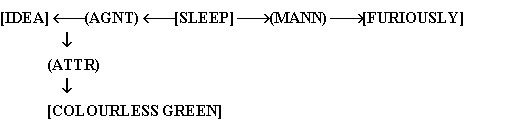
Canonical graphs are meaningful graphs which represent real or possible situations in the external world. Schema is the basic structure for representing background knowledge for human like inference. Schemata favour plausible combinations by incorporating more knowledge about the world and avoiding less likely possibilities. While canonical graph represent everything that is conceivable, schemata represent everything that is possible. The following is the schema for BUS (Sowa,1984:129):
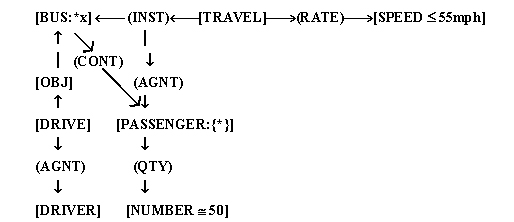
(In the above diagrammatic representation of schema for BUS, "*x" is a variable in which "*" is a generic marker and "x" is an indicator for cross reference, "(INST)" denotes the relation INSTRUMENT, "(CONT)" denotes the relation CONTAIN, "(QTY)" denotes QUANTITY.)
Computational analysis of nominal compounds
Our proposal for automatic interpretation of meaning of the compounds from the meanings of concatenated nouns leads us to turn our eyes to an approach founded on cognitive science and artificial intelligence of knowledge representation. Conceptual graphs will be used to serve our purpose. From the meanings of constituent nouns (which constitute a compound) which are expressed in terms of conceptual graphs, it is possible for us to establish the meaning of the compound.
Take for example the compounds ndooy kirumi 'germs which causes disease'. A schema of kirumi = GERMS should contain the information that 'germs can cause disease' and similarly a schema of ndooy = DISEASE should contain the information that 'disease can be caused by germs'. That means the schemata for both the constituent nouns contain the following common graphical portion which might have been expressed differently:
[GERMS] <- (AGNT) <- [CAUSE] -> (OBJ) -> [DISEASE]
The unification of these two graphical portions can give us the following conceptual graph for the compound nooy kirumi:
[DISEASE CAUSING GERMS] <- (AGNT) <- [CAUSE] -> (OBJ) -> [DISEASE]
The schema for the kaakkaay = CROW and kuuTu = NEST should contain the information that 'crow can build nest' and 'nest can be built by crow' respectively. The following graphical portion will be shared by both the constituent nouns:
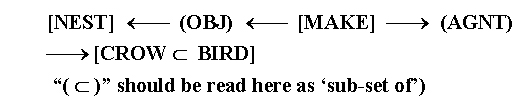
The meaning of the compound kaakkaaykkuuTu can be interpreted by the unification of the relevant portions of the schemata. The schema for maN = CLAY as well as pommai = TOY should contain the information that 'clay can be used to make toy' and 'toy can be made up of clay' respectively. The following graphical portion will be shared by both the constituent nouns:
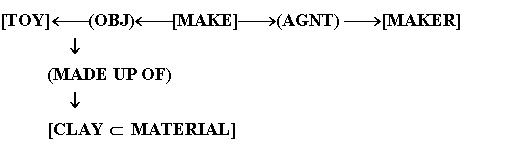
The meaning of the compound maN pommai can be interpreted by the unification of the relevant graphical portions of the schemata of the constituent nouns.
There is no need of cataloguing of schema for each concept as the schema of a concept at a higher level can be used to build the schema for a concept at lower level. For example the schema for BIRD can be used to build schema for CROW and kuruvi = SPARROW and also the interpretation of paRavaikkuuTu 'bird's nest' can take care of the interpretation of kaakkaik kuuTu 'crow's nest' and kuruvikkuuTu 'sparrow's nest'. The hierarchical representations of canonical graphs can be captured by having a thesaurus in which the concepts are arranged in the hierarchical fashion. The following is a thesauric model for PHYSICAL OBJECT:
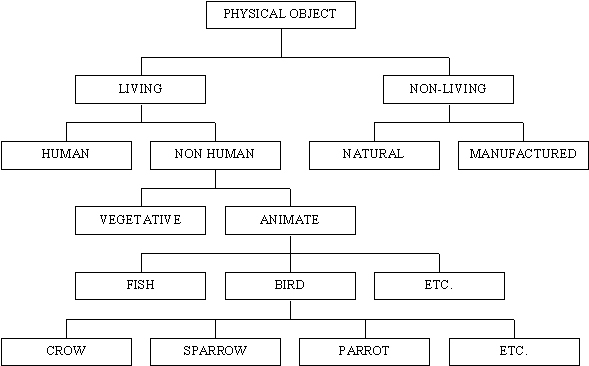
Note that the above table is incorporated in the printer-friendly version. You need not print this table separately!
Algorithm
1. Parse the nominal compounds into bipartite units of constituent nouns.
2. Select the schema for each noun which constitute the compound from the conceptual catalogue of schemata.
3. Identify the similar or identical graphical portions of schemata.
4. Extract the identical portions.
5. Unify them in such a way that the head-nounship is not altered.
6. Covert the conceptual graph into logical proposition which represent the meaning of the compound.
The proposed alternative of automatic interpretation of the meaning of nominal compounds from the meanings of nouns which constitute them is aimed to recapitulate the psychological reality of understanding by human brain in which the percepts are stored as conceptual graphs and the building up of and understanding of the new complex graphs is based on the already existing or stored conceptual graphs. Though knowledge representation by conceptual graphs is a tedious process and basing the semantic interpretation of compounded lexical units on the graphical representations of concepts is a challenge and sometimes may appear as a futile task, such attempt will depict the psychological reality of understanding by means of the information stored in the brain in terms of perceptual models called conceptual graphs.
The deep structure representations from which the compounds are derived by transformational rules or formative rules is artificial and analysing and understanding a derived language unit by making use of a formalism whose foundation is deep structure representation does not represent a model which tries to capture the cognitive process of understanding and generation of language units. As conceptual graphs are finite they can be easily stored and manipulated by the computer. The conceptual semantic interpretation of nominal compounds helps in the translation of the compounds into other language. This type of conceptual graphic representation lends a helping hand in the machine translation in which the interlingual representation of compounds is a challenging job.
3. ConclusionThe transformational generative grammarians' approach takes up the view of deriving compounds from underlying deep structures that carry all the properties necessary for the semantic interpretation of the compounds. The generation or derivation of the nominal compounds can be interpreted as being derived by the simple rule of juxtaposing nouns. The weeding out of non-interpretable or unacceptable compounds will be taken care of at the level of semantic interpretation that is known in the TG framework as LF (i.e. Logical Form).
There are various treatments for nominal composition or formation of compound nouns from nouns. All the theories, which discuss the formation of compound nouns from nouns, try to explain the interpretation of the resultant meaning one way or other. Traditional out look on compound formation envisages two views which can be very well correlated with the modern approach to compound formation which are not qualitatively different from the traditional approach on nominal composition:
- Transformation approach that presumes that nominal compounds are formed from a structure that carries the information for the interpretation of the nominal compounds.
- Interpretive approach which presumes that nominal compounds need to be understood by expanding them into bigger phrases or sentences which carry all the information for the interpretation of the nominal compounds.
It is clear that at least in the present day Tamil compound nouns are not deduced from bigger phrases or sentences, but simply juxtaposing two or more nouns forms; the native speakers give interpretations to them, which are widely accepted by the speech community. The items resulted by the process of nominalization by compounding pass through the stages such as nonce formation, institutionalisation and lexicalisation before they get entered into dictionary for the correct interpretation of the meaning. So, as for as formation of compound noun is concerned, the predominantly followed word formation rule could be:
[N+ N + ...] N
REFERENCES
Allen, M. 1978. Morphological investigation. PhD dissertation, University of Connecticut.
Aronoff, M. 1976. Word formation in generative grammar. Cambridge, MA: MIT Press.
aaTci collakaraati, tamizh vaLarcci iyakkunar, tamizhndaaTu aracu.
Bauer, L. 1983. English word-formation. Cambridge: Cambridge University Press.
Botha, R.P.1968. The function of lexicon in transformational generative grammar.
Fabb, N. 1984. Syntactic affixation. PhD. dissertation, MIT.
Beard, R. 1988. On the separation of derivation from morphology: Towards a lexeme/morpheme-based morphology. Quaderni di Semantica 9, 3-59.
Borer, H. 1988. On the parallelism between compounds and constructs. Year Book of Morphology 1, 45-66.
Botha, R.P. 1968. The Function of lexicon in transformational generative grammar. The Hague: Mouton.
Botha, R.P. 1983. Morphological mechanism. Oxford: Pergamon Press.
Chomsky, N. 1970. Remarks of nominalization. In: Jacobs, R and Rosenbaum, P. (eds.). Readings in English transformational Grammar. Waltham, MA: Blaisdell.
kiriyaavin taRkaalat tamzih akaraati. Chennai:Cre-A. 1992.
Dhamodaran, G.R. (ed.) 1985. kalaiccol akaraati tokuti 3. Kalaikkathir: Coimbatore.
Di Sciullo, A.M. and Williams, E. 1987. On the definition of word. Cambridge, MA: MIT Press.
Fillmore, C.F. 1968. Case for case. In: Batch, E. and Harms , R. (eds.). 1968. Universal in Linguistic theory. New York: Holt, Rinehart and Wilson.
Kothandaraman, Pon. 1972. ilakkiya ulakil putiya paarvai. Chennai: Tamil nulakam.
----------1979. collaakka ndeRimuRaikaL. tamizh aayvu 7, Chennai: Madras University.
Lees, R.B. 1960. The Grammar of English Nominalizations. International Journal of American Linguistics 26.
Lees, R.B. 1963. The Grammar of English nominalization. The Hague: Mouton.
Lees, R.B. 1970. Problems in the grammatical analysis of English nominal compounds. In: Bierwisch, M. and Heidolph, K.L. (eds.). 1970. Progress in Linguistics. The Hague: Mouton.
Levi, J.N. 1978. The Syntax and Semantics of Complex Nominals. New York: Academic Press.
Lieber, R. 1983. Argument Linking and Compounding in English. Linguistic Inquiry 14:251-86.
Maraimalai, I. 1984. Word-formation in Modern Tamil with special reference to administrative terms. Unpublished Ph.D. thesis. Madras: University of Madras.
ndannuul:kaaNTikai urai. cennai: te.cai.ci patippuk kazhakam
Rajendran, S. 1989. tamizhil collaakkam. mozhiyiyal, 13,14 163-192.
-------1997. Grammatical Formalism and Computational Analysis of Nominal Compounds in Tamil. South Asian Language Review 7.1, 27-46.
-------2000. Strategies in the Formation of Compound Verbs in Tamil. International Journal of Dravidian Linguistics 29.2,107-126.
-------2000. Types of Word Formation in Tamil. In Ahser, R.E. & Harris, R. (eds.) Linguisticoliterary, Pilgram Book Pvt. Ltd. 323-343.
-------2001. Word Formation in Tamil - A computer assisted study. (manuscript). Thanjavur: Tamil University.
-------2001. taRkaalattamizhc coRkaLanjciyam. Thanjavur:Tamil University.
-------2004. tamizhil collaakkam. Thanjavur:Tamil University.
Roeper, T. 1987. Implicit arguments and head-complement relation. Linguistic Inquiry 18, 267-310.
Roeper, T. 1988. Compound syntax and head movement. Year book of Morphology. 1, 187-228.
Roeper, T. and Siegel, D. 1978. A Lexical transformation for verbal compounds. Linguistic Inquiry 9, 199-260.
Sakthivel, S. & Rajendran, S. 1995. coRkaL:vaazhvum varalaaRum. Chennai: Manivacakam Printers.
Selkirk, E. 1982. The Syntax of Words. Cambridge, MA: MIT Press.
Sowa, J.F. 1984. Conceptual structures: Information processing in mind and machine. Reading: Addison-Wesley Publishing Company.
Spencer, A. 1991. Morphological theory: An Introduction to word structure in generative grammar. Oxford: Basil Blackwell.
Sproat, R. 1985. On deriving the lexicon. PhD dissertation. MIT.
tolkaappiyam:collatikaaram:iLampuuraNar urai, (patippu 1973), cennai: te.cai.ci. patippuk kazhakam
tolkaappiyam:collatikaaram:kallaaTanaar urai, (patippu 1964), cennai: te.cai.ci. patippuk kazhakam.
tolkaappiyam:collatikaaram:ceenaavaraiyar urai, (patippu 1963), cennai:te.cai.ci. patippuk kazhakam.
tolkaappiyam:collatikaaram:teyvaccilaiyaar urai, (patippu 1974), cennai: te.cai.ci. patippuk kazhakam
tolkaappiyam:collatikaaram-ndaccinaarkkiniyar urai, (patippu 1973), cennai:te.cai.ci patippuk kazhakam
Vijayavenugopal, G. 1979. Nominal Composition in Tamil. Madurai: Madurai Kamaraj University.
CLICK HERE FOR PRINTER-FRIENDLY VERSION.
APABHRAMSHA - AN INTRODUCTION | LITERATURE, MEDIA, AND SOCIAL TRANSFORMATION - Andhra Experience | BHARATHI - A COMMON SCRIPT FOR ALL INDIAN LANGUAGES | PHONOLOGICAL AND MORPHOLOGICAL PROBLEMS OF ORIYA SPEAKERS LEARNING KANNADA | A REVIEW OF AN ELEMENTARY SCHOOL TEXTBOOK TO TEACH ENGLISH IN INDIAN SCHOOLS - FROM THE PERSPECTIVE OF A NATIVE SPEAKER OF ENGLISH | A LEARNER'S INTRODUCTION TO MANDARIN CHINESE | COMMUNICATION VIA EYE AND FACE IN INDIAN CONTEXTS | STRATEGIES IN THE FORMATION OF COMPOUND NOUNS IN TAMIL | HOME PAGE | CONTACT EDITOR
S. Rajendran, Ph.D.
Department of Linguistics
Tamil University
Thanjavur 613004, Tamilnadu
India
C/o. Language in India
Send your articles
as an attachment
to your e-mail to
thirumalai@bethfel.org.