Ph.D. Dissertation
Language of Advertisements in Tamil Mass Media
Sandhya Nayak, Ph.D.
© 2002 by Sandhya Nayak, E-mail: sandhya@ciil.stpmy.soft.net. Ph.D. in Linguistics, Awarded by the University of Mysore, 2000.
Click HOME PAGE of Language in India for the current issue articles. Click BACK ISSUES for previous issues.
CONTENTS
| PREFACE | Preface |
| Chapter 1 | Introduction |
| Chapter 2 | Grammatical Aspects of Advertisements in Tamil |
| Chapter 3 | Prosody and Figures of Speech of Advertisements in Tamil |
| Chapter 4 | Discourse Aspects of Advertisements in Tamil |
| Chapter 5 | Discussion and Conclusion |
| References | |
| Appendix |
*** *** ***
PREFACE
My thanks are due to Dr. K. Ramasamy who kindly supervised and guided my Ph.D. work. My thanks are due also to the authorities of the Central Institute of Indian Languages for their generous permission to pursue my research and their help throughout my research work. The love and concern of my husband Ravindra Shenoy and my kids, Vijendra and Dhirendra, was a great source of strength to me during my research work.
I am grateful to the following persons who kindly helped me in various ways while I was engaged in my research work on this topic: Dr.K.V.V.L.Narasimha Rao, Dr.K.Viswanatham, Smt.B.Syamalakumari, Dr.N.Nadaraja Pillai, Dr.T.Kanagasabai, Dr.T.Manian, Dr.C.Sivashanmugam, Sri.C.K.Anandan, Dr.B.A. Sharada, Sri. Mir Nissar Hussain, Smt. N.Vijaya, Sri.R.Parthasarathy, Sri.M. Srinivasan, Sri.C.K. Manikantan, Sri.M.Bhaskar Rao, Sri.M.Parandhama Reddy, Sri.Tholkappian, Sri.M.Venugopal, my younger sister Ms. G. Kanchana, and Smt. Thayamma.
I enjoyed reading and watching the Tamil advertisements in the mass media, and I do hope that this analysis of the language used in the Tamil advertisements will help improve the communicability of the advertisements in Tamil. I do believe that the advertisements have a useful role in educating the people and, if these are couched in a style and language that is understood by many, these would even help strengthen the retention of literacy among the less educated people.
Sandhya Nayak
*** *** ***
CHAPTER 1
INTRODUCTION
1.0. Introduction
`Words used in their proper order and in a pleasing manner would readily be accepted and obliged by the world' says Thiruvalluvar (Circa 100 B.C., kuRaL: 648), an ancient Tamil poet, highlighting the importance of language used in making human communication highly effective. This is true not only of language use in interpersonal communication at an informal level but also in the fields of education, administration and mass communication at a formal level. Mass communication plays a vital role in the overall development of the modern society through quick dissemination of information pertaining to all aspects of life to a wider public. In this respect, the different media used such as newspapers, magazines, radio and television aim at brevity, preciseness and clarity of information besides attempting to inform, attract and persuade people towards certain action or change. In this endeavour, the way language is used remains an important influencing factor, which demands a systematic study.
Advertising is a form of mass communication closely linked with the world of commerce and marketing. It is a powerful tool for the flow of information from the seller to the buyer. It influences and persuades people to act or believe. It is also something which affects most of us in a number of different spheres of our lives. It not only influences any human society but also reflects certain aspects of that society's values and structure. There are many special and specific reasons for using advertising in its several forms. Announcing a new product or service, expanding the market to new buyers, announcing a modification or a price change, educating customers, challenging competition, recruitment of staff and attracting investors are a few such reasons. In the process of creating advertisements for all these reasons, language, i.e., choice of expression is of crucial importance. What kinds of choices make an advertisement highly effective is something worthy to be studied from a linguistic perspective.
1.1 Advertising - An Overview
Advertising is an indispensable component of all sorts of business. Commenting on the indispensability of advertising in a business, Stewart H.Britt states in a higher vein `Doing business without advertising is like winking a girl in the dark ; you know what you are doing, but nobody else does' (quoted in Chunawalla, 1985 : 1). About the usefulness of advertising Madhu (1996) states as follows: `Advertising spurs economic development. It engineers sales. It helps people and organizations find each other. It creates and sustains thousands of jobs-in advertising agencies, in various promotion and exhibition industries. Governments everywhere are major advertisers. They depend on advertisements to lure foreign investors and tourists. Governments advertise within the country too-to recruit young men into army, navy and air force, to advise citizens about traffic, tax and drug laws or about voting rights. Advertising gives the public the right to choose between many options, many brands. It enables consumers to opt for the best quality or the lowest price or the best mix of quality and price. In the absence of advertising, the public would be at the mercy of a few high-priced or low-quality brands' (p.16).
According to Chunawalla (1985), the form of advertising for the transmission of information dates back to ancient Greece and Rome, when criers and signs were used to carry information for advertising goods and services. This practice was continued even during the middle ages. During the 17th century, when newspapers started appearing in various parts of the world, newspaper advertising began to develop. However, the great break through for advertising came only in the late 19th century, when technology and mass production techniques were sufficiently developed. The field of advertising has been revolutionized after the advent of radio and television as popular media of communication in this century. While the press could cover only the literate population, the radio and television have widely covered both the literates and the non-literates. Television and Radio remain the most popular media in urban as well as rural areas. Recently, during the 90s, the arrival of satellite television, internet, web-marketing, e-biz and e-commerce has resulted in significant changes in the field (for details see Madhu, 1996; Kalidas, 1999).
Advertising is defined by Harris & Seldon (1962) as a public notice `designed to spread information with a view to promoting the sales of marketable goods and services' (P.40). Advertising makes us to know what we have to sell or what we want to buy and according to Sherlekar (1995), it is paid communication because the advertiser has to pay for the space or time in which his advertisement appears. Advertising appears in the recognized media such as newspapers, magazines, radio, television, cinema film, outdoor hoardings and posters, direct mail and transit (car cards). The sole purpose of advertising is to sell something-a product, a service, or merely an idea through effective communication.
Advertising in the print media is the oldest and the largest in terms of advertising billing. Advertisers spend more money on newspapers and magazines than any other medium. In India, more than Rs.61/- out of every Rs.100/- is spent on magazine advertising (cf Chunawalla, 1985; Vinayaga Moorthy, 1989), Advertising in magazines has its own advantages. Magazine subscribers can keep the particular issue and read it several times. This shows that magazine advertisements can get the full attention of the readers. Also, they are good in quality in terms of printing and colour. The formal components of a magazine advertisement are: (1) headline, (2) body copy (3) signature line (4) standing details and (5) illustrations. The headline usually appears on the top of the advertisement and it is printed in bold types of different sizes. The message is conveyed with maximum brevity and preciseness and in an attractive manner. The readers mostly rely on the headline for the relevant information. The body copy includes the main part of the advertising message often divided into various sections under sub-heads. The signature line mentions the brand name, which is accompanied by a price tag, slogan and trade mark. The standing details include cut out coupons, address of the firms etc. The illustrations are the printed visuals depicting the product and/or the secondary participant. What is sold in magazine advertising is `space'.
Both radio and television are broadcasting media. Communication in radio is only through sound while it is through a combination of sound, sight (picture) and motion in television (for details see Jefkins, 1973:275-6). Radio demands only listening while television demand both listening and viewing. Both radio and television advertisements are made attractive with the help of background music, voices on or off, product sounds and different other sound effects. The motion picture gives an additional effect to the television advertisements. What is sold in both the media is time. Since both radio and television involve oral communication, the demand for the use of spoken style of language is more when compared with the magazines.
The advertisements can be classified into non-commercials and commercials on the basis of the object and purpose involved in advertising. In non-commercial advertisements, selling and buying are not involved and certain ideas, morals or appeals are communicated to the common public from government agencies or various associations and societies. The purpose may be related to charity, political propaganda, or different social welfare measures. Commercial advertisements are sub classified into commercial consumer advertisements and prestige advertisements. The commercial consumer advertisements involve consumer goods such as cosmetics, medicines etc., while the prestige advertisements include services like banking, insurance etc., Of the different classes of advertisements, the commercial consumer advertisements are the most prominent in terms of both quality and quantity.
A successful advertisement is expected to accomplish five functions namely (1) attracting attention (2) commanding interest (3) creating desire (4) inspiring conviction and (5) provoking action. (see Jefkins, 1973 ; Vestergaard and Shrodder, 1985). All these five functions are inter related and in concert serve to promote the selling power of the product advertised. In achieving these functions in the production of an advertising copy, an effective use of language becomes all the more important. Commenting on the extreme care that one should take with regard to the use of language in advertisements, Ranade (1998) states : `Incredible, the amount of damage one may cause with a slight play on words here and there, or a twist in the title, or even by the willful omission of a single comma' (P.III).
1.2. Language of Advertising - Previous Studies
The study of language of advertising from a linguistic perspective has been attempted by several scholars (Leech 1966; Kumar 1978; Gopal 1980; Geis 1982; Vestergaard and Schrodder 1985; Manian 1986; Dhongde 1987; Hemamalini 1989; Mencher 1990; Satyanarayana 1990; Venkatesa Raja 1991; Suresh 1992; Arokianathan 1993; Manoharan 1994).
Leech (1966), in his pioneering and comprehensive study on English in advertising, has analysed in detail different aspects pertaining to grammar, vocabulary, discourse and rhyme and rhetoric of advertising with special reference to television. He has effectively related these aspects with the functional factors such as attention value, listenability/readability, memorability and selling power. Illustration, display typography, vocal emphasis, prompt spelling, grammatical solcism, metaphor and paradox are some of the aspects linked with attention value. Simple and colloquial style and familiar vocabulary are connected with readability. Phonological regularities such as alliteration, rhythm, rhyme and jingle are related to memorability. Frequent use of imperatives and superlatives are connected with selling power. The distinctive property of advertising language has been closely identified with the use of clauses, phrases and words as minor sentences, which constitute a different kind of grammar called as disjunctive grammar.
Geis (1982) has made an attempt to describe how language is used in American advertising, especially television advertising. He has focused on certain linguistic devices that figure most prominently in advertising. According to him, the advertising claims employing the word 'help' as in phrases like 'helps to achieve' and comparative phrases like 'more or less' are impressive because they are indistinguishable from the law like generic claims of scientists. He has concluded that advertisers in general tend to prefer vague language rather than language with explicit empirical consequences and to prefer subjective claims to objective claims.
Vestergaard and Schroder (1985) have studied the language use in commercial press advertising in relationship with communicative functions of language such as expressive, directive, informational, metalingual, interactional, contextual and poetic and the five advertising functions. The different textual aspects such as coherence and cohesion, topicalization, presupposition and entailment and participant roles have been studied in detail. They have also identified the importance of imperatives and directive speech acts in encouraging the audience to buy the products.
Mencher (1990) has looked into the aspect of vocabulary in advertising and identified ten words as the most personal and persuasive. They are : 'new', 'save', 'safety', 'proven', 'love', 'discover', 'guarantee', 'results', 'you' and 'health'. The psychological impact of these words on the consumer has also been discussed.
In the Indian context, Kumar (1978) has analysed the linguistic and stylistic aspects of radio advertisements in Hindi on the model of Leech (1966) and identified the structures related to different advertising functions. According to him, the use of parataxis, compounds, layers of natural and nativized vocabulary, devices of non-segmental phonology are some of the aspects related to readability / listenability. Attention value is achieved by embedded structures, minor sentences, style of writing system, nominal groups, idioms, figurative devices, jingles and alliteration. The frequent use of nominal groups, jingles and alliteration contribute to memorability. The selling power is linked with the use of hypotaxis, verbal groups, adjectives and adverbs and idioms in particular and the entire language in general.
Dhongde (1987) has studied the common linguistic features of advertising English used in Indian newspapers and magazines. The study includes graphological and phonological, lexical, phrasal, clausal and sentence level features of advertising English. Some of the significant generalization of the study are: (i) there is a bit of over reliance on words as key to persuasion ; (ii) short words, short sentences and short paragraphs are preferred for inducing easy readership; (iii) some semantic strategies like including certainty rather than doubt, like being positive rather than negative, like being universal rather than particular and like using commendatory rather than pejorative attributes are commonly observed ; (iv) concrete and familiar words are deliberately chosen ; (v) a surprising element, a dramatic appeal, unconventional linguistic behaviour, slight departures from language rules, innovation and playing on words are introduced from time to time to make the copy attractive and (vi) keeping in the mind the limitations of space and the sense of formal beauty, language is disciplined to be expressed in a succinct and precise manner.
In the context of advertising in Tamil, Gopal (1980) has analysed a few press advertisements linguistically and observed that advertising Tamil is deviant at the grammatical level, which includes disjunctive clauses and phrases. Similar observations have also been made by Manian (1986), who has also identified certain aspects related to prosody and figures of speech which are specific to advertising Tamil.
The use of regional and social dialects of Tamil has been identified in the studies of Hemamalini (1989), Arokianathan (1990) and Manoharan (1994). The election advertisements in Tamil have been studied by Satyanarayana (1990), whose observations are as follows: (i) words acquire special meaning, expansion of meaning, generalization and amelioration ; (ii) English, Sanskrit and Urdu words have been borrowed in accordance with the genius of Tamil language ; (iii) attributes, colloquial expressions and emphatic markers are used; (iv) the occurrence of optative and interrogative sentences are frequent and (v) figures of speech such as simile, ironical expressions and idioms are used. A sociolinguistic study of Tamil advertisements with special reference to press media done by Venkatesa Raja (1991) ascertains the effective use of all the communicative functions in the language of advertising. Gender variations in respect of advertising language has been studied by Suresh (1992).
A comprehensive study of language of advertising in Tamil encompassing all the three media namely magazines, radio and television has not been done so far. The present study has been undertaken in response to the above need.
1.3. The Present Study
The purpose of the present study is to analyse the language of advertisements in magazines, radio and television and find out the differences in choice of expression among the three media.
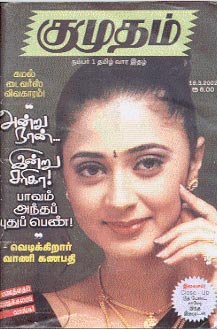
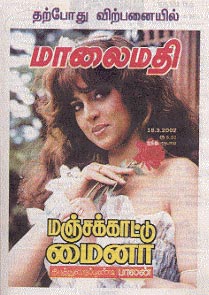
The data for the study were collected from the advertisements published in Tamil magazines such as Ananda Vikatan, Kumudam, Kunkumam, Idayam pecukiratu and Mangaiyar Malar, broadcast over All India Radio, Madras and telecast over Sun T.V. The data covered 186 commercial consumer advertisements (magazines, 69; radio, 60; television, 49), 22 commercial prestige advertisements (magazines, 16; radio, 3; television, 3) and 7 non-commercial advertisements (magazines, 5: radio, 2). About 27 different products have been covered under commercial consumer advertisements and 20 different services under commercial prestige advertisements. All the non-commercial advertisements belong to a single item, AIDS. All the particulars about the advertisements selected for the study are given in Appendix.
The language part of the advertisements were alone considered for analysis. The analysis was undertaken at three levels, which include grammar, prosody and figures of speech and discourse. The grammatical analysis includes different units of language placed in order of decreasing extent namely sentence, clause, phrase, word and morpheme and the structures, classes, or systems involved in each unit. The study of prosody includes alliteration, assonance, rhyme, rhythm and jingle and figures of speech includes simile, metaphor, personification, pun, etc. Form of address and style of discourse were considered for discourse analysis. The structural method of linguistic analysis was in general followed in the lines of Leech (1966). For the different levels of analysis, the studies such as A Grammar of Contemporary English by Quirk, et al (1972), A Grammar of Modern Tamil by Lehmann (1989), Modern Studies in Tamil by Kothandaraman (1976), Advanced Studies in Tamil Prosody by Chidambaranatha Chettiar (1942), Classical Tamil Prosody: An Introduction by Zvelebil (1989) and Onomatopoeia in Tamil by Gnanasundaram (1985) were referred.
The comparative study among the three media was made at all the three levels of analysis, both qualitatively and quantitatively.
The main study that follows this introduction is organized in four chapters. The grammatical aspects of the advertising Tamil of all the three media are presented in Chapter 2. The different aspects related to prosody and figures of speech are dealt with in Chapter 3. Chapter 4 includes discourse related aspects. In Chapter 5, the findings of the study are interpreted and discussed.
*** *** ***
CHAPTER 2
GRAMMATICAL ASPECTS OF ADVERTISEMENTS IN TAMIL
2.0. Grammatical Aspects
An attempt is made in this chapter to study the grammar of the language used in the advertisements of magazines, radio and television and identify the different kinds of linguistic choices preferred in advertising. The study includes an analysis of the different units of language placed in order of decreasing extent namely sentence, clause, phrase, word and morpheme and the structures, classes, or systems involved in each unit. In the context of analysing advertising English, Leech (1966) makes a distinction between discursive grammar and disjunctive grammar based on the fact that the linguistic units such as clause, phrase and word, which are of dependent nature in discursive grammar, are used independently as minor sentences in disjunctive grammar. The disjunctive grammar is a deviation from the discursive grammar, which refers to the full grammar of a particular language. The use of disjunctive grammar is prevalent in situations such as advertising, news reporting etc. The different aspects pertaining to the discursive and disjunctive grammars of advertising Tamil are discussed in detail here.
2.1 Sentences
Nominal sentences, verbal sentences, interrogative sentences, cohesion between sentences and parataxis lacking inter- sentential cohesion in the context of advertising language are dealt with in this section.
2.1.1 Nominal sentences
A nominal sentence has a noun phrase, or a nominalised adjective as complement in its predicate position. The use of the copula aakum `is' after the complement is optional in Tamil. The nominal sentences used in the advertisements do not normally make use of the copula. However, the use of copula is occasionally found in the body copy of the magazine advertisements. The use of nominal sentence in the normal order as well as in its topicalized version is predominant in radio and television copies and headlines and slogans of magazines. Consider the following examples:
(a) Nominal complement as predicate
1. pears carumattai cuttamaakka itamaana vazi (Magazine)
Pears skin-acc cleanse-inf soothing means
`Pears is a soothing means of cleansing the skin.'2. ISO 9001 eeRRumatit tarac caanRitaz
export quality certificate
peRRa pukaz mikka Crompton Greeves
have-pst.rp reputed highly
niRuvanattin putiya paTaippu
company-lm-gen(0) new creation
`ISO 9001 is a new creation of the Crompton Greeves Company, which is a highly reputed one having export quality certificate'(Radio, Grinder Care Motor)3. Complan tiTTamiTTa paripuuraNa
complan planned complete
cattuNavu paanam
nutrious drink
`Complan is a planned and complete nutritious drink'(Television, Complan)(b) Nominalised adjectival complement
4. vaazvil muTiveTutta antat
life-loc take decision-pst.rp that
taruNam enRum pacumaiyaanatu
moment ever green-pro
`the moment when that decision was taken will ever be green (in one's memory)'(Yesde Associated Builders Ltd., Magazine, headline))5. braze naRumaNam mikkatu
sweet fragrance full of-pro
`Braze is full of sweet fragrance' (Braze Talcum Powder) (Radio)6. Brooke Bond Bru
filter coffee yaip poonRee cuvaiyaanatu
filter coffee-acc like-emp tasty-pro
`Brooke Bond Bru is tasty exactly like filter coffee'(Bru Instant Coffee) (Television)In the above nominal sentences, the copula aakum `is', the occurrence of which is optional in Tamil, has been omitted. However, there are rare instances of the copula being used in the 3 advertisements of magazines, especially in the body copy, as shown in the following example:
7. itu oru aaRRalmikka kLiinar aakum
(body copy) this a powerful cleaner is
`This is a powerful cleaner' (Lizol) (Magazine)The nominal sentences are quite often used with topicaliza tion wherein the nominal or the nominalised adjectival complement gets focussed by being placed before the subject noun (phrase).
Examples:
(a) Nominal complement focussed
8. intiyaavin mikap periya tanka nakaik kaTai
India-lm(gen(0) very big gold jewellery shop
caravaNaa sToors
Saravana Stores
`Saravana Stores is a very big gold jewellery shop in India.' (Saravana Stores) (Magazine)(headline)9. talaimuTiyin vayatu eeRaamal taTukkum
hair-lm(gen 0) age rise-neg.pp stop-fut.rp
veeli-niili
fence-Nili
`Nili (brungadi hair oil) is a fence which does not allow the age of the hair to increase.'(Radio) (Nilibrungadi Hair Oil)10. cantanamkoNTatu Ponds Sandal Talc
(Television) sandal contain-pst.rp-pr
`The Ponds Sandal Talc contains sandal in it.' (Ponds Sandal Talc)(b) nominalised adjectival complement focussed
11. uNNuvataRkoo ruciyaanatu uTalnalanukku ciRappaanatu
relish-ger- is tasty-pro health-dat good-pro dat-part.intens
asvini karuveeppilaip poTi
Ashwini curry leaf powder
`Ashwini curry leaf powder is extremely tasty to relish and good for health'. (Magazine)(headline)(Ashwini Curry Leaf Powder)12. taramaanatu cuttamaanatu Leo coffee
standard-pro pure-pro
`Leo coffee is a standard and pure one.' (Radio) (Leo Coffee)2.1.2 Verbal Sentences
A verbal sentence has finite verb, imperative verb, defective verb, modal verb, or negative verb as predicate. Verbal sentences with the different forms of verbs and thier topicalized versions are presented and discussed below:
(a) Finite verb
A finite verb in Tamil is of the structure verb root + tense +PNG. Besides tense, it may include inflections pertaining to aspect, mood and voice. Verbal sentences having finite verb in all its above variations are more frequent in the magazine adver- tising body copy than in radio and television copies. The way in which tense, aspect, mood and voice are preferred in the language of advertisements is dealt with here.
(i) Tense
Among the three tenses, the preference for present and future forms in the sense of `unrestrictive time' is more fre- quent than the past tense form, which is used usually connecting a past event with its present or future consequence. Consider the following examples:
Present tense
13. aaNTutooRum 90,98,000 kaTikaarankaL
every year clocks
tayaarikkiRarkaL
produce-pr-3hpl
`They produce 90,98,000 clocks every year.' (Magazine) (body copy) (Ajanta Quartz)14. naan eppavum Sunola-taan upayookikkiReen
I always Sunola-emp use-pr-1s
`I always use only Sunola.' (Radio) (Sunola)15. oru refil naaRppataintu iravukaL varai
one forty five nights upto
varukiRatu
last-pr-3ns
`One refill lasts upto forty five nights'(Television) (Good Night Liquidator)Past tense
16. K.K.R paamaayil vantappuRam
K.K.R.palm oil become available-pst.rp-part.time
ataiyum naalu kiloo vaankineen
that-also four kgs purchase-pst-1s
`After the KKR Palm oil became available, I purchased four kgs of that also.' (Magazine) (body copy) (KKR Palm Oil)17. varumpootu Archanaviliruntu sweet
come-fut.rp archana-abl
-part.time
vaankiNTu vanteen
buy-refl-pp come-pst-1s
(Archana Sweets) `While coming, I brought sweets from Archana' (Radio) (Archana Sweets)18. unkaLukkaakattaan vaankiTTu vanteen
for you(hon.s) buy-refl-pp come-pst-1s -emp
`I brought (V-Guard clock) for you only.'(Television) (V-Guard Clock)Future tense
19. pala varuTankaL niiTikkum
many years last-fut-3ns
`It will last for many years.' (Magazine)(body copy) (Hertel Plus)20. itu muunRu vazikaLil ceyalpaTum
this three ways-loc act-fut-3ns
`This will act in three ways.' (Radio) (Active Pain Ointment)21. niiNTa kaalam uzaikkum
long period last-fut-3ns
`It will last for a long period.' (Television) (V Guard Clock)(ii) Aspect
The aspects such as progressive, perfect, perfect progres- sive, habitual, definitive, trial, preservative, completive and reflexive are found to be used in the language of advertisements. The different aspectual auxiliary verbs are added to the past participial form of the verb.
Progressive (koNTiru)
The progressive form koNTiru in all the three tenses are used chiefly to denote the durative sense.
Examples:
Present
22. muzu tirupti aLikkumvakaiyil laapakaramaaka
full satisfaction provide-fut.rp profitably -part.manner
iyankik koNTu irukkiRatu
function-prog-pr-3ns
`It is functioning profitably in a fully satisfying manner.'(Magazine)(body copy) (Liifin India Ltd.)23. namma kalyaaNattappoo vaankuna Rally fan iruvattanju
our marriage-during buy-pst.rp twentyfive
varuSamaa innum nallaa ooTikkiTTirukku
years-adv still well run-prog-pr-3ns
`Rally fan, which was bought during the time of our marriage, is still functioning well since twenty five years.' (Radio) (Rally Fan)Past
24. oru maacattukku naalu kiloo kaTaleNNey
one month-dat four kgs groundnut oil
vaankiTTu irunteen
buy-prog-pst-1s
`I was buying four kgs of groundnut oil for a month.' (body copy) (KKR Palm Oil)Future
25. ini unkaLukku puttuNarvaana elumiccai maNaM
hereafter you-dat refreshing lemon fragrance hon.s
koNTa minuminuppu niiTittuk koNTirukkum
have-shining last-prog-fut-3ns pst.rp
`Here after, you will feel the shining in your vessels lasting with refreshing lemon fragrance.'(Magazine) (body copy) (Vim Ultra Paste)Perfect (iru)
The present and future perfect forms only are attested from the corpus of the data.
Present
26.itu manatai cuRucuRuppaakavum vizippuNarcciyuTanum
this mind-acc actively-conj awareness-assoc-conj
vaittirukkiRatu
keep-perf-pr-3ns
`It keeps (one's mind) active and with awareness.' (Magazine)(body copy) (Vallaarai Capsule)Future
27. atu tavira aTaiyaaLap paricuk kuuppan onRaiyum
that except identity gift coupon one-acc-also
peRRiruppiirkaL
get-perf-fut-2pl
`You would have got an identity gift coupon also.'(Magazine)(body copy) (Sri Ram Chits)Perfect progressive (koNTee iru)
The future perfect progressive form alone has been used denoting durative sense with an emphasis.
Future
28. unkaL DepaaciT tokai vaLarum, vaLarum...
your deposit amount grow-fut grow-fut -3ns -3ns
vaLarntu koNTee irukkum
grow-perf.prog-fut-3ns
`Our deposit amount will be growing constantly.' (Magazine) (body copy) (Karur Vysya Bank)Iterative (vaa)
The iterative sense is found to be expressed through the use of the auxiliary verb vaa.
29. ruu 10,000/- mutal ruu.5,00,000/- varai matippuLLa
Rs from Rs upto valuable
ciiTTukkaLai ciRanta muRaiyil naTatti varukinRoom
chits-acc in a proper manner organise-iter-pr-1pl
`We have been organizing chits valued from Rs.10,000/- to 5,00,000/- in a proper manner.'(Magazine)(body copy) (Sri Visalam Chit Fund Ltd.)30. itan cipaaricu Doctor-kaL pallaaNTu kaalamaaka
this- recommen- Doctors for a period of lm(gen 0) dation many years
ceytu varukiRaarkaL
do-iter pr-3hpl
`The doctors have been recommending this for many years.' (Television) (Crocin)Definitive (viTu or tiiru)
The definitive sense is expressed through the use of the auxiliary verb viTu or tiiru.
31. Sri Raajiiv Gandhi maNTapam amaiyap peRRa Sriperumputuur
Sri Rajiv Gandhi memorial situated Sriperumputur
inRu ulakap pukaz peRRa Tavunaaki viTTatu
today world fame get-pst.rp town-become-def-pst-3ns
`Sriperumputur, where Sri Rajiv Gandhi's memorial is situated, has become a world famous town' (Magazine)(body copy) (VGP Housing Pvt Ltd.)32. kaSTamaana araikkaRa veelaiyaik kuuTa
difficult grinding work-acc-even
ciikkiramaa muTiccuTum
quickly finish-def-fut-3ns
`it will finish quickly even the difficult grinding work.' (Radio)(Ralli Mixi)33. Pepsi-ye naan kuTiccee tiiruveen
(Television)(Pepsi) Pepsi-acc I drink-emp-def-fut-1s
`I will drink Pepsi certainly.'Trial (paar)
The sense of trial is denoted by the use of the auxiliary verb paar.
34. atulee atiracam cenju paartteen piramaatam
that-loc a sweet prepare-trial-pst-1s excellent dish
`I tried preparing atiracam (a sweet dish) with that (KKR Palm oil)'(Magazine)(body copy) (KKR Palm Oil)Preservative (vai)
The auxiliary verb vai gives the preservative sense.
35. Stake brand appaLam poriccu vaccirukkuReen
pappad fry-preser-pr-1s
`I have fried stake brand pappad and kept it (for you).' (Radio)Completive (aaccu)
36. keeTTa nakaikaL kuTuttaaccu, etukkuk koopam
demand jewels give off-compl why anger -pst.rp -pst-3ns
(Television) (Poombukar Banian,Jattis) `The jewels demanded by him (son-in-law) have been given off, even then why is he angry?'(Television) (Poombukar Banian, Jattis)Reflexive koL
37. kaRkaLai ciRitaLavu taLLupaTiceytu naankaLee
stones-acc to some give-discount-pp we-emp extent
eTuttuk koLkiRoom
take back-refl-pr-1pl (Magazine) (body copy) (Jaipur Gems N Jewels)(iii) Mood (inceptive)
The inceptive mood is expressed through the finite form of verb by adding the auxiliary verb iru or poo to the infinitive base.
38. S.S.bowl mutal tanka neklas varai paravacamuuTTum
S.S.bowl from gold necklace to give-ecstacy- fut.rp
paricukaLai peRavirukkiRiirkaL
gifts-acc get-incep-pr-2pl
`You are going to get ecstacy giving gifts ranging from S.S.bowl to gold necklace.' (Magazine) (body copy) (Sri Ram Chits)39. pacanka nammaLa paTTini poTTuTap pooRaanka
children we-acc leave to starve-incep-pr-3hpl
`(Our)children may leave us to starve.'(Radio) (Stake Brand Papad)40. G.E-oLiyai unkaLukku
G.E.light-acc you-dat
aLikkap pookiRatu
provide-incep-pr-3 ns (Television) (G.E.Bulb)(iv) Voice (passive)
Passive voice is found to be used rarely in magazine and radio advertisements especially in monologue form of address. It is not attested in Television advertisements, which predominantly involve dialogue form of address.
41. amerikkaaviliruntu iRakkumati ceyyappaTukiRatu
America-abl import-pass-pr-3ns
`It is imported from America.'(Magazine)(body copy) (Hertel Plus)42. aayurveeta muulikaikaLaal tayaar ceyyappaTTatu
Ayurvedic herbs-ins make-pass-pst-3ns
`(it) is prepared out of ayurvedic herbs'(Radio) (Active Pain Balm)(b) Imperative
The occurrence of verbal sentences using imperative form of verb is quite prevalent in advertising language of all the three media. The use of imperatives is closely related to the function of getting action from the consumers or the selling power of the product. Three forms of imperatives namely singular, plural and polite are found to be used. The use of imperative singular is rare and is found to occur in dialogues between intimate persons. Imperative plural is used to address the consumers and it is expressed through the markers -iir or -nkaL. The predominant use of the marker -iir is one of the distinctive features of the advertising language. This is also true of the use of the polite form of imperative which is formed by adding the marker -vum to the infinitive base.
Singular
43. ippa veeTikkaiyep paaru
now fun-acc see
`see the fun now'(Television) (Vicks Chewing Tablet)Plural
-iir
44. ilavaca ceykuuli calukaiyaip peRRiTuviir
free making charges concession- acc get-imp.pl
`get the concession of free making charges'(Magazine)(body copy) (Kerala Jewellery)45. ovvouru ceelaikkum 300/- mutal 3000/- ruupaay varai
each sari-dat-purp from rupees upto
ceemippiir save-imp.pl
`save from Rs.300/- to Rs.3,000/- for each sari' (Radio) (S.M.Silks)46. paRcitaivai etirttiTuviir
tooth-decay fight against-imp.pl
`fight against tooth decay' (Television) (Colgate Tooth Paste)-nkaL
47. aaRee maatankaLil azaku miLirnta
six-emp months-loc beauty shining
kuuntalaip peRunkaL
flowing hair-acc have-imp.pl
`have shining beautiful flowing hair just within six months' (Magazine) (body copy) (Kesavartini)48. eNNeyep paarunka, eNNeyin tarattep
oil-acc see-imp.pl oil-lm(gen 0) quality-acc
paarunka
see-imp.pl
`see the oil and see the quality of the oil' (Radio) (Anandam Gingely Oil)49. inRee mutaliiTu ceyyunkaL
today-emp invest-imp.pl
`invest today itself' (Television) (S B M Teak)-vum
50. Insta color maiyattai aNuki 626 SeeTukaLil
Insta colour centre-acc approach-pp shades-loc
teevaiyaana onRait teernteTukkavum
required one-acc choose-imp.polite
`choose the required one out of 626 shades by approaching Insta colour centre' (Magazine) (body copy) (Insta Color)51. viparankaLukku anjali nalleNNey vaankavum
details-dat. Anjali Gingely oil buy-imp.polite
`to know further details buy Anjali Gingely oil' (Radio) (Anjali Gingely Oil)(c) Defective
teriyum `be known', pootum `be enough', kiTaikkum `be available' and unTu `is/has' are some of the defective verbs frequently used in advertisements.
52. naan colRatu uNmaitaannu unkaLukkee teriyum (Magazine)
I say-ger truth-emp- comp you-dat-emp be known
`you yourself know that what I say is exactly true' (body copy) (Vivekanda Institute)53. Organics challenge
iraNTee vaarankaLil vittiyaacam teriyum
two-emp weeks-loc difference be known
`you will feel just within two weeks the change of using Organics challenge shampoo ' (Television) (Organics Shampoo)54. maRakkaamal oru aayurveetak kuLiyal
forget-neg.pp an Ayurvedic bath
tinacari eTuttaal pootum
daily take-cond be enough
`it is enough if one takes Ayurvedic bath daily' (Magazine) (body copy) (Medimix Soap)55. oru maTakku kuTiccaalee pootum
one gulp drink-cond-emp be enough
`it is enough if you drink just one gulp' (Radio) (Roop-Aqua Mineral Water)56. oree coTTu pootum
one-emp drop be enough
`just one drop is enough' (Television) (Super Biz)57. 2 mutal 12 vayatiRkuTpaTTa ciRuvar ciRumiyarukkup
from age-within boys girls-dat
palavita vaNNankaLil kiTaikkum
many kinds colours-loc be available
`dresses are available to boys and girls within the age group of 2 to 12' (Magazine)(body copy) (Snuggles Children Wear)58. neeraTiyaay ceerum cantaataararkaLukkum paricu uNTu
directly join-fut.rp subscribers-dat-also gift is
`there is gift for the subscribers who join directly also'(Magazine)(body copy) (Sri Ram Chits)59. ellaak kaTaikaLilum kiTaikkum all shops-loc be available
`it is available in all the shops' (Radio) (Rani Comics)60. Gitanjali-race garden vacatiyum uNTu
facility also is
`Gitanjali has race garden facility also' (Radio) (Hotel Gitanjali)(d) Modal
The modal auxiliaries are added to the infinitive form of the verb. -laam, -Num(veeNTum), muTiyum and -TTum are the modal auxiliaries found to occur in advertisements. The use of -laam is more frequent than the others.
(i) -laam
-laam is used in the meanings of `potentiality',`optionali ty',`probability' and `suggestive.'
Potentiality
61. mikac sTraankaana taniccuvai koNTa pala
very strong special taste have-pst.rp many
kappukaL Tii uNTaakkalaam
cups tea make-can
( `one can make many cups of very strong tea with special taste' (Magazine) (body copy) (No.1 Strong Dust Tea)Optionality
62. ruupaay 300/- viitam tavaNaiyilum
rupees at the rate of instalment-loc-also
mutaliiTu ceyyalaam
invest - can
`one may invest in instalments also at the rate of Rs.300/-' (Radio) (Anubhav Plantation Ltd)Probablity
63. eyTs nooy eLiyavarkaLaittaan taakkum
aids disease poor persons-acc.-emp attack-fut-3ns
enRu niinkaL ninaikkalaam
comp you-pl think-may
`you may think that aids disease will attack the poor only' (Aids)Suggestive
64. naamum kuTumpattooTa vasantam bavanukkup poolaanka
we-also family-assoc Vasantam Bhavan-dat go-may-addr .resp
`we too may go with family to Vasantham Bhavan'(Radio) (Vasantam Bhavan)(ii) -Num (veeNTum)
65. niinkaLum K.K.R. aayil upayookikkaNum
you-also K.K.R oil use-should
`you should also use K.K.R. oil' (Magazine) (body copy) (KKR Palm Oil)66. wife-NNaa ivarukku uyiraay irukkaNum
wife-means he-dat life-adv be-should
`wife means life for him' (Television) (Prestige Pressure Cooker)(iii) muTiyum
muTiyum is used in the sense of `circumstantial possibility.'
67. unkaL cinnap peNNum itil eLitaaka
your little daughter-also this-loc easily
cavaariceyya muTiyum
ride can
`your little daughter also can ride on this (moped) easily' (Magazine)( body copy) (Sunny Zip)(iv) -TTum
-TTum is used in the `optative' sense.
68. unkaLin paacap piNaippil
your bond of affection-loc
avar tiNaraTTumee
he suffocate-let-emp
`let him suffocate in the bond of your affection' (Magazine)(body copy) (Mark Jewellery)(e) Negative
The negative forms corresponding to the different forms of verbs discussed above are found to be used in the advertisements. The use of all different kinds of negatives is related to the goal of effectively impressing upon the consumers about the positive effect or quality of the product or service advertised. That is, the negative form of expression contributes in a great way to create conviction among the consumers.
(i) Nominal negative
69. avaRRai upayookippatu nallatalla
they-acc use-ger good-be-neg
`it is not good to use them' (instead, use Dainty Care) (Magazine)(body copy) (Dainty Care)70. itu aayirattooTu aayirattu onRu alla
this thousand-assoc thousand one be.neg
`this is not simply the ordinary one' (Naga Detergent is something special) (Radio) (Naga Detergent)(ii) Existential negative
71. kiLaikaL veeRu enkum illai
branches anywhere else be.neg
`there are no branches anywhere else'(therefore be careful about fake ones) (Radio) (Abhirami Covering)73. inta vittiyaacattai en toozikaLaal
this difference-acc my friends-ins
nampavee muTiyavillai
believe-inf-emp able be.neg
`my friends are not at all able to believe this difference'(Dabur Vatika Hair Oil makes a great differ- ence)(Magazine)(body copy)(Dabur Vatika Hair Oil)74. etai eTukkaRatu etai viTuRatuNNee teriyale
which take-ger which leave-ger-comp-emp be known- pr.neg
`(I) am at a loss to know which to choose and which to leave'(the varieties available are so many) (B.M.Silks)75. enta shampoovum carivaralee
any shampoo be suitable-pst.neg
`no other shampoo was suitable'(Only organics Shampoo was suitable) (Television) (Organics Shampoo)(iv) Future negative
76. unnait tavira veeRu oru peNNait
you-acc except any other woman-acc
toTamaaTTeen
touch-fut.neg-1s
`I will not touch any other woman except you' (I am extremely careful about contracting aids through illicit relations with other women) (Magazine) (headline) (Aids)77. caataraNamaana cuttam itu poonRa
ordinary cleaning this kind of
kirumikaLai azikkaatu
germs-acc destroy-fut.neg-3ns
`this kind of cleaning will not destroy this kind of germs' (complete cleaning is possible only through Lizol) (Magazine) (body copy) (Lizol)78. manaiviye rompa neecikkaRavanka
wife-acc much love-pr.rp-pro
Prestige veeNTaamNu collamaaTTaanka
do not want- comp say-fut.neg-3hpl
`any one who loves his wife will not say no to Prestige (Pressure Cooker)' (Television) (Prestige Pressure Cooker)(v) Habitual negative
79. atu carumattin inRiyamaiyaata iyaRkai
that skin-lm(gen 0) essential natural
eNNeykaLai akaRRuvatillai
oils-acc remove-ger-be.neg
`that never removes the essential natural oils from the skin' (Pears soap helps to maintain them) (Magazine)(body copy) (Pears Soap)(vi) Imperative negative
80. caliccukkaatee
feel fed up-imp.neg-s
`don't feel fed up'(Rally Mixi is here to rescue you) (Radio) (Rally Mixi)81. atel tare meel vacciTaatee
that floor on keep-imp.neg.s
`don't keep that on the floor'(since you have severe crack wounds and the remedy for that is Crack Cream)(Television)(Crack Cream)82. eetaavatu oru ai upayookikaatiirkaL
any kind of 2T oil-acc use-imp.neg-pl
`don't use any other kind of 2T oil'(use only Super 2T oil) (Magazine) (body copy) (Super 2T Oil)83. ennep paakkaatiinka, eNNeyep paarunka
I-acc see-imp.neg-pl oil-acc see-imp.pl
`don't see me, see the oil' (Radio) (Anandam Gingely Oil)84. taaymaarkaLee maRanturaatiinka
ladies-voc forget-imp.neg.pl
`O ladies don't forget (Shakti Masala)' (Television) (Shakti Masala)(vii) Defective negative
85. atika pukai kiTaiyaatu
much smoke be.neg
`there is no much smoke' (Magazine) (body copy) (Rooster Mosquito Coil)86. atulee picupicuppu kiTaiyaatu
that-loc stickiness be.neg
`there is no stickiness' (Radio) (Goldwinner Sunflower Oil)87. kuTumpam aarookkiyamaa irukkaNumnaa naama
family be healthy must-comp-cond we
anpaa iruntaa maTTum pootaatu
be affectionate-cond-only not enough
`if the family has to be healthy, it is not enough we are just affectionate'(we also need to use Sunola oil for cooking) (Sunola)(viii) Modal negative
88. repair-ee varak kuuTaatu
repair-emp come should not
`there should never be a chance for repair'(if so, use Texla TV) (Radio) (Texla TV)89. POWER CUT. kavalai veeNTaam
worry need not
`Power cut ? (you) need not worry' (Magazine) (head line) (R.G.Electronic Generator)90. enakkuc caappaaTu veeNTaam
I-dat meals want not
`I don't want meals' (Radio)(Stake Brand Papad)91. cuLukku talaivalikkuLLatu veeNTaam
sprain head ache-be meant for-pro want not
`(I) don't want the one meant for sprain and head ache' (Television) (Moov Pain Ointment)92. itupoonRa cavaalai veeRuyaarum tara muTiyaatu
this kind of challenge-acc anyone else give cannot
`no one else can make this kind of challenge'(Magazine) (body copy) (Jaipur Jems N Jewels)93. valuvaana paRkaLil kirumikaL
strong teeth-loc germs
paRkuziyai eeRpaTutta muTiyaatu
(Television) tooth-cavity-acc make cannot
(Colgate Toothpaste) `germs cannot make cavity in the strong teeth'The verbal sentences in their topicalized version are found to occur frequently in advertisements. The verb or the verb contained clause is focussed by placing it before the noun phrase or clause involved in the sentence.
94. vazankukiRoom aayil girainTing teknaalajiyil
present-pr-1pl oil grinding technology-loc
uruvaakiya 7`O' clock permasharp
get produced-pst.rp
`we present 7 `O' clock permasharp blade which produced out of the oil grinding technology' (Magazine)(head line) (7 `O' Clock Blade)95. enkum kiTaikkaatu kacaanaavait tavira
anywhere be available- fut.neg.3ns Kazana-acc except
`it will not available anywhere except Kazhana' (Magazine) (headline) (Khazana Jewellery)96. unkaL manatil oru tanippaTTa iTam irukkalaam
your mind-loc a special place be-may
philips C.D.piLeeyar vaankum varai
Philips C.D.player buy-fut.rp till
`there may be a special place in your mind till you buy Philips C.D.Player' (Magazine) (Philips) (headline)97. paalla kalantu appaTiyee koTukkalaam
milk-loc mix-pp as such give-can
tenamum reNTu taTave
daily two times
`you can give as such two times a day mixing it with milk' (Magazine) (body copy) (Junior Horlicks)98. itayattin ovvoru tuTippum collum ulakattil
heart-lm(gen 0) each beat say-fut-3ns world-loc
avarait tavira unkaLukku veeRu etuvumee
he-acc-except you-dat anything else-emp
mukkiyamillai enRu
important-be-neg-comp
`each beat of (your) heart will say that there is not all anything which is more important than him'(Magazine) (head line) (Mark Jewellery)99. aNintu makizunkaL Anand BaniankaL jattikaL
wear-pp feel-happy-imp-pl Anand Banians & Jattis
`wear Anand Banians and jattis and feel happy'(Radio) (Anand Banians & Jattis)100. konca iTam pootumee itukku
small space be-enough(q-tag) this-dat
`just a small space is enough for this' (Radio) (MPC Cloth Stand)101. paRkaLaik kaattiTunkaL
teeth-acc safe-guard-imp.pl
moTTu veNmai poolee
jasmine bud whiteness like
`safe-guard your teeth in such a way that it has jasmine bud like whiteness' (Radio) (Colgate Tooth Powder)102. iNNekku namma studio-vukku vantirukkaanka
to-day our studio-dat come-perf.pr.3 h.s.hon
pirabala uuTTaac cattu nipuNar professor Subbulakshmi
well known nutrition expert
avarkaL
esquire
`to day we have with us in our studio the well known expert on nutrition Professor Subbulakshmi' (Television) (Complan)103. viparankaLukkuc cantikka vaarunkaL - V.G.P.
details-dat meet-inf come-imp.pl-V.G.P.
viRpanaip piratinitikaLai
sales representatives-acc
`for details visit the sales representatives of V.G.P.' (Television) (V.G.P.Housing Pvt.Ltd.)104. kaRaipaTumee enRa kavalai ini illai unkaLukku
get stained -q(tag) comp worry hereafter be-neg you-dat
`there is no worry to you hereafter that the dress will get stained' (Television) (Johnson Stainguard Dhoti)105. paricaakap peRa viraintiTunkaL inRee
(Television) gift-as have-inf hurry-up-imp.pl to day-emp
`to have (that) as gift huury up to day itself'2.1.3 Interrogative or question sentences
All the three kinds of question forms namely information question, Yes/no question and tag question are found to be used in advertisements. But, they are not oriented towards eliciting reponses from the addressee or the consumers. They are used to stimulate the interest of the customers towards the product advertised. The response to the question is provided in the advertisement itself. Sometimes it serves the purpose of an imperative to persuade the audience to buy the product. Consider the following examples.
(a) Information question
106. unkaL vilaimatikkamuTiyaata
your invaluable
uTaimaikaLai enku vaippatu?
belongings-acc where keep-fut-ger
`where to keep your invaluable belongings?'
(it can be kept in Vaults Division lockers) (Magazine) (body copy) (Vaults Division Lockers)107. paavam ammaa, enaa paNNalaam?
(Radio) alas mummy what do-can
(MPC Cloth Stand) `Alas mummy is helpless, what can be done ?'
(her difficulty can be removed with the help of MPC cloth stand)108. keeTTa nakaikaL kuTuttaaccu.
demand-pst.rp jewels give-off-compl-pst-3ns
etukkuk koopam?
why anger
`the jewels demanded by him(son-in-law) have been given-off why is he angry?'
(he is in need of Poombuhar banian and jatti) (Radio) (Poombuhar Banian/Jatti)(b) Yes/No question
109. muTi utirvaTum poTukum unkaLukkup
hair lose-ger-conj dandruff-conj you-purp-dat
piraccinaiyaa?
(Magazine)(head line) problem-q
(Ashwini Hair Oil) `Are hair loss and dandruff problems for you?'
(the problem can be solved by the use of Ahwini hair oil)110. stake brand appaLamaa?
papad?
`is it stake brand papad?'
(if so, the children may eat up everything making us to starve) (Radio) (Stake Brand Papad)111. niinka pooTTup paattirukkiinkaLaa?
you use-pp-trial-perf-pr-2pl-q
`have you ever tried (it)?' (if not, try now) (Television) (Organics Shampoo)(c) Tag question
112. itiluLLa iyaRkaiyaana citta muulikaikaL
this-loc-contain-pr.rp natural siddha herbs
en mukattiRku muzumaiyaana paraamarippai
my face-dat complete care-acc
aLikkinRatu enRu paarttaalee purikiRatallavaa?
provide-pr-3 ns comp see-cond.emp sense-pr.3 ns-tag
`you are able to sense just by seeing (my face) that the natural siddha herbs contained in this provide complete care to my face, aren't you?'(Magazine)(body copy) (Beauty Care Cream)2.1.4 Cohesion between sentences
Cohesion between sentences is established by using pronouns and sentence connectors.
(a) Pronouns
Pronouns of different kinds of reference viz., deictic (referring to the picture), catephoric (referring to the follow- ing noun) and anaphoric (referring to the preceding noun) are to found to be used.
(i) Deictic Pronoun
115. ivar 25 vayatu iLainar
this person 25 age youth
`this person (shown in the picture) is a 25 years old youth' (Magazine)(body copy) (Aids)(ii) Catephoric reference
116. itu aapattu
this dangerous
"enakku eyTsaip paRRi kavalai illai
I-dat aids-acc about worry be-neg
enRu alaTciyamaay iruppatutaan aapattu".
comp with negligently be-ger-emp dangerous
`this is dangerous- to be negligent that "I have no worry about aids" is dangerous' (Aids) (Magazine) (headline)117. itu muunRu vazikaLil ceyalpaTum
this three ways-loc act-fut-3ns
Active Active
`this acts in three ways'
Active, Active (Radio) (Active Pain Balm)118. itellaam kuTunka
this-all give-imp-hon.s
veerkkuru powder, mukapparu cream
prickly heat powder pimple cream
`please give all these: prickly heat powder, pimple cream etc.' (Television) (Medimix Soap)(iii) anaphoric reference
119. lisool kirumikaLai 99.9 % azikkiRatu
Lizol germs-acc 99.9 % eradicate-pr-3ns
itan aTarvu ceyta pikeesi faarmulaa
this-lm(gen 0) concentrate-pst.rp pikeci formula
illankaLil irukkum kirumikaLai 99.9 %
home-loc be-fut.rp germs-acc 99.9 %
azikkiRatu
eradicate-pr-3ns
`Lizol eradicates 99.9 % of the germs. The pikeci formula contained in this eradicates 99.9 % of the germs which are present in homes' (Magazine)(body copy) (Lizol)120. kalki- teyva avataaramalla
Kalki- God manifestation-be-neg
avaL oru putirin avataaram
she a mystery -lm(gen 0) manifestation
`Kalki is not a manifestation of God.
She is a manifestation of mystery'(Radio) (Kalki-Film)121. namma uurru vaNTi TVS-XL
our place vehicle TVS-XL
ippa ituvum namma family-ilee
now this also our family-loc
oru member aayiTuccinka
a become-defin-pst-3ns-addr(resp)
`TVS-XL is the vehicle of our place. Now this also has become a member in our family' (Television) (TVS-XL)In the case of anaphoric reference, the proximate form is preferred more than the remote one.
(b) Sentence connectors
The sentence connectors are more widely used in the body copy of the magazines rather than in radio and television body copies. The most frequently used sentence connectors are aanaal `but', eenenRaal `because',aakavee/aakaiyaal `therefore', appaTi enRaal `if it is so', ataavatu `that is' meelum, `further', illai enRaal `otherwise', attooTu `besides that', atanaal `that is why', atuvum `that too' and atu maTTumilla `not only that'
(i) aanaal/aanaa `but'
122. ciRiyatu. aLavil kuRaivaanatu.
small-pro quantity-loc less-pro
aanaal niinkaL payanpaTuttiya maRRa enta
but you use-pst.rp any other
caataaraNa pavuTaraiyum viTa pattu maTanku
ordinary powder-acc than ten times
atika cakti koNTatu
more powerful-pro
`the container is small, the quantity is less but it is ten times more powerful than any other powder you have used' (Magazine)(body copy) (Ultra Vim)123. enta shampoo-vum carivaralee aanaa
any shampoo be suitable-pst.neg but
Organics pooTTappuRam iraNTee vaarankaLil
use-pst.rp-part.time two-emp weeks-loc
vittiyaacam terinjatu
difference be found-pst-3ns
`no shampoo was suitable, but after the use of Organics shampoo, the difference was found just in two weeks' (Television) (Organics Shampoo)(ii) eenenRaal `because'
124. paattirankaL ulanrnta piRakum kuuTa
vessels dry-pst.rp-part.time-even
minuminuppu niiTikkum. eenenil Vim alTraa
shining prolong-fut-3ns because Vim Ultra
peesT kacaTukaL paTiya viTaatu.
paste dust allow to get-fut.neg-3ns
`the shining will prolong even after the vessels become dry because Vim Ultra paste will not allow dust to stay (on the vessels)' (Magazine) (body copy) (Vim Ultra)125. Bramha enkee computer paTiccaaru ? septraasula taan
where learn-pst-3hs Septras-loc-emp
eennaa Septrasula D.T.P., Computer Services, Multimedia
because Septras-loc
maRRum anaittu software-kaLum kaRRut taRaanka
and all softwares teach-pr-3hpl
`where did Bramha learn Computer? It is only in Septras. Because, in Septras, they teach D.T.P., Computer services, Multimedia and all other softwares' (Radio) (Septras Computer Centre)126. Whisper iruntaa iirankaRa peeccee ille eennaa
be-cond wetness-comp talk-emp-be. neg because
itil irukkiRa dryfeel iirattee uLLee uRinci
this-loc be-pr.rp wetness-acc inside absorb-pp
meeRpuRattee cuttamaa ularvaa vaikkutu
surface-acc cleanly dryly keep-pr-3ns
`if there is Whisper there is no scope for wetness. Because the dryfeel present in this absorbs the wetness and keeps the surface clean and dry' (Television) (Whisper)(iii) aakavee/aakaiyaal `therefore'
127. ovvoru maNi neerattiRkum unkaLil oruvarukkuk
every hour time-lm-dat you-loc one person-dat
kiTaikkalaam oor atirSTap paricu.
get-may a lucky prize
aakavee unkaL paati nuzaivuc ciiTTaip pattiramaaka
therefore your counterfoil-acc safely
vaittirunkaL
keep-imp.pl
`every hour one among you may get a lucky prize. Therefore keep your counterfoil safely' (Magazine) (body copy) (Exhibition)128. ovvoru maatamum nakaikaL vaankiya anaivarin
every month jewels buy-pst.rp allpersons-lm(gen 0)
peyarilum kulukkal naTaipeRRu oruvarukku oru
name-loc lottery take place-pp one person-dat one
cavaran nakai paricaaka 12 maatamum
sovereign jewel prize-adv 12 months
vazankappaTum. aakaiyaal vaaTikkaiyaaLarkaL
distribute-fut-3ns therefore customers
nakaikaL vaankiya kuRippiTTa maatattu billai
jewels buy-pst.rp particular month-lm (gen 0) bill-acc
paatukappaaka vaittiruntu paricai venRiTuviir
safely keep-pp prize-acc win-imp.pl
`lottery will be conducted every month using the names of all the customers who have bought jewels and one sovereign gold as prize will be distributed in all the 12 months for each one selected. Therefore, the customers may keep safely the bill concerned with the particular month towards the purchase ofjewels and win the prize' (Magazine) (body copy) (Kerala Jewellery)(iv) appaTiyenRaal or appaTiNNaa `if it is so'
129. carumattukkum keecattukkum
skin-dat-conj hair-dat-conj
nalla azake koTukkutu
more beauty-acc provide-pr-3ns
appaTiNNaa vile rompa jaastiyaa irukkumee
if it is so cost very much-adv be-fut-3ns -q(tag)
`it gives more beauty to the skin and hair'
`if it is so, it may be very costly' (Television) (Medimix Soap)(v) ataavatu `that is'
130. unkaLukkuk kiTaippatoo meenmeelum atika
you-dat get-fut.rp-pro-part.intens further and further more
Seev. ataavatu biLeeTil eNNey irukkumpootu
shave that is blade-loc oil be-fut.rp-part.time
roomam maayamaay maRaintupookum (Magazine)(body copy)
hair magically disappear-fut-3ns (7 `O' Clock Blade)
`what you get is further and further more shaves, that is, when there is oil in the blade, the hair disappears magically.'(vi) meelum `further'
131. lisool ellaa tarai parappukaLilum upayookikka
Lizol all floor surfaces-loc use-inf
paatukaappanaatu ; meelum kuzantaikaL irukkum
safe-pro further children be-fut.rp
illankaLilum upayookikka ukantatu
homes-loc-also use-inf suitable-pro
`Lizol is safe for using on the surface of all kinds of floors. Further it is also suitable for using in homes where children are present.' (Magazine) (body copy) (Lizol)(vii) illai enRaal `otherwise'
132. ivaruTaiya kuuntalukku ivvaLLavu azaku
her flowing hair-dat this much beauty
ippootutaan kiTaittatu. illeeNNaa utirntiTum
now only be available-pst-3ns otherwise fall- fut-3ns
`she could get this much beauty to her flowing hair only now.Otherwise loss of hair would have taken place'(Television) (Organics Shampoo)(viii) atooTu `besides that'
133. iyaRkaiyaana muRaiyile ite tayaariccirukkiRataale
natural ways-loc this make-perf-pr-ger-ins
iisiyaa jiiraNamaakutu
easily get digested-pr-3ns
atooTa, itula eksTraa kaalSiyam, eksTraa ayarn
besides that this-loc extra calcium extra iron
mukkiya viTTaminkaL, prooTTiinkaL ellaam irukku
essential vitamins proteins all be-pr-3ns
`since this has been made in a natural way, it gets digested easily. Besides that, extra calcium, extra iron, essential proteins and vitamins are contained in this'(Magazine) (body copy) (Junior Horlicks)(ix) atanaal `therefore'
134. inta eNNey aaNTu varutu..atanaala enakkup
this oil save-fut-3ns therefore I-dat
paNamum niRaiya miccamaakutu
money also more save-fut-3ns (Magazine) (body copy) (K.K.R.Palm Oil)(x) atuvum `that too'
135. paattirankaLil eeRpaTTa picupicuppai irunta
vessels-loc form-pst.rp stickiness-acc be-pst.rp
iTam teriyaata aLavukku minuminukka vaikkum
place know-neg.rp-part manner make shine-fut.rp-3ns
aaRRalkoNTatu. atuvum paattirankaL ularntapiRakum
powerfupro that too.vessels dry-pst.rp- part.time
kuuTa minuminuppu niiTikkum
even shining remain-fut-3ns
`it is powerful to the extent of making the vessels shine with no trace of stickyness. That too, even after the vessels become dry the shining will remain' (Magazine) (body copy) (Ultra Vim Paste)(xi) atu maTTumilla `not only that'
136. itula atika aLavu pavuTar irukku
this-loc more quantity powder be-pr-3ns
atu maTTumilla, cariyaana muulikaikaLin
not only that appropriate herbs-lm(gen 0)
kalavaiyinaala muTi paTTup poola irukku
mixture-ins hair silk like be-pr-3ns
`there is more quantity of powder in this. Not only that, the hair is like silk due to the mixture of appropriate herbs'(Magazine)(body copy) (Raaga Herbal Powder)2.1.5 Parataxis
Parataxis refers to a sequence of sentences placed in apposi tion without any cohesive element. This kind of structure is found to be more frequently used in the advertisements of radio and television.
138. Anantam nalleNNeyila tuLikuuTa kaaral
gingely oil-loc a little-even mustyness
kiTaiyaatu rattattula cholestrole kaTTuppaTuttutu
no blood-loc cholestrol-acc control-pr-3ns
`there is no mustiness or bitterness even a little in Anandam gingely oil and it controls cholestrol in the blood'(Radio) (Anandam Gingely Oil)139. Colgate paRpoTi paRkaLukkup
tooth powder teeth-dat
paatukaappaanatu. muRRilum
safe-pro fully
nampakamaanatu
(Television) reliable-pro
(Colgate Tooth Powder) `Colgate tooth powder is safe for the teeth and fully reliable'2.2 Clauses
As already pointed out in the beginning of this chapter, the clauses have two modes of use, discursive and disjunctive. In discursive mode, they are dependent and part of the sentence while in disjunctive mode, they are independent and function as minor sentences. The clauses involved in both the modes are illustrated here.
2.2.1 Clauses in discursive mode
Dependent clauses representing hypotaxis are more frequently used in magazine and radio advertisements than in television advertisements. Four types of such clauses namely noun clauses, adjectival clauses, adverbial clauses and quotative clauses are found to be used. Each of them will be dealt with here.
(a) noun clauses
Noun clauses involve verbal noun or participial noun.
(i)Verbal noun
140. Anandam nalleNNeyilee camaiyalceyyaRatu
gingely oil-loc cook-ger
rompa aanantamaana viSayam
very blissful matter
`it is a blissful experience to cook with Anandam gingely oil' (Radio) (Anandam Gingely Oil)(ii) Participial noun
141. kulukkalil venRavarkku pampar paricaaka maaruti 800
lottery-loc win-pst.rp-pro-dat bumper prize-adv Maruti 800
vazankap paTum
present-pass-fut-3 ns (Magazine) (body copy) (Kerala Jewellery)142. tamizakattileeyee atikamaaka viRpanaiyaavatu tinat
Tamilnadu-loc-emp more get sold-fut.rp-pro Dinat
tanti
tanti
`Dinat tanti is the highest sold daily in the entire Tamilnadu' (Radio) (Dinat Tanti)(b) Adjectival clause
The occurrence of adjectival clause, which forms a part of a noun clause is more frequently used than the other types of de- pendent clauses. The adjectival clauses used are of two kinds, Complement clauses and relative clauses.
(i) Complement clause
A complement clause defines what the following noun(phrase) is.
143. purintu koLLum aaRRalaiyum uyartti atika
understanding capacity-acc-also increase-pp more
nampikkaiyuTan teervukaLaic cantikka utavukiRatu
confidence-assoc examinations-acc face-inf help-pr-3ns
`it helps to increase the understanding capacity' (Magazine) (body copy) (Memory Plus)144. pincuk kuzantaiyum eyTsin piTiyil
tender baby-lm(gen 0) aids-lm(gen 0) influence-loc
tavittiTum nilaimai maaRa veeNTum
suffer-fut.rp condition change-inf must
`the condition of tender children suffering from the influence of aids should change' (Radio) (Aids)145. mirutuvaana cooppukaL nanRaaka cuttam ceyvatu illai
soft soaps well clean-ger-be.neg
enkiRa mikapperiya tavaRaana karuttu nilavi varukiRatu
comp very big wrong notion be prevalent-pr-3ns
`there is a very big wrong notion that the soft soaps do not clean well' (Magazine) (body copy) (Pears Soap)In examples 137 and 138, the head nouns aaRRal `capacity' and nilaimai `condition' are defined by the respective preceding complement clause using relative participle. In 139, the head noun phrase mikap periya tavaRaana karuttu `very big wrong notion' is preceded by the complement clause involving the complementizer enkiRa `that'.
(ii) Relative clause
A relative clause involving a relative participle serves as an attribute to the following head noun (phrase).
146. 18 muulikaikaL kalanta paricuttat teenkaay eNNeyil
18 herbs mix-pst rp very pure coconut oil-loc
tayaaraana Medimix Ayurveda Bath soap vaankunkaL
get prepared- pst.rp Medimix Ayurvedic bath soap buy-imp.pl
`buy the Medimix Ayurvedic bath soap which was prepared by mixing 18 different herbs in a very pure coconut oil'(Magazine)(body copy) (Medimix Soap)147. kuzantaikaL irukkum illankaLilum upayookikka
children be-fut.rp houses-loc-even use-inf
ukantatu suitable-pro
`it is suitable for use even in the houses having children' (Magazine) (body copy) (Lizol)148. pala ariya muulikaikaL kalanta Kalpa palpoTi
many rare herbs mix-pst.rp Kalpa tooth powder
upayookittup paarunkaL
use-trial-imp.pl
`try to use and see Kalpa tooth powder which contains many rare herbs'(Radio) (Kalpa Tooth Powder)In example 146, there are two relative clauses used in the same sentences, one involving the relative participle kalanta modifying the noun phrase paricutta teenkaay eNNey and another involving the relative participle tayaaraana modifying the noun phrase meTimiks aayurveeta baat soop. The noun phrase paricutta teenkaay eNNey is locative phrase in the main clause as well as in the subordinate clause in relationship with the relative participle kalanta. The noun phrase meTimiks aayurveeta baar soap is an object in the main clause while it is a subject in the subordinate clause in relationship with the relative participle tayaaraana. In 147, the head noun illankaL is in the locative relationship in the main clause as well as in the subordinate clause in relationship with the relative participle irukkum. In 148, the compound noun kalpa palpoTi is an object in the main clause while it is locative in the subordinate clause in relationship with the relative participle kalanta. In advertising language, it is generally found that relative clauses involved in nouns or noun phrases having identical casal relationship in both subordinate and main clause or the instances where the relativised noun phrase is a subject in the subordinate clause are preferred.
(c) Adverbial clause
An adverbial clause is used to modify a verb in the main clause. Adverbial clauses expressing the relationship of time, manner, purpose, reason, comparison, condition and concession are found to be used.
(i) Time
Simultaneous actions or events
149. carumattai mirutuvaaka cleansing ceykaiyil
skin-acc smoothly do-part.time
ceyyak kuuTiyatu, ceyyak kuuTaatatu
do can-ger do-should not-ger
`while cleansing the skin smooth, what can be done and
what should not be done (are as follows)' (Magazine) (body copy) (Pears Soap)150. poTuku ciRitaLavee irukkumpootu arippu
dandruff very little-emp be-fut.rp part.time itching
eeRpaTum
happen-fut-3ns
`itching will start even when the dandruff are a little in quantity'(Magazine) (body copy) (Clinic All Clear)151. inta vaaram Kishkinta pooyiTTu varumpootu
this week go-def-pp come-fut.rp-part.time
kuTumpattooTa Hotel Annamalai-le caappiTalaamunka
family-assoc Annamalai-loc dine-let-addr(resp)
`let us dine with family in Hotel Annamalai while coming back from Kishkinta this week'(Radio) (Hotel Annamalai)Successive actions or events
152. tinacari tuunkuvataRku mun maaRRa veeNTiya
daily sleep-ger-dat before replace-need-pst.rp
tollaiyillai
trouble-be.neg
`there is no trouble in replacing (the refill) daily before going to sleep' (Television) (Good Night Liquidator)153. putiya raagaa mahaa peek vantappuRam
new Raaga maha pack arrive-pst.rp-part.time
oree ceeSee pootumaanatu
one-emp sachet enough-pro
`after the arrival of new Raaga Maha pack, just one sachet is enough' (Magazine) (body copy) (Raaga Herbal Powder)154. apuurva vantatukkappuRam camaiyalla
Apoorva arrive-ger-dat-part.time cooking-loc
tani taste-taan
special taste-emp
`there is always special taste in cooking after the arrival of Apoorva (mixi)' (Apoorva Mixi) (Radio)155. koors muTintu veRRi peRRavuTaneeyee
course complete-pp succeed-pst.rp.-part.time-emp
veelaiyil ceeruvatu niccayam
job-loc join-ger definite
`it is definite to join a job very immediately after completing the course successfully' (Magazine) (body copy) (Pentagon Academy)156. Henko Stain Champion vantatuleeyiruntu no tension
Henko Stain Champion arrive-ger-abl no tension
`no tension after the arrival of Henko Stain Champion' (Television) (Henko Detergent Powder)157. putiya Clinic All Clear shampoo maTTumee poTukaik
new only dandruff-acc
kaTTuppaTutti azakiya talaimuTiyait tarukiRatu
control-pp beautiful hair-acc give-pr-3ns
`New Clinic All Clear shampoo alone controls dandruff and gives beautiful hair'(Magazine) (body copy) (Clinic All Clear Shampoo)(ii) Manner
158. oru DaakTaraana naan enatu illattil kirumikaL
a doctor I my house-loc insects
aRavee illaatavaaRum cuttamceykiReen
entirely be-neg.rp- part.manner-also clean-pr-1s
`as a doctor I clean my house in such a way that
there is not even a single insect'(Magazine) (headline) (Lizol)159. kavanattuTan payiriTTu, muRRiya koTTaikaLaip paRittu
carefully cultivate-pp ripe seeds-acc pluck-pp
patappaTutti vaRuttu araippatuTan niRkaamal oru
season-pp roast-pp grind-ger-asso stop-neg.pp a
naviina instanting cisTattaip payanpaTutti paarampariya
modern system-acc use-pp traditional
pilTar kaapiyin mutal TikaakSanin
filter coffee-lm(gen 0) first decoction-lm(gen 0)
naRumaNattaiyum cuvaiyaiyum appaTiyee tarum
sweet flavour-acc conj taste-acc conj exactly give-fut-3ns
oor aRputak kalavaiyaakkit tarukiRatu
a wonderful make mixture-pp give-pr-3ns
`Tata coffee gives it after cultivating the plants carefully, plucking the ripe seeds, seasoning them, roasting them and grinding them and above all using a modern instanting system converting the powder into a wonderful mixture with exactly the flavour and taste of the first decoction of the traditional filter coffee'(Magazine) (body copy) (Tata Kaapi)160. unkaL illattin tirumaNam maRRum ellaa
your home-lm(gen 0) marriage and all
viceeSankaLukkuum unkaL illattiRkee vantu
functions-dat your home-emp come-pp
service ceykiRoom
do-pr-1pl
`we come and do service at your home itself for (Radio) (Hotel Saravana)162. inRu atikamaana iLampeNkaL tankaL
today most of the young-women their
meeniyezilaip paraamarikka avarkaLin
body beauty-acc maintain-inf their
ammaakkaL nampuvataiyee avarkaLum
mothers rely-ger-acc-emp they also
nampukiRaarkaL
rely-pr-3hpl
`in order to maintain the beauty of their physique,
most of the young woman rely on what their mothers
rely on' (Magazine) (body copy) (Lacto Calamine Lotion)163. spree ceyyumpootu valuvaana piTippu taruvataRkena
do-fut.rp- strong adv.part grip provide-ger- dat-purp
vaLaintu kuzinta vaTivamaippu tarappaTTuLLatu
curved hollow structure provide-pass-pr.perf-3ns
`in order to provide strong grip, a curved hollow structure has been provided'(Magazine)( body copy) (Hertel Plus)164. tozil tuvanki caatanai paTaikka viyaapaarattaip
industry start-pp create record-inf business-acc
perukka, eRRumatiyil kaalpatikka
improve-inf export-loc lay foot-inf
paTiyunkaL tozil ulakam
read-imp.pl Tozil Ulakam
`read the magazine Tozil Ulakam in order to start industry, create record, improve business and lay foot in export' (Radio) (Tozil Ulakam Magazine)(iv) Reason
165. atika ruciyaa iruntataale tiffin box
more be tasty-cond
kaaliyaanatee teriyallee
get emptied-ger-emp know-pst.neg
`(I) was not even aware that the tiffin box got emptied since the food was tastier' (Radio) (Goldwinner Sunflower Oil)166. oru peNNaaka iruppataal peNkaL anupavikkum
a woman-adv-be-ger-ins women experience-fut.rp
maataviTaay kaala avastaikaLai naan nanku aRiveen
menses period sufferings-acc I well know-fut-1s
`as a woman, I know well the sufferings that women experience during menses period'(Magazine) (body copy) (Dainty Care)(v) Comparison
167. enna talaimuRai iTaiveLi tiTiirenRu
what generation gap suddenly
kuRaintu viTTatu poolat toonRavillai
(Magazine) narrowdown-def-ger like look-pr.neg
`what, does it not look like the generation gap having narrowed down?'(signature line) (Tata Kaapi)(vi) Conditional clause
168. niinkaLum Dabur Vatika hair oil
you-also Dabur Vatika Hair Oil
upayookippiirkaLeeyaanaal, aTutta taTavai Dabur
use-fut-2pl-if next time
peNmaNiyaaka aaka virumpinaal unkaLuTaiya
woman-adv become-inf like-cond your
pukaippaTattuTan muzu vivarankaL inta
photograph-assoc full details this
mukavarikku anuppunkaL
address-dat send-imp.pl
`if you also use Dabur Vatika hair oil and if you like to become Dabur Woman next time, send full. details along with your photograph to this address' (Magazine) (body copy) (Dabur Vatika Hair Oil)169. ippootu oru bottle organics shampoo vaankinaal
now one bottle organic shampoo buy-cond
innoru bottle ilavacam
another free
`now, if you buy one bottle of organics shampoo, another bottle is free' (Television) (Organics Shampoo)170. itaik kaTTup paTuttaaviTTaal arippu
this-acc control-neg.cond itching
poRukkamuTiyaata aLavu atikamaakki viTum
able to tolerate-neg.rp-part.manner increase-def-fut-3ns
`if this is not controlled, itching will increase to an intolerable extent' (Magazine) (body copy)(Clinic All Clear)(vii) concession
171. itayattiRku itamaana itayam nalleNNey
heart-dat soothing Itayam gingely oil
kaTal kaTantum iNNekku rucikkutu
sea cross-concess today taste-pr-3ns
`Idayam gingely oil, which is soothing for the heart, is tasty today even after crossing the sea' (Magazine) (headline) (Itayam Gingely Oil)172. enta naaTTula tamizarkaL iruntaalum
which country-loc Tamilians be cond-concess
avankaLooTa kuNam, kalaaccaaram, paNpaaTu, ruci
their quality culture culture taste
ellaam oree maatiriyaattaan irukku
all remain same-emp-pr-3ns
`in whichever country Tamilians are, their qualities and culture remain the same'(Magazine)(body copy) (Itayam Gingely Oil)(d) Quotative Clause
Quotative clauses involving the quotative particle enRu (spoken -Nu) or infinitive form of the verb are found to be frequently used.
173. atarvaNa veetattil birammi ennum muulikai
Atarvana Veda-loc brahmi comp herb
naapakacaktittiRanai atikarikkum enRu
memory power-acc increase-fut-3ns Q
kuuRappaTTuLLatu
say-pass-pr.perf-3ns
`it is said in Atarvana Veda that the herb called Brahmi will increase the memory power' (Magazine) (body copy) (Memory Plus)174. computer kattukkiRatukku neRaiya
learn-ger-dat more
celavaakumNu nenekkaatiinka
cost-fut-3ns-Q think-imp.neg-pl
`don't think that it will cost more for you to learn computer' (Radio) (Computer Software College)175. manaiviye rompa neecikkiRavanka
wife-acc so much love-pr.rp-pro
Prestige veeNTaamNu collamaaTTaanka
do not want-Q say-fut.neg-3hpl
`one who loves his wife will not say no to Prestige (Pressure Cooker) .' (Television) (Prestige Pressure Cooker)176. tamizp puttaaNTaiyum intiya naaTTin
Tamil New year-acc-conj Indian nation-lm(gen 0)
50 aam viTutalai aaNTaiyum koNTaaTa
50th Independence year-acc-conj celebrate-inf
Sri Ram Chits eNNiyuLLatu
(Magazine)(body copy) Sri Ram Chits think-pr.perf-3ns
`Sri Ram chits has planned to celebrate the Tamil New Year and the 50th year of Independence of India' (Sri Ram Chits)In example 173, the quotative particle enRu has been used. In examples 174 and 175, the spoken form of the quotative parti- cle -Nu is found to occur. In 176, quotative clause has been formed making use of the infinitive koNTaaTa `to celebrate'. The use of the different kinds of clauses discussed above significantly contribute to the selling power of the commodity by providing the details related to the qualities and usefulness of the product advertised.
2.2.2 Clauses in disjunctive mode
The clauses related to the disjunctive mode are more frequent in magazine advertisements than in radio and television advertisements and they contain a noun (phrase), which is preced- ed by one of the following four forms of non-finite verbs:
- Relative Participle
- Infinitive
- Past participle and
- Conditional concessive
(a) Relative participle
177. unkaL kuzantai nalan kaakkum kocuviraTTi
your child health take care -fut.rp mosquito repellant
`the mosquito repellant which takes care of your child's health'(Magazine)(body copy) (Watchman Herbal Mosquito Repellant)178. etirpaarppukaLai miiRiya taram
expectations-acc exceed-pst.rp quality
`the quality which exceeds (your)expectations'(Radio)179. Daan vazankum snakkiLes
Daan present -fut.rp snuggles
`Snuggles which Dan presents' (Magazine) (body copy) (Snuggles Children Wear)(b) Infinitive
180. teernteTukkap pala vaTivankaL
choose-inf many shapes
`(there are) many shapes (available for you) to choose' (Magazine)(body copy) (Prince S.S.Kitchen Sink)181. vaNNap paTTuc ceelai vaanka Pondicherry murukan taan
colourful silk sari buy-inf Murugan emp
`it is only Pondicherry Murugan for buying colourful silk saris' (Radio) (Murugan Textiles) (which is suitable)182. Taperecorder maRRum anaittu viiTTup poruTkalai kuRainta
and all home appliances-acc low
vilaiyil vaankiTa- Mohan Radio
price-loc buy-inf
`Mohan Radio is there for you to buy Tape recorder and all kinds of home appliances in low price' (Television) (Mohan Radio)(c) Past participle
183. 30% celutti pativuceytu miitam 12/24 maatat
pay-pp register-pp balance monthly
tavaNaikaLil
instalments-loc
`after paying 30 % and having registered, the balance amount can be paid in 12/24 monthly instalments' (Magazine) (body copy)(V.G.P.Housing Ltd)184. kuuTutal vilai illamaleeyee muunRu varuTa uttaravaatam
increased price without-emp three years guarantee
`three years guarantee with no increase in price' (Radio) (Grinder Care Motor)(d) Conditional concessive
185. ippa kaalep paartaalum raajakumaaritaan
now foot-acc see-cond.concess princess-emp
`now she looks like a princess even if one looks at her feet' (Television) (Crack Cream)2.3 Phrases
The different kinds of phrases belonging to the discursive and disjunctive mode are discussed below.
2.3.1 Phrases in discursive mode
Adjectival phrases, adverbial phrases and intensifier phrases make the advertisements very attractive and they are helpful in drawing the attention of the consumers and persuading them to buy the product. Some such phrases used in the adver- tisements of all the three media are classified and exemplified here.
(a) Adjectival phrases
Adjectival phrases are subclassified into three kinds namely, adjectival phrases of quality, quantity and number.
(i) Quality
186. aaRRal mikka (kLiinar)
capability more
`more capable' (Magazine) (body copy) (Lizol)187. aaRRal niRainta
capability full
) `fully capable'(kiccan) (Magazine) (body copy) (Ultra Mixer Grinder)188. oor cukamaana (uLLaaTai)
a comfortable (underclothing)
`a comfortable (underclothing)' (Radio)(Anand Banian & Jatti)189. ciriyatoru (mutaliiTu)
small-pro-a (investment)
`a small (investment)' (Magazine) (headline) (Tornado Trendy)190. cinnanciRiya (aRputam)
small small (Wonder)
`very small' (Magazine) (headline) (Submersible Pump)191. cezumaiyaana karukaru (paTTukkuuntal)
lush jet black
`lush and jet black'(Magazine) (head line) (AVM Pavun Coconut Oil)192. tanittanmai vaaynta (naacil)
distinctiveness having (Nacil)
`distinctive' (Magazine) (body copy) (Lizol)193. tiRamai vaaynta (executive)
talent having
`talented (executive)' (Magazine) (body copy) (Pentagon Academy)194. perumai vaaynta (kaNTupiTippu)
pride having (discovery/invention)
`proud (discovery) (Magazine) (body copy) (Memory Plus)'195. maNamikka (uNavup poruTkaL)
flavour full of (food products)
`(food products) full of flavour' (Magazine) (headline) (AVM Pavun Coconut Oil)196. (manatil) oru tanippaTTa (iTam)
' a special (place)'
`a special (place)' (Magazine) (headline) (Philips)197. nallatoru (kaaraNam)
good a (reason)
`a good (reason)' (Magazine) (headline) (Tornado Trendy)198. nallatoor (vanki)
good-pro-a (bank)
`a good (bank)' (Radio) (T.N.S.E. Bank)199. (vacatikku) oru putu (vaTivam)
(Magazine)(headline) (for convenience) a new (form/shape)
'(for convenience) a new (form/shape)' (Ultra Mixer Grinder)200. viyattaku (vilaikaLil)
amazing (prices)-loc
'amazing' (prices)(Magazine)(body copy)(Hayagriva Silk House)201. perumai mikka
proud full
`proudful' (dealer) (Radio) (T.A.Watch Company)202. perumai vaaynta (formula)
proud having (formula)
`proud (formula)' (Television) (Memory Plus)203. cuttamaana ularvaana (uNarvu)
clean dry (Whisper)
`clean and dry (whisper)' (Television)(ii) Quantity
204. ellaavita (eNNeyp picukkukaLaiyum)
all kinds (oily stuff)
`all kind of (oily stuff)' (Magazine) (headline) (Hertel Plus)205. palavita putiya (maaTalkaL)
many kinds new (models)
`many kinds of new' (Magazine) (body copy) (Supreme Furniture)206. palavakai (cuvaikaLil aavin)
many kinds (of tastes of aavin) ` in many kinds of (tastes of aavin)' (Magazine) (body copy) (Aavin Ice Cream)207. perumaLavu (aataayam)
great amount (of profit)
`great amount of (profit)' (Magazine) (headline) (No.1 Strong Dust Tea)Definite
208. 40 vatu aaNTu (ciRappuc calukai)
40th year anniversary (special discount)
`40th year anniversary (special discount)'(Magazine) (headline) (Kerala Jewellers)Distributive
209. veeRu oru (peNNai)
any other (woman) `any other (woman)' (Magazine) (headline) (Aids)(b) Adverbial phrases
Adverbial phrases are subclassified into adverbial phrases of time, place and manner.
(i) Time
210. aaNTaaNTuk kaalam (aziyaata)
year by year period (non-depreciative)
`for years together (non-depreciative)' (Magazine) (headline) (Poompuhar)211. uTanaTiyaaka (niikkukiRatu)
immediately (disappears/clears)
`immediately (disappears/clears)' (Magazine) (headline) (Hertel Plus)212. 40 aaNTukaLaakac
40 years for
`for 40 years' (ciRantu viLankum) (Magazine)(headline)(Saraswathi Catering Service)213. 7 nimiTankaLilee
7 minutes-loc
`within 7 minutes' (Magazine) (body copy) (Insta Color)214. irumuRai (kazuva veeNTiya avaciyattaip pookkukiRatu)
two times
(Magazine)(body copy) `twice'215. naaLukku naaL (teevai atikarittuk koNTu varukiRatu)
day-dat day
`day by day' (Magazine) (body copy) (Pentagon Academy)216. puttam putitaay (paaNTiyil vaanka)
new new-adv
`pretty new' (Radio)(Ram Silks)217. (kuurmaiyuTan vaittirukkiRaTu) niiNTa kaalattiRku
long period-dat
`for a long period' (Magazine) (body copy) (7 `O' Clock Blade)218. pattu varuTankaLaaka laapakaramaaka
ten years-adv profitably
(iyankik koNTirukkiRatu)
`for 10 years profitably' (Magazine) (body copy) (Leafin India)219. pala varuTankaL (niiTikkum)
many years
`for many years' (Magazine) (body copy) (Hertel Plus)220. munpellaam (iraNTu caaSee teevaippaTTatu)
earlier-all
`in earlier occasions' (Magazine) (body copy) (Raaga Herbal Powder)221. (kuuntalukku ivvaLavu azaku) ippootutaan (kiTaittatu)
now-emp
`now only' (body copy)(Raaga Herbal Powder) (Television) (Organics)(ii) Place
222. inkum ankum (iTam maaRRa vacatiyaaka)
here there
`here and there' (Magazine) (body copy)(Ultra Mixer Grinder)223. inkutaan (unkaL varunkaala rakaciyam oLintirukkiRatu)
here-emp
`here only' (Magazine) (body copy) (Sri Ram Chits)(iii) Manner
224. (anRaaTat teevaikaLukku) uRRa tuNaiyaakavum
trusted companian-adv-also
(viLankukinRatu)
`also as a trusted companian' (Magazine) (body copy) (Sunny Zip)225. paTucuttamaaka paLiccenRu
perfectly cleanly shining with
`perfectly clean and shining' (toonRum) (Magazine) (body copy)(Lizol)226. maNNooTu maNNaaka
soil-assoc soil adv
`disappear' (makkiviTum) (Magazine) (body copy) (Hertel Plus)227. (cantooSattaic) contamaayp (peRRut tarukiRatu)
own-adv
`as own' (Radio) (T.N.S.E.Bank)228. (vile rompa) jaastiyaa (irukkumee)
exceedingly
`exceedingly' (Television)(Medimix)(c) Intensifier phrase
The intensifier phrases are mostly used as the modifiers of adjectives or adjectival phrases.
229. 10 maTanku atika (kaansanTreeTTaT cakti)
10 times more
`10 times more' (Magazine)(headline) (Ultra Vim Paste)230. (camaiyalum) rompa nallaa (TeesTTaa irukku)
very very
`very very' (Magazine) (body copy) (K.K.R.Palm Oil)231. meenmeelum (atika Seev)
(Magazine)(body copy) more more
`more and more' (K.K.R.Palm Oil) (7 `O' Clock Blade)2.3.2 Phrases in disjunctive mode
A phrase related to disjunctive grammar consists of a noun (Phrase) preceded by any one of the following five constituents:
- a casal noun phrase
- a postpositional noun phrase
- a coordinate noun phrase
- an adjective or adjectival phrase, and
- an adverb or adverbial phrase.
(a) Casal Noun Phrase
(i) Subject noun phrase + noun phrase
232. Henko Stain Champion putitu pool veNmai
new one like whiteness
putitu pool prakasam
new one like brightness
`Henko Stain Champion provides fresh whiteness and fresh brightness' (Television)(Henko Stain Champion)(ii) Object noun phrase + noun phrase
233. janakalyaaN manaikaL & viiTukaL viRpanai
Janakalyan sites & houses sale
`Janakalyan sites and houses are ready for sale' (Magazine) (headline)(Janakalyan)234. kal, muttu, pavaLam ilavacam
stone pearl coral free
`we provide stones, pearls and corals free'(Radio) (Asian Jewellers)235. ovvoru machine-uTanum ruu. 63 vilaiyuLLa refill ilavacam
every machine-assoc Rs. cost free
`a refill costing Rs.63/- is free with (the purchase of) every machine' (Television) (Goodnight Liquidator)(iii) Dative noun phrase + noun phrase
236. ponnaana vaayppu nalla viiTTu manai vaankuvataRku
golden opportunity good house site purchase-ger-dat
`(we provide) golden opportunity for purchasing good hourse site'(Magazine)(headline) (VGP Housing Pvt Ltd)237. cuvaiyaana camaiyalukku Shalini kuuTTup perunkaayam
tasty cooking-dat asafoetida
`(use) Shalini asafoetida for cooking tasty food'(Radio) (Shalini Asafoetida)238. putiya Clinic plus Shampoo cuttamaana aarookkiyamaana
new clean healthy
talaimuTikku
hair-dat
`(use) Clinic Plus Shampoo for having clean and healthy hair'(Television) (Clinic Plus Shampoo)(iv) Purposive noun phrase + noun phrase
239. taankaL pooTTuppaarppatarkaakavee iraNTu fiTTing ruumkaL
you wear-trial-ger-dat. purp-emp two fitting rooms
`there are two fitting rooms exclusively for (trying the fitting of your blouse)'(Magazine) (bodycopy) (Athreya Readymade Blouses)(v) Ablative noun phrase + noun phrase
240. kanaTaaviliruntu ulakat taramaanatoor tayaarippu
Canada-abl international standard-pro-a production
`this is an international standard production from Canada'(Magazine)(body copy) (Hertel Plus)241. aaviliruntu aahaa varai
pain-abl relief to
`it takes you from pain to relief' (Television) (Moov)(vi) Genitive noun phrase + noun phrase
242. naakariika peNkaLin niiNTakaalak kanavu
civilized women-lm -(gen 0) long time dream
`(this is a) long time dream which civilized woman had' (Magazine) (headline) (Dainty Care)243. pirapala Kanchipuram B.M.Silks-in maaperum Christmas,
well known silks-lm (gen 0) largescale
puttaaNTu ciRappu viRpanai
New year special sales
`the well-known Kanchipuram B.M.Silks has opened a large scale special sales for Christmas/New Year' (Radio) (B.M.Silks)244. Godrej-in tayaarippu
Godrej-lm(gen 0) production
`this is a product of Godrej' (Television) (Good Night Liquidator)(vii) Associative noun phrase + noun phrase
245. aRuntu pookaata vaaruTan Miami Cushion chappals
wear out-neg.rp strap-assoc
`Miami Cushion chappals with straps which will not wear out' (Radio) (Miami Chappal)246. viiTiyookaan unkaLooTu
Videocon you-assoc
`let Videocon be with you' (Magazine) (headline) (Videocon)(viii) Locative noun phrase + noun phrase
247. palavakai cuvaikaLil aavin
many kinds of tastes-loc Aavin
`Aavin ice cream is available in many kinds of taste' (Magazine) (headline) (Aavin Ice Cream)248. veLLikizamaikaLil ciRuvar tankamalar
Fridays-loc ciRuvar tankamalar
`CiRuvar tanga malar (as a supplement) is released on Fridays' (Radio) (Dinat Tanti)249. Vasanth & Co-vil DeepaavaLi viRpanai
Vasanth & Co-loc sales
`there is Deepavali sales at Vasanth & Co.' (Television) (Vasanth & Co)(b) Postpositional noun phrase + noun phrase
250. itamaana kLensin paRRiya teLivaana uNmaikaL
soothing cleaning about plain facts
`(these are) the plain facts about soothing cleansing'(Magazine) (headline) (Pears Soap)251. ponvizaa aaNTai nookki tennakattil makkaL
golden jubilee year-acc towards South India-loc people
nampikkaikkup paattiramaana oppaRRa ciiTTu
trust-dat object-of incomparable Chit funds
niRuvanam
company
`the (Visalam Chit funds) company which has incomparably gained the trust of the people in South India (is proceeding) towards the golden jubilee year' (Magazine) (body copy) (Visalam Chit Fund)252. iccalukai 12.04.96 varai
this offer 12.04.96 upto
`this offer is valid upto 12.04.96' (Magazine) (signature line) (Kerala Jewellers)253. Asian Jewellersin patinaankaam aaNTu tuvakka
Asian Jewellers-lm(gen 0) fourteenth year beginning
vizaavai munniTTu ciRappu viRpanai
function-acc regarding special sales
`Asian Jewellers have opened special sales in connection with the celebration of (their) fourteenth year beginning' (Radio) (Asian Jewellers)(c) Coordinate noun phrase
254. putiya raakaavum eNNeyk kuLiyalum
new Raaga-conj oil bath-conj
`the new Raaga Herbal Powder and the oil bath, (which are inseparable)' (Magazine) (headline) (Raaga Herbal Powder)255. tuuymai maRRum muzuk kuTumpattin aarookkiyam
purity and entire family-lm(gen 0) good health
`K.K.R. Palm oil is pure and capable of providing good health for the entire family'(Magazine) (signature line) (KKR Palm Oil)(d) Adjective + noun phrase
256. menmaiyaana paTTu meeni
soft silky body
`(Rexona) provides soft and shining body' (Television) (Rexona Soap)257. oru cinnanciRiya aRputam
a very small wonder
`it remains as a very small wonder' (Magazine) (headline) (Wondersub Submarsible Pump)258. itamaana vacatiyaana aaTaikaL
soothing comfortable dresses
`(Snuggles provides) soothing and comfortable dresses' (Magazine) (body copy) (Snuggles Children Wear)259. atika paatukaappu, atika nampikkai, atika varumaanam,
more safty more confidence more income
niRaivaana ceevai
satisfactory service
`(India Security Ltd. provides) more security, more confidence, more income and satisfactory service' (Magazine) (body copy) (India Securities Ltd)260. itamaana paatukaappu, kaTina uzaippu, atika piTippu
soothing care longstanding use more grip
`(Miami Chappals provide) soothing care, longstanding use and more grip'(Radio) (Miami Chappals)(e) Adverbial phrase + noun phrase
261. intat taTavai Daabar vaaTikaa peNmaNi
(Magazine) this time Dabur Vatika woman
`(see here in the picture) the Dabur Vatika Woman this time'(headline) (Dabur Vatika Hair Oil)262. maRupaTiyum atee vaayt turnaaRRam
again same mouth bad smell
`the same bad smell in the mouth has appeared again' (Television) (Colgate Tooth Paste)2.4 Words
Compounds and single words which are of special relevance to advertising language are dealt with here.
2.4.1 Compounds
Compounds are found to be used in both discursive and disjunctive modes.
(a) Compounds in discursive mode
The most widely used type of compounds in advertisements is the attributive compound, in which the first part of the compound may be a nominal attribute or adjectival attribute.
(i) With nominal attribute
The attributive compound with nominal attributes are found to be very frequent. The brand names are usually found to be nominal attributive compounds. In a nominal attributive com- pound, the second part of the compound represents the generic form, while the first part represents the member or kind of the generic form.
263. camaiyal kalai ulaku
cooking art world
`world of cooking art' (Magazine) (headline) (Saraswathi Catering Service)264. kuTumpa paraamarippu coop
family maintenance soap
`the soap meant for family maintenance' (Magazine)(signature line) (Medimix)265. aayurveeta muulikai
ayurvedic herb
`ayurvedic herb' (Television) (Medimix)266. uuTTac cattu
nourishment
`nourishment' (Television) (Complan)(ii) With adjectival attribute
In this kind of compound, the first part is an adjective without the adjectival suffix. It is used as an attribute to the noun which forms the second part of the compound.
267. uTanaTi nivaaraNam
immediate relief
`immediate relief' (Magazine) (headline) (Active Pain Ointment)268. paripuuraNa cattuNavu paanam
complete nutritious drink
`complete, nutritious drink' (Television) (Complan)269. tani kavanam
special attention
`special attention' (Radio) (T.N.S.E.Bank)(iii) idiomatic
Certain idiomatic compounds are also rarely found to be used.
270. tiruppu munai
turning point
`turning point' (Magazine) (headline) (Murugan Metal Mart)271. paavi mavaL
sinner's daughter
`wretched woman' (Radio) (Arasan Soap)(iv) Code mixed
Code mixing is commonly found in the use of compounds. The compounds are formed by mixing Tamil and English words besides the fact that both the parts of the compound may involve only English words.
Tamil-English
272. iTli kukkar
itli cooker
`idly cooker' (Magazine) (headline) (Murugan Metal Mart)273. intiya biranTukaL
indian brands
`Indian brands'(Magazine) (headline) (Ajantha Quartz)274. piratyeeka pamp
separte pump
`separate pump' (Magazine) (body copy) (Hertel Plus)275. putticaali haspeNTu
intelligent husband
`intelligent husband' (Television) (Prestige Pressure Cooker)276. mukapparu kriim
(Magazine)(headline) pimple cream
(Medimix Soap) `pimple cream'277. veerkkuru pavuTar
prickly heat powder
`prickly heat powder' (Magazine) (headline) (Medimix Soap)English-Tamil
278. bampar paricu
bumper prize
`bumper prize' (Magazine) (body copy) (Kerala Jewellers)279. pLasTik naaRkaalikaL
plastic chairs
`plastic chairs' (Magazine) (body copy) (Supreme Furniture)280. cuuppar cuttam
super cleaning
`super cleaning' (Television) (Wheel Detergent Powder)281. ayooTaisT Solar uppu
iodised Solar salt
`iodised Solar salt' (Radio) (Solar Salt)English-English
282. Milk boiler (Magazine)(headline)(Murugan Metals)
283. water filter (Magazine)(headline)(Murgan Metals)
284. Free pillows (Magazine)(slogan)(Duroflex Mattresses)
285. School uniform (Television)(Complan)
286. Triple action (Radio)(Active Pain Ointment)
287. Pain ointment (Radio)(Active Pain Ointment)
288. Supreme Furniture (Magazine) (headline) (Supreme Furniture)
289. Organics challenge (Television)(Organics Shampoo)
290. Classic Cleaning Powder (Radio)(Classic Cleaning Powder)
(b) Compounds in disjunctive mode
Compounds in disjunctive mode are found to involve nominal, adjectival and verbal attributes.
(i) With nominal attributes
291. aayuTkaala uttaravaatam
life long guarantee
`(Prince Stainless Steel) provides life long guarantee' (Magazine) (slogan) (Prince Stainless Steel)292. ceyalaaRRal
efficiency
`(it) has efficiency' (Magazine) (headline) (Videocon)293. eeRRumati taram
export quality
`it has export quality' (Magazine) (body copy) (Hertel Plus)294. taLLupaTi kuuppan
rebate coupon
`(here is the) rebate coupon' (Magazine) (signature line) (Kerala Jewellers)295. irumal maruntu
cough syrup
`(this is the) medicine for cough.' (Television) (Nivaran)(ii) With adjectival attributes
296. atika muulikai atika cakti
more herb more effectiveness
`Errica hair oil contains more herbs and more effectiveness'(Magazine)(slogan) (Errica Hair Oil)297. kuuTutal vaTTi
(Radio) (T.N.S.E. Bank) increased interest
`(T.N.S.E. bank provides) increased rate of interest'(iii) With verbal attribute
298. kaNkavar cuttam
eye catching purity
`Annapurna Iodised Salt has eye catching purity' (Television) (Annapurna Iodised Salt)2.4.2 Single words
The use of words belonging to the classes of adjectives, adverbs and intensifiers significantly contributing to the adver- tising function of attracting attention. They are dealt with here. Besides the above, there are also certain terms which find special relevance in texts involving conversation used especially in radio and television advertisements.
(a) Adjectives
Adjectives related to quality, quantity, number and demon- strative are found and they are exemplified below:
(i) Quality
299. azakiya
beautiful
`beautiful' (talaimuTi) (Magazine) (headline) (Clinic All Clear Shampoo)300. itamaana
soothing
`soothing' (klensin) (Magazine) (headline) (Pears Soap)301. teLivaana (uNmaikaL)
clear
`clear' (Magazine) (headline)(Pears Soap)302. uTanaTi (nivaaraNam)
immediate
`immediate' (Magazine) (headline) (Active Pain Ointment)303. uRutiyaana (cimeNT)
strong
`strong' (Magazine) (headline) (Aracu Cement)304. uNmaiyaana (aTaiyaaLam)
real
`real' (Magazine) (headline) (Videocon Television)305. cantooSamaana (camaaccaaram)
(Magazine)(headline) happy (Idayam Gingely Oil) `happy'306. tani (cukam)
special
`special' (Magazine) (headline) (Shopping Complex)307. teLivaana (nookku)
clear
`clear' (Magazine) (headline) (Videocon)308. niiTitta (uzaippu)
long standing
`long standing' (Magazine) (headline) (Videocon)309. ponnaana (vaayppu)
golden
`golden' (Magazine) (headline) (Yezde Associate Builders)310. (illattaracikaLukku) putiya (tuNai)
new
`new' (Magazine) (headline) (Murugan Metal Mart)311. nuutanamaana (vaTivamaippu)
novel
`novel' (Magazine) (body copy) (Ultra Mixer Grinder)312. puraTcikaramaana (domasTic submarcibal pump)
revolutionary
`revolutionary' (Magazine) (body copy)313. besT (painaappiL)
best (pineapple) (Rasna) (Magazine)(body copy)314. super (painkiller)
super (painkiller) (Magazine) (body copy) (Active Pain Ointment)315. naviinap (peNkaL)
(Magazine)( headline) modern
(Dainty Care) `modern'316. kuRukiya (kaalam) short (time/period) `short' (Radio) (T.N.S.E.Bank)317. cariyaana (uppu)
appropriate (salt)
`appropriate (salt)' (Radio) (Solar Salt)318. cikkanamaana (vilai)
thrifty (price)
`thrifty (price)' (Radio) (Anand Banian & Jatti)319. menmaiyaana (paTTu meeni)
soft (silk body)
`soft (silk-like body/skin)' (Television) (Rexona)320. cuttamaana (ayooTaisTu coolaar uppu)
clean (iodized solar salt)
`clean (iodized solar salt)' (Radio) (Solar Salt)321. taramaana (pavuTar)
standard (pavuTar)
`standard (powder)' (Radio) (Classic Cleaning Powder)322. nampikkaiyaana (vanki)
reliable
`reliable' (Radio) (T.N.S.E.Bank)323. niyaayamaana (kaTTaNam)
reasonable
`reasonable' (Radio) (Annai Computer Academy)324. makattaana (pattirikai)
grand/impressive (magazine)
`grand/impressive' (Radio) (Mangaiyar Malar)325. maNamaana (kaapi)
flavourful coffee
`flavourful (coffee)' (Radio) (Liyo/Leo Coffee)326. paripuuraNa (aayurveeta muulikaikaL)
complete (ayurvedic herbal)
`complete (ayurvedic herbal)' (Television) (Medimix)327. nija (speSalisT)
(Television) real (speSalist)
`real (specialist)' (Medimix) (Moov Pain Ointment)328. riyal (anpin cinnam)
real symbol-poss. love
`symbol of real love' (Television) (Prestige Pressure Cooker)329. besT (paarTnar)
best (partner)
`best (partner)' (Television) (TVS-XL Moped)330. raaciyaana (vaNTi)
lucky
`lucky' (Television) (TVS-XL Moped)331. tiiTTiya (kuurmunai)
sharpened
`sharpened' (Magazine) (body copy) (7 `O' Clock)332. makattaana (vacati)
grand (convenience)
`grand convenience' (Magazine) (body copy) (Ultra Mixer Grinder)333. ciRappaana (etirkaalam)
bright
`bright' (Magazine) (signature line) (Philips)334.tiTamaana (teeyilaikaLin caampiyan)
solid
`solid' (Magazine) (body copy) (No.1 Strong Dust Tea)335. apaara (ceyal tiRan)
superb
`superb'(Magazine)(body copy)336. eLiya (cavaari)
easy
`easy' (Magazine) (body copy) (Sunny Zip)337. iniya (payaNam)
pleasant
`pleasant' (Magazine) (body copy) (Sunny Zip)338. ciRanta (matippu)
high
`high' (Magazine) (body copy) (Pentagon Academy)(ii) Quantity
339. eeraaLamaana (nurai)
plenty of
`plenty of' (Radio) (Wheel)340. (inRaiya mankaiyar) ellaa (iTankaLilum arunceyalaaRRi)
all
`all' (Magazine) (headline) (LIC of India)341. atika (naapakacakti)
more
`more' (Magazine) (headline)(Vallarai Capsules)342. muzumaiyaana (eNNeyk kuLiyal)
full
`full' (Magazine) (body copy) (Raaga Herbal Powder)343. cila (nalla viSayankaL)
some
`some' (Magazine) (headline) (Lacto Calamine)344. muzu (kuTumpattin aarookkiyam)
entire
(K.K.R.Palm Oil) `entire' (Magazine) (body copy) (Magazine) (body copy)345. pala (koorskaL)
many
`many' (Radio) (Annai Computer Academy)346. anaittu(maruntuk kaTaikaLilum)
all
`all' (Magazine) (signature line) (Active Pain Ointment)347. atika (naapaka shakti)
more
`more' (Magazine) (signature line) (Vallarai Capsule)348. atika (piTippu)
more
`more' (Radio) (Miami Cushion Chappal)349. ivvaLavu (azaku)
this much
`this much' (Television) (Organics)(iii) Demonstrative
350. inta (aRputap faarmulaa)
this
`this' (Magazine) (body copy) (Memory Plus)(iv) Number
Indefinite
351. oree (caaSee potumaanatu)
single
`single' (Magazine) (body copy) (Raaga Herbal Powder)352. cila (niRuvanankaL)
some
`some' (Magazine) (signature line) (Pentagon Academy)353. pala (kaRaikaL)
many
`many' (Magazine) (body copy) (Hertel Plus)Distributive
354. maRRa (kocu viraTTikaL)
other
`other' (Magazine) (body copy) (Watchman Mosquito Repellent)355. ovvoru (maNi neerattiRkum)
every
`every' (Magazine) (body copy) (Exhibition)(b) Adverbs
Adverbs are sub classified into adverbs of time, place and manner.
(i) Time
356. inRee ......(poruttuviir)
today-emp
`today itself' (Magazine) (signature line) (R.G.Electronic Generator)357. (nam nencil) enRum (niRainta)
ever
`ever' (Magazine) (signature line) (Poompuhar)358. (paymaa ? enakkaa ?) NEVER
`never'
(Vivekananda Institute)(Magazine)(headline)359. (pinaayilkaL) ini (enakkut teevaiyillai)
here after
(body copy) `here after' (Magazine) (Magazine) (Lizol)360. (cila nalla viSayankaL) enRumee (maaRuvatillai)
ever-emp
`for ever'(Magazine) (headline) (Lacto Calamine)361. (tiiTTiya kuurmunai) eppootum
always
`always' (Magazine)(body copy) (7 `O' Clock Blade)362. naaLum (nampikkai vaLarkkum)
daily
`daily' (Magazine) (slogan) (KVB Safe)363. ippozutee (pativu ceyyunkaL)
now-emp
`now itself' (Magazine) (body copy) (Pentagon Academy)364. tinacari (naaTakam)
daily
`daily' (Magazine) (body copy) (Exhibition)365. eppavumee (KKR paamayiltaan)
always
`always' (Magazine) (body copy) (K.K.R.Palm Oil)366. naaLai (oru vazi kiTaikkum)
tomorrow
`tomorrow' (Radio) (Aids)367. (paTam) ippootee (vantuviTTatu)
now-emp
`now itself' (Radio) (Kalki-Film)368. eppavum (meeneej paNReen)
always
always (Television) (TVS-XL)(ii) Place
369. enkum (kiTaikkaatu kacaanaavait tavira)
anywhere else
`anywhere else' (Magazine) (head line) (Khazana Jewellery)(iii) Manner
370. (illankaLai) veRumanee (cuttam maTTumee ceykiRaarkaL)
simply
`simply' (Magazine)(headline) (Lizol)371. azakaa (irukkaRatu eppaTiNNu)
beautifully
`beatifully' (Magazine) (headline) (Lacto Calamine)372. (paNamum) niReya (miccamaakutu)
more
`more' (KKR Palm Oil) (Magazine) (body copy)373. (naRumaNattaiyum cuvaiyaiyum) appaTiyee (tarum)
as such
`as such' (Magazine) (body copy) (Tata Kaapi)374. (talaimuRai iTaiveLi) tiTiirenRu (kuRaintu viTTatu)
suddenly
`suddenly' (Magazine) (signature line) (Tata Kaapi)375. caraLamaaka (inkiliiS peeca muTikiRatu)
fluently
`fluently'(Magazine) (bodycopy) (Vivekananda Institute)376. (karaTumuraTaana paataikaLaiyum) eLitil (kaTakka)
easily
`easily' (Magazine) (body copy) (Sunny Zip)377. (itil) eLitaaka (cavaari ceyyamuTiyum)
easily
`easily' (Magazine) (body copy) (Sunny Zip)378. alaTciyamaay (iruppatutaan aapattu)
negligently
`negligently' (Magazine) (body copy) (Aids)379. nanRaakap (purintu koLLalaam)
well
`well' (Magazine) (body copy) (Ultra Mixer Grinder)380. (roomam) maayamaay (mazikkap paTTuviTum)
magically
`magically' (Magazine) (body copy) (7 `O' Clock Blade)381. melitaaka (spreey ceyya utavum)
faintly
`faintly' (Magazine) (body copy) (Hertel Plus)382. ilaapakaramaaka (iyankik koNTirukkiRatu) profitably
(body copy) `profitably' (Magazine) (Magazine) (Leafin India Ltd)383. (paTam) teLivaa (teriyaRaa maatiri)
clearly
`clearly' (Radio) (Texla T.V)384. (paati nuzaivuc ciiTTaip) pattiramaaka (vaittirunkaL)
safely
`safely' (Magazine) (body copy) (Exhibition)385. (kaalkaLai) uRutiyaaka (uunRa muTikiRatu)
firmly
`firmly' (Magazine) (body copy) (Sunny Zip)386. niccayamaaka (niruupaNamaakiRatu)
definitely
`definitely' (Magazine) (body copy) (Aids)387. aRputamaaka (vaTivamaikkap paTTatu)
wonderfully
`wonderfully' (Radio) (Anand Banian & Jatti)388. (nampikkai) niccayam (veeNTum)
definitely
`definitely' (Radio) (Aids)389. (muuv) nijamaavee (SpeSalisTtaan)
really
`really' (Television) (Moov Pain Ointment)(c) Intensifier
Intensifiers are used to modify adjectives or adverbs.
(i) Adjective modified
390. (niinkaL celaviTum tokaiyoo) mikavum (kuRaivee)
very
`very' (Magazine) (body copy) (Sunny Zip)391. muRRilum (putiya faarmulaa)
entirely
`entirely' (Magazine) (body copy) (Vim Ultra)392. mikac (cikkanamaanatum kuuTa)
very
`very' (Magazine) (body copy) (Hertel Plus)393. ivvaLavu (nalla koors)
this much
`this much' (Magazine) (signature line)(K.V.R.Institute)394. mika (nalla cooppu)
very
`very' (Radio) (Arasan Soap)395. (maneviye) rompa (neecikkiRavanka)
very much
`very much' (Television) (Prestige Pressure Cooker)(ii) Adverb modified
396. (ippootu) mikac (caraLamaaka English peeca muTikiRatu)
very
`very' (Magazine) (body copy) (Vivekananda Institute)397. innum (koncam veeNumaa)
still
`still' (Radio) (Arasan Soap)(d) Words of conversational significance
(i) vocatives
398. haloo ! oru mukkiyamaana viSayam
hello an important matter
colReen keeLunka
tell-pr-1s listen-imp.pl
`hello, please listen I am going to tell an important matter' (Magazine) (body copy) (K.K.R.Palm Oil)399. ammaa coffee kuTikkalaamaa ?
mummy drink-q
`mummy can we have coffee?' (Television) (Bru Instant)400. ayyoo aNNi itu caataa ceeletaan
alas sister-in-law this ordinary sari-emp
`Alas ! sister-in-law, this is just ordinary sari' (Television) (Rin Shakti)401. eey unnooTa anta cirippu
hey your that smile
atu ammaakkiTTee iruntu vantirukku
that mummy-abl come-perf-pr-3ns
`hey, that smile of yours is inherited from our mummy' (Television) (Crack Cream)(ii) Conversation opener
402. ennanka niinka ; cakti macaalaave
what you sakti masala-acc
vaankunka caTTupuTTuNNu camaiyale muTinka
buy-imp.pl quickly cooking finish-imp.pl
`hey, what is this ? Buy Sakti masala and finish cooking quickly' (Television) (Sakti Masala)403. ennanka, Time enna ?
hey, what
`hey, what is the time?' (Television) (Timex watch)404. enna innekku unka viiTTilee mutton-aa ?
what, today your house-loc mutton-q
`hey, what is it mutton at your house to day?' (Television) (Sakti Masala)(iii) Attention drawing expression
405. itoo paaru anitaa
here look Anita
`look here Anita' (Magazine) (body copy) (Athreya Readymade Garments)406. itap paarunka, nalla Portable T.V-yaa vaankunka
here look-imp-hon.s good adv buy-imp hon.s
`look here, buy a good Portable T.V' (Radio) (Texla T.V)(iv) Expression of surprise
407. ellooraiyumee acattutu paarunka
all-emp over awe aha -pr-3ns
`aha, it overawes every one' (Radio) (Classic Cleaning Powder)(v) Expression of approval
408. Person 1: paavattek kazuviTTiinka aanaa
sin-acc wash-off-def-2hon.s but
uppek kazuvaliinkaLee
salt-acc wash off-pst.neg-2hon.s-emp
`you have washed off your sins but you didn't wash the salt'Person 2: uppaa? salt-q
`is it salt?'Person 1: aam uppilirukkum azukkek kazuvamutiyaatu
yes salt-loc-contain -fut.rp dirt-acc wash cannot
`of course yes, it is not possible to wash off the dirt contained in the salt' (Television)(Annapoorna Iodised Salt)(vi) Contrary to the expectation
409. daughter-in-law: maami naan aracan cooppettaan
mother-in-law I Arasan soap-acc-emp
aacep paTTuk keeTTeen atu tappaa
desire-pp ask-pst-1s that wrong-q
`mother-in-law,I eagerly asked for just Arasan soap, is it wrong'mother-in-law: appaTiyaa naan payantee pooyiTTeen
is it so I be afraid-emp-def- pst-1
`is it so? I was totally afraid thinking otherwise' (Radio) (Arasan Soap)(vii) Expression of disapproval
410. Person 1: cuvaikku maTTumtaan uppu
taste-dat only-emp salt
`salt is only for taste'Person 2: mhuum tapput tappu
no, wrong wrong
`no it is wrong'Person 1: caktikkum puttikkum
energy-dat-conj knowledge-dat-conj
itoo irukku Solar uppu
here be-pr-3ns Solar salt
`here is Solar salt for energy and knowledge' (Radio) (Solar Salt)411. Classic ennuTaiya illa , illa
my, no, no,
unkaLuTaiya choice
your
`Classic is my, no..no.. your choice' (Radio) (Classic Cleaning Powder)(viii) Expression of appreciation
412. son: ammaa coffee kuTikkalaamaa ?
mummy drink-can-q
`mummy can we have coffee?'mother: mm....mm filter coffee?
okay
`okay, is it filter coffee?'son: haa...haa....itu bru-mmaa?
this is bru-addr
`Haa, Haa, this is Bru (coffee) mummy'(mother) (Television) (Bru-Instant Coffee)2.5 Morphemes
There are certain morphemes which are predominantly used in the language of advertising. They are as follows:
2.5.1 Euphonic morpheme -iTu-
In order to achieve euphony and uniformity in the verbal bases, the morpheme -iTu- is added to the past participle and then the conjugation is effected. Observe the following examples:
413. cukattai pakuttut tantiTutee
comfort-acc divide give-pr-emp
`it distributes comfort evenly' (Radio) (Dabur Amla Hair Oil)414. kaN munnee kampuuTTar teevaiyaana kalarait
eye before computer necessary colour-acc
tayaarittiTum
produce-fut-3ns
`the computer will produce the colour that (you) require before your eyes' (Magazine) (signatureline) (Insta Color)415. cuttam kaNkuuTaakat terintiTum
purity apparently be seen -fut-3ns
`purity will be seen apparently' (Television) (Annapoorna Iodised Salt)416. paricaakap peRa viraintiTunkaL inRee
(Television) gift-adv get-inf hurry up-imp.pl today-emp
`hurry up today itself to have the gift' (MTR Jamoon Mix)417. pootaak kuRaikku curukkam uNTaaki mutumait
to add to the troubles wrinkles-form-pp oldness
tooRRam kiTTiTalaam
appearance acquire-may
`to add to one's trouble, one may get appearance of oldness due to formation of wrinkles' (Magazine) (body copy) (Pears Soap)2.5.2 Emphatic particle `-ee'
The emphatic particle-ee is very frequently used in advertising language adding degrees of emphasis on the meaning of the word it is attached to.
418. unkaL illattin tirumaNam maRRum ellaa
your home-lm (gen 0) marriage and all
viseeSankaLukkum unkaL illattiRkee vantu
functions-dat your home-emp come-pp
service ceykiRoom
do-pr-1pl
`we come and do service at your home itself for the marriage and all other functions' (Radio) (Hotel Saravana)419. intac calukai kuRippiTTa kaalattukku
this concession specified period-dat
maTTumee
only-emp
`this concession is for a limitted period only'(Magazine) (signature line) (No.1 Strong Dust Tea)420. intiyanaakaTTum allatu vesT intiyanaakaTTum
Indian be-let or West Indian be-let
tiRamaicaalikaLin karuttu ituvee
efficient persons-lm(gen 0) opinion this-emp
`this exactly is the opinion of the efficient persons whether one is Indian or West Indian'(Magazine) (headline) (Rasna)421. ippa naan maNikkaNakka veLiyee poonaalum
now I hours-together out go-cond.concess
iira uNarvee ille
wet feeling-emp be-neg
`there is no feeling of wetness at all even if I go out for hours together' (Television) (Whisper)422. unkaLukkakavee computer mayamaay
you-purp-emp computerised
ceyalpaTTu varukiRatu
operate-hab-pr-3ns
`it operates in a fully computerised manner for you alone' (Television) (Tamilnadu Mercantile Bank)423. pericaa palacaaliyaa vaLara utavumee
big-adv strong person-adv grow-inf help-fut-3ns
`it will exactly help you to grow as a big and strong person - is it not ?' (Television) (Complan)424. atuvum avar tantataaccee
that-too he give be-pst-3ns-emp
`that to, it is exactly something which he gave me' (Television) (Rin Shakti)425. veNmaiyee putitu
whiteness-emp- new
`that whiteness itself is unusual' (Television) (Rin Shakti)426. putiya school uniform ataRkuL
new so soon
cinnataanatee
become small-pst-3ns-emp
`how it is that the new school uniform became small so soon' (Television) (Complan)In example 418, ee has been added to the word illattiRku in the emphatic sense of `itself'. In 419, it is used for addition- al emphasis with maTTum. In 420, it is used in the meaning of `exactly'. In 421, ee appended to the word uNarvu `feeling' has been used in the sense of of `at all' implying total absence of the thing referred to. In 422, it is used in the sense of `alone' implying the distinctiveness of the person referred to. In 423,it stands for the tag question marker allavaa `seeking con- firmation. In 424, it denotes the feeling of pride on the part of the speaker. In example 425, it is used in the sense of `itself' denoting the speciality of thewhiteness. In 426, it refers to the sense of `surprise'.
2.5.3 Particle of contrast or intensity -oo
The particle `-oo' is used to denote the sense of contrast or Intensity.
Contrast
427. itan vilaiyoo 15,000/- ruupaay
its price-part.contr rupees
`but its price is just Rs.15,000/-' (Magazine) (headline) (Sunny Zip)Intensity
428. ruciyoo ruci
taste-part.intens taste
mutton meat masala
`mutton meat masala is full of taste'(Television) (V.M.C.Mutton Masala)2.5.4. Suffixes denoting addressee
(a)-ñka
429. rompa easy-ñka
very easy-addr(resp)
`it is very easy (to dissolve in milk)' (Magazine) (body copy) (Junior Horlicks)430. Lion Brand peericcampazatte caappiTTaa
date-acc eat-cond
unka aayuL niiTikkunka
your life prolong-fut-3ns-addr(resp)
`if you eat Lion Brand dates, you will have a long life' (Radio) (Lion Dates)431. raaciyaana vanTinka
lucky vehicle-addr(resp)
`it is a lucky vehicle' (Television) (TVS-XL Moped)(b)-mmaa
432. enakku interest illemmaa
(Television) I-dat be-neg-addr (mother)
`I have no interest mummy' (Bru-Instant)(c) -yaa
433. veRum muuNu ruupaaytaanyaa
mere three rupees-emp-addr (male-resp)
`it costs just three rupees only' (Television) (Colgate Tooth Powder)(d) -Taa
434. inta photovaavatu paareNTaa
this photo-atlest see-imp-s-addr (male-s-intim)
`see this photo atleast, my son' (Television) (Bru Instant)2.5.5 Suffix denoting assurance -aakkum
435. nallaa naaLpaTa varutu
much for many days last-pr-3ns
keTTum pooRatillaiyaakkum
get spoiled-also-pr-ger-be.neg-assurance
`it also very much last for many days' (Magazine) (body copy) (KKR Palm Oil)
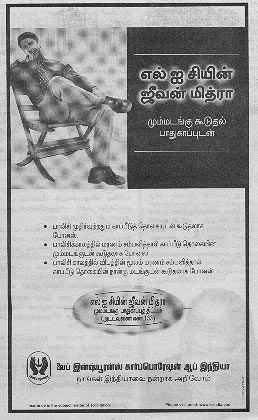
*** *** ***
CHAPTER 3
PROSODY AND FIGURES OF SPEECH OF ADVERTISEMENTS IN TAMIL
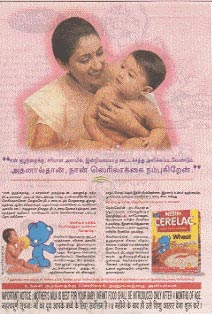
Prosody refers to the versification of a statement whereas figures of speech represent the deviant and forceful form of expressions. Both prosody and figures of speech are used in order to arrest the attention of the consumers and help to imprint the message in their memory. They also serve to indirectly establish symbolic connections between the product and the consumers' ideals and emotive urges. The different aspects of prosody and figures of speech used in the advertisements of magazines, radio and television are discussed in this chapter.
3.1 Prosody
The aspects of prosody widely used in advertising language are alliteration, assonance, rhyme, rhythm and jingle. Each of these aspects will be dealt with in this section.
3.1.1 Alliteration
Alliteration is related to the recurrence of the same initial sound or letter in succeeding words as well as lines. The different patterns in which alliteration occurs are illustrated below.
(a) between first and second word
1. naaLum nampikkai vaLarkkum vanki
everyday confidence add-fut.rp bank
`the bank which adds confidence everyday' (Magazine) (slogan) (Karur Vysya Bank)2. mankaiyarai mankaLakaramaakkum kunkumam
women-acc make-auspicious-fut. rp kumkum
koopuram kunkumam
Gopuram Kumkum
`Gopuram kumkum is the one which makes women auspicious' (Radio)(Gopuram kumkum)3. Colgate paRpoTi
Colgate tooth powder
paRkaLukkup paatukaappaanatu
teeth-dat is safe-pro
`Colgate tooth powder is safe for teeth' (Television) (Colgate tooth powder)(b) between first and third word
4. azakiya illam, aRucuvai uNavu + hayakriivaa paTTukkal
beautiful home six-tastes food Hayagriva silks
`beautiful home, tasty food and Hayagriva silks'(Magazine) (slogan) (Hayagriva silks)5. ettuRaiyilum peNkal enpataRku
all fields-loc women comp-ger-lm-dat
puttuyirkoTukkum pattirikai mankaiyar malar
give revival-fut.rp journal Mangaiyar malar
`Mangaiyar Malar is a journal which gives revival to the goal that women should develop in all the fields' (Radio) (Mangaiyar malar)6. aLittaalum makizcci aTaintaalum
present-cond.concess happiness have-cond.concess
makizcci V.Guard Clocks
happiness
`V-Guard clocks provide happiness whether you present it to others or you have it for yourself' (Television) (V.Guard clocks)(c) between first and fourth word
7. vacatikku oru putu vaTivam
comfort-dat a new form
Ultra mixer grinder
`Ultra mixer grinder, a new form of (grinder) for your comfort'(Magazine) (headline) (Ultra Mixer Grinder)8. paavaiyarkaL teeTivantu teernteTukkum paTTu
women desire for-pp select-fut.rp silk
`the silk the women desire for and select' (Radio) (Ram silks)9. anpee unpaatam rompa azakaa irukku
darling-voc yourfoot very be beautiful-pr-3ns
`O darling, your feet are very beautiful' (Television) (Crack cream)(d) Among first, second and third word
10. unkaL uTalai uRutiyaakat taanki, teekattiRku
your body-acc firmly bear-pp body-dat
cukamaLittu kuLumaiyaana anupavattaiyum
provide comfort-pp pleasant experience-acc-also
tarukiRatu
give-pr-3ns
`(Duroflex mattresses) bears your body firmly and provides comfort and pleasant experience' (Magazine) (body copy) (Duroflex mattresses)11. kallilee kalaivaNNam kaNTaan
rock-loc arts create-3ms
`(some one) created arts in rocks' (Radio) (Anand banian & jaTTis)12. appaTiNNaa ammaa atellaam maRantuTunka
if it is so mummy those-all forget-you(hon.s)
`if it is so, mummy, forget all those (cosmetics)' (Television) (Medimix Soap)(e) Among first, third and fourth words
13. nam kanavukaLaiyellaam nanavaakkum nallatoor
our dreams-acc-all bring to reality- good-pro-one fut.rp
vanki T.N.S.E
bank
`T.N.S.E. bank is a good one which brings all our dreams to reality' (Radio) (T.N.S.E.Bank)14. roomattai maayamamaay maRaikkaveeNTumaa?
hair-acc magically remove-must-q
`do you like to remove your hair magically?' (Magazine) (headline) (7`O'clock blade)(g) between third and fourth word
15. kuRainta voolTeejilum nillaata, niRainta
low voltage-loc-even stop-neg.rp full
aravai
grinding
`full grinding without break even in low voltage' (Radio) (Grinder care motor)(h) between first & second line
16. uRutiyaana cimeNT
strong cement
uttaravaata mutaliiTu
guaranteed investment
`Coromandal Cement, a strong one means a guaranteed investment' (Magazine) (slogan) (Coromandal cement)17. anRum inRum Philips
those days these days
ankee inkee Philips TV
there here
`Philips TV everywhere in the past as well as in the present' (Radio) (George enterprises)18. itanooTa ruci nallaayirukku
this-gen taste be good-pr-3ns
ituvee ematu paatukaappu valaiyam
this-only our safety circle
`the taste of this (tooth paste) is good and this alone is our safety circle' (Television) (Colgate tooth paste)3.1.2 Assonance
Assonance is characterised with the recurrence of the second sound or letter in succeeding words and lines. Consider the following examples of assonance occurring in different patterns:
(a) between first and second word
19. uLLattaik koLLaikoLviir
heart-acc rob-imp.pl
Ti.mangaaraam puTavaiyinaal
T.Mangaram sari-ins
`rob the heart (of your darling) with T.Mangaram sari' (Magazine) (headline) (T.Mangaram silks)20. veLLinilavil tuLLivarum ennavaLee
silver moon-loc bounce-fut.rp my darling
`O my darling, bouncing from the silver moon' (Radio) (Nilibringadi Oil)(b) between first and third word
21. aravaikkut tuNaiyaakum taramaana paTaippu
grinding-dat be helpful-fut.rp standard creation
`the standard creation which is helpful for grinding'(Radio) (Grinder care motor)22. oLiyai unkaLukku aLikkappookiRatu
light-acc to you give-incep-pr-3ns
`(it) is going to give you the light' (Television) (G.E.bulb)(c) Among first, second and third word
23. anRum inRum enRum
those days -conj these -conj days always
Supreme Furniture
`Supreme Furniture (is meant) for all the times' (Magazine) (headline) (Supreme furniture)(e) Among first, second, third and fourth word
24. paalakan paalukazutaal paaluuTTi
baby milk-dat-cry-cond feed milk-pp
taalaaTTal eppaTi?
sing lullaby-ger how
`how to feed milk and sing lullaby if the baby cries for milk' (Magazine)(headline) (City Union Bank Ltd.)(e) between second and third word
25. ciRuvar ullaaca ulakam
children fun world
`children's fun world' (Magazine) (body copy) (Exhibition)(e) between first and second line
26. makattaana vacati
grand comfort
makattaana anupavam
grand experience
`grand comfort, grand experience' (Magazine) (slogan) (Ultra Mixer Grinder)27. karumpalla peNkaL kaTittavuTan viTTeRiya
sugarcane-be.neg women chew-pst.rp- throw away-inf
immediately after
irumpenRu kaaTTa inRezunta
steel-comp prove-inf today arise-pst.rp
PeN-kalki
woman-Kalki
`women are not sugarcane to throw away immediately after chewing and to prove that they are steel, the woman who has arisen today is `Kalki'(a film)' (Radio) (Film-Kalki)3.1.3 Rhyme
Rhyme is related to the use of an identical sound, letter or syllable at the end of adjacent words or lines. The occurrences of rhyme in different patterns are exemplified below:
(a) between first and second word
28. caktikkum puttikkum itoo irukku
energy-dat.purp.conj knowledge-dat.purp.conj here be-pr-3ns
coolaar uppu
Solar salt
`here is Solar salt, which is useful for acquiring energy as well as knowledge' (Magazine) (headline) (Solar salt)29. moTTumallikai taTTuppunnakai
jasmine bud plate smile
ituvee pootumaTi
this-emp enough-euph
`jasmine bud, makes the plate smile-this is enough' (Radio) (Wheel basumati rice)(b) between first and third as well as second and fourth word
30. unkaL eNNam enkaL vaNNam
your thought our colour
`we provide all the colours which remain in your thoughts' (Magazine) (slogan) (Insta paints)31. kuuntalukku vaLamai uTalukku kuLumai
hair-dat fertility body-dat coolness
`fertility to your hair and coolness to your body' (Radio) (Nilibrungadi hair oil)(c) between second and fourth as well as first and third word
32. illattin vekumati ! uLLattin nimmati !
home-lm(gen ø) gift heart-lm(gen Ø) contentment
`gift for the home, contentment for the heart'(Magazine) (headline) (Wondersub submersible pump)33. iyaRkaiyin paTaippu taayin aravaNaippu
nature-lm(gen Ø) creation mother-lm(gen Ø) protection
`nature's creation, mother's protection' (Radio) (Grinder care motor)34. aLittaalum makizcci ; aTaintaalum makizcci
present-cond. concess happiness concess have-cond. happiness
`provides happiness whether you present to others
or you have it for yourself' (Television) (V-Guard clocks)(d) between second and fifth word
35. tuLikuuTa kaRaiyillai ituvee cuttattin ellai
bit-even stain-be-neg this-emp cleanliness end -lm(gen Ø)
`not even a bit of stain, this itself effects the end of cleanliness' (Magazine) (Ultra vim)(e) among first and second line
36. uRutiyaanatu
strong-pro
upayookamaanatu
useful-pro
maRRum azakaanatu
and beautiful-pro
`(it)is strong, useful and beautiful' (Magazine) (headline) (Prince stainless steel kitchen sink)37. uNmaiyaana paTTu itu
real silk this
menmaiyaana paTTu
soft silk
`this is the real silk and the soft silk' (Radio) (Ram silks)38. vaayt turnaaRRattai tavirttiTuviir
mouth bad smell-acc avoid-imp.pl
paRcitaivai etirttiTuviir
(Television)(Colgate Toothpaste) tooth decay-acc fight against-imp.pl
`avoid bad smell in the mouth and fight against tooth decay'3.1.4 Rhythm
Rhythm is formed by a harmonial succession of sounds contributing to the musical flow of language. Observe the following examples:
39. murukan meTTal enRaalee
Murugan metal hear of-cond-euph
mukam malarum tannaalee
face blossom-fut-3ns on its own
`the moment one hears of Murugan metals his/her face will blossom on its own' (Magazine) (slogan) (Murugan metals)40. aracan soppu pootumaa
Arasan soap enough-q
innum koncam veeNumaa
further something want-q
`is Arasan soap enough or do you want something more?' (Radio) (Aracan soap)41. puumpukaarin baniyan jaTTi vanta neeramaTaa
Poopuhar-lm(gen Ø) come-pst.rp time-euph
`the time when Poompuhar's banian and jatti's arrived (is a happy occasion)'(Television) (Poompuhar banian & jatti)The euphonic vowel -ee added finally to the ending words of the lines in example 39 makes the text rhythmic. In 40, rhythm results from the question marker -aa added to the ending words of the lines. In 41, the rhythmic effect is due to the addition of the euphonic suffix -aTaa.
3.1.4 Jingle
Jingle is a short verse involving repetition of similar sounds or same words.
42. vaNNankaL palavitam
colours different kinds
ovvonRum oruvitam
each unique kind
`colours are different, each colour is unique' (Magazine) (headline) (Insta paints)43. poruL teeTum puumiyil
wealth desire for-fut.rp earth-loc
aruL teeTum nencamee
grace desire for-fut.rp heart-voc
niRam maaRum puumiyilee
colour change-fut.rp earth-loc-euph
nijam maaRak kuuTumoo
truth change possible-q (Radio) (Film Kalki)`O heart, you are after grace in the world which is after wealth ; in this world, where colours may change, is it possible to change the truth ?'
44. azakaana kaalai malarnta ruci
beautiful morning blossom-pst.rp taste
anpaay nenjil niRainta ruci
affectionately heart-loc fill-pst.rp taste
`the taste which blossoms in the beautiful morning, the taste which filled the heart affectionately' (Television) (Tata Chakra Gold)Of the five aspects described above, alliteration is found to be more frequently used than the other four. Alliteration is also embedded in the other four. Since the traditional rules of versification are not strictly observed, assonance and rhyme are sporadically used. This is also true of the use of rhythm and jingles.
3.2 Figures of Speech
The figures of speech commonly found in the language of advertising are simile, metaphor, personification, pun, hyper-bole, litotes, antithesis, oxymoron, metonymy, interrogation, exclamation, climax, reduplication, repetition, onomotopoeia and idiom. The use of these figures of speech in advertisements is described with examples in this section.
3.2.1 Simile
Simile refers to the comparison made between two objects of different kinds which have however one point in common. It is of two types namely explicit and implicit simile. In explicit simile, the comparative particle poola or poonRa appears, whereas in implicit simile it is omitted. Consider the following examples :
(a) Explicit simile
45. muTi paTTup poola irukku
hair silk-like be-pr-3ns
`the hair is like silk' (Magazine) (body copy) (Raaga herbal powder)46. tiipattin cuTaraip poola
lamp-gen(Ø) flame-acc like
unkaL meeniyum paLapaLakkaTTum
your body-also glow-let
`let your body also glow like the flame of the lamp' (Television) (Ponds sandal talc)Simile has been explicitly used in the statements exemplified in 45 and 46 above. In 45, muTi `hair' is compared with paTTu `silk' for the quality of `softness', which is claimed to be the effect of using the herbal powder of the brand `Raaga'.In the same manner, in 46, `the glow of the body' is compared with `the flame of the lamp'. It is stated that such a `glow' for the body will be the result of using `Ponds sandal talc'
(b) Implicit simile
47. cezumaiyaana karukaru paTTukkuuntal
(Magazine) lush jet black silky flowing hair
`lush jet black silky flowing-hair'(headline) (AVM pavun coconut oil)48. ammavenRazaikkaata uyirillaiyee
mother-comp-call-neg.rp being-be.neg-emp
Grinder Care MotorinRi grinder illaiyee
Grinder Care Motor-without grinder be.neg-emp
`there is no being which doesn't call as `amma'; similarly, there is no grinder without Grinder Care Motor' (Radio) (Grinder Care Motor)Implicit simile has been used in examples 47 and 48. In 47, the comparative particle poonRa' `like' has been omitted in the compound `paTTuk kuuntal, which means that the flowing- hair of the woman will become as soft as silk by the use of `AVM pavun coconut oil'. In 48, `the invariable and wider use of Grinder care motor in every grinder' is considered on par with `the indispensable attachment that every being has towards one's mother'
3.2.2 Metaphor
Metaphor involves a comparison of two things x and y, where x is totally identified with y as if x is y itself. This is different from simile, where x is considered to be like y.
49. enkaL uzaippil viLainta veRRikkanikaL
our labour-loc yield-pst.rp success fruits
unkaLukkaakattaan
you-purp-emp
`the fruits of success yielded out of our labour are for you only' (Magazine) (Headline) (The Vysya Bank)50. tavaNai ulakil tankaccurankam
world of hire purchase-loc gold mine
P.V.R.traders
`P.V.R.Traders remain the gold mine in the world of hire-purchase' (Radio) (P.V.R.traders)51. putiya Super Wheel cuttattin puyal
new cleanliness-lm(gen 0) storm
`the new Super Wheel is the storm of cleanliness' (Television) (Wheel detergent)In example 49, metaphor is used in the compound veRRikkanikaL, where veRRi `success' is equated with kanikaL `fruits' implying the profit made by the bank through the savings of its clients.
In 50, the company called P.V.R Traders is considered to be tankac curankam `a gold mine', which implies the variety of valuable things the company provides through different hire purchase schemes.
3.2.3 Personification
In personification, inanimate objects and abstract notions are spoken of as having life and intelligence.
Examples:
52. itanaal bleeTukkuk kiTaikkiRatu LONG LIFE
this-ins blade-dat be available-pr-3ns Long Life
`because of this, the blade gets long life'(Magazine) (bodycopy) (7`o'clock blade)53. kuTumpam aarookkiyamaa irukaNumnaa
family healthily be-must-cond
naama anpaayiruntaa maTTum pootaatu
we be affectionate-cond only not enough
Sunolavin akkaRaiyum veeNum
Sunola-lm(gen Ø) care-also is needed
`if the family is to be healthy, it is not enough if we are just affectionate and Sunola's care is also needed' (Radio) (Sunola oil)54. namma uuru vaNTi TVS-XL
our place vehicle
ippa ituvum namma familyilee
now this also our family-loc
oru member aayiTuccinka
a member become-def-pst-3ns-addr
`TVS-XL is the vehicle of our place. Now, it has also become a member of our family' (Television) (TVS-XL moped)In example 52, the phrase Long Life, which is usually associated with animate nouns, is here associated with the inanimate object, 7 `O' clock blade. Similarly, in 53, the term akkaRai `care' used in collocation with human nouns is associated with the inanimate thing, cooking oil of the brand Sunola.
In 54, the mophed TVS-XL is personified as a member of the family.
3.2.4 Pun
A pun consists in the use of a word in two different meanings leading to two different interpretations of a statement.
Examples :
55. kuzikaranTi, waaTTar filTar
hollow spoon water filter
ellaam tantiTum murukan
all provide-fut.rp Murugan
`Lord Murugan, who graces people with spoons, water filter and all other vessels'or`the Murugan Metals', which sells spoons, water filter and all other vessels' (Magazine) (headline) (Murugan metal industries)56. ammaa em poNTaaTTi eppavum
mummy-voc my wife always
aracantaan veeNumnu aTampiTikkiRaa
king-emp must-comp be stubborn-pr-3fs
`mummy, my wife is stubborn that she wants only the king/the King detergent soap' (Radio) (Arasan soap)In example 55, the proper noun `Murukan' has been used in such a way that is may mean either `Lord Muruga' or the firm `Murugan metals' selling different kinds of vessels. Similarly, in 56, the word `aracan' has been used to mean either `the king' or the brand name of the detergent soap.
3.2.5 Hyperbole
In hyperbole, a statement is made emphatic by overstatement.
Examples:
57. un kuuntal eeRi tavazum puu
your flowing hair occupy-pp caress-fut.rp flower
kooTi ruupaay
crore rupees
`the flower which caresses your flowing hair worths crores of rupees' (Magazine) (headline) (Errica hair oil)58.civappu hiT ; kaRuppu hiT - eenenil puuccikaLil
red ; black - because insects-loc
puumikkum aakacattukkumuLLa vittiyaacam irukku
earth-dat-conj sky-dat-conj difference be-pr-3ns
`Red Hit, Black Hit (are needed), because the difference found among the different kinds of insects is to the extent of the space between the earth and the sky' (Television) (Hit)In example 57, the worth of the flower caressing the beloved's flowing hair being estimated at one crore rupees and, in 58, the extent of difference found among different kinds of insects being compared with the `extent of space' between `the earth and the sky' are overstatements representing hyperbole.
3.2.6. Litotes
In litotes, an affirmative is conveyed by negation of the opposite, the effect being to suggest a strong expression by means of a weaker.
Example:
59. avan kanavukaaNavillaiyenil illai mallai
(Magazine) (bodycopy) he dream-pst.neg-comp.cond be.neg Mallai
(Sri Ram chits) `there is no Mallai (Mahabalipuram) if he had no dreams of it' (Television) (Hit) (Narasimhavarman)The ancient port city of Pallavas, Mahablipuram, was conceived and formed by the king Narasimhavarman. The importance of this historical fact has been highlighted through a negative expression in the above example. The implication of the statement is that one should have high dreams in his/her life and to make it a reality, he/she should invest in Sri Ram chits.
3.2.6 Oxymoron
Oxymoron is a special form of antithesis whereby two contradictory qualities are predicted at once of the same thing.
Examples:
60.kirumikaLin azivil aarookkiyam aarampam
germs-lm(gen Ø) extinction-loc health emerge
`health emerges from the ruin of germs'(Magazine) (slogan) (Lizol)61.vilaiyoo kuRaivu taramoo niRaivu
cost low quality high
`cost is low but the quality is high' (Radio) (B.M.silks)62. mokattep paartaa raajakumaari; aanaa kaalep paartaa
face-acc look at -cond princess; but foot-acc look at -cond
veelekkaari
servant maid
`if you look at her face, she is a princess, but, if you look at her feet, she is a servant maid' (Television) (Crack cream)In example 60, the effective use of `Lizol',a floor cleaning liquid has been exphasized through its two opposite qualities that it simultaneously leads to extinction of germs and emergence of health for the residents of the house.
In 61, about B.M.silk saris, it is stated that its quality is high while its cost is less.
In 62, two opposite kinds of appearance of a woman is stated as follows: she appears like a princess by her face but like a servant maid by her feet. The point emphasized here is that she suffers from cracks in her feet and she has a strong need to use `Crack cream'
3.2.7 Metonymy
Metonymy involves change of name. An object is designated by the name of something which is generally associated with it. It is a `whole' and `part' relationship, where `whole' may refer to `part' or the vice versa.
Example:
63. tinamaNiyaip pirittaal
Dinamani-acc open-cond
oru putu ulakam unkaLmun viriyum
a new world you-before open-fut-3ns
`a new world will open before you if you open Dinamani' (Magazine) (body copy) (Dinamani Daily)In the above example, the word ulakam, `world', has been used to denote the news about the world in the context of referring to the daily newspaper `Dinamani'
3.2.8 Interrogation
Interrogation is the asking of a question not for the sake of getting an answer, but to put a point more effectively. This figure of speech is also known as `rhetorical question' because a question is asked merely for the sake of rhetorical effect, which includes doubt, speculation, or negative implication.
(a) doubt
64. oru poTuku Saampuu evvaaRu
a dandruff Shampoo how
azakiya talaimuTiyait taramuTiyum?
beautiful hair-acc give-can
`how can a dandruff shampoo give (you) beautiful hair? (Magazine) (headline) (Clinic All Clear)The above question implies doubt on the added effect of Clinic All Clear shampoo for making the hair beautiful while the normally expected effect is only to eradicate dandruff from the hair.
(b) speculation
65. enna iNNekku onka viiTTilee maTTanaa ?
what today your home-loc mutton-q
`Is mutton prepared at your home today' (Television) (Sakti masala)The question here implies the speculation arising from witnessing a woman grinding masala. Subsequently, it is suggested that Sakti masala would be a better substitute helping to avoid the labour of grinding masala for preparing mutton.
(c) negative
66. KVB-Safe-il
KVB-safe-loc
MutaliiTTin
investment-lm(gen Ø)
vaLarccikku
growth-dat
muTivu eetu?
end where
`where is the end for the growth of investment in KVB-Safe ? = there is no end to the growth of investment in KVB-Safe' (Magazine) (headline) (Karur Vysya Bank)67. veeRenta mooTTaarum
any other motor
Grinder Care Motorukku iNaiyaakumaa?
Grinder Care Motor-dat be equal-fut-3ns-q
`can there be any other motor equal to Grinder Care Motor?
('there can be no other motor equal to Grinder Care Motor') (Radio) (Grinder Care Motor)In examples 66 and 67, questions have been used for negative implication. In 66, muTivu eetu `where is the end' means muTivu illai `no end' and in 67, iNaiyaakumaa `can it be equal' means iNaiyaakaatu `cannot be equal'.
3.2.9 Exclamation
Exclamatory form is used to draw greater attention to a point than a mere barred statement of it could do.
Examples:
(a) surprise
68. aTa Shanti, paarttu evvaLavu naaLaaccu!
Ah! Shanti, meet-pp how many days-pass-pst-3ns
`Ah Shanti, how many days have passed after we met last' (Television) (Clinic Plus)In example. 68, `surprise' is revealed through the interjection aTa `ah' as well as the interrogative pronoun evvaLavu (=ettanai) `how many'. This statement opens the conversation in appreciation of Clinic Plus shampoo.
(b) rejoice
69. cingappuuril itayam evvaLLavu cantooSamaana
Singapore-loc Itayam how much happy
camaccaaram
news
`Idayam in Singapore, how happy a news it is!' (Magazine) (headline) (Idayam gingely oil)70. evvaLavu vaacane!
how much flavour!
`how much of flavour it has!' (Television) (V.M.C.Mutton masala)71. aTaaTaaTaa
Hurra
caambaar enna maNam, enna taste
saambaar what flavour what taste
`Hurrah ! what a flavour, what a taste the sambar is!' (Radio) (Shalini Asafoetida)In 69, `rejoice' towards the arrival of Idayam gingely oil in Singapore is expressed through the adjective cantooSamaana `happy' and the exclamatory form of sentence introduced by the interrogative pronoun evvaLavu `how much'
In 70, `appreciation' of the flavour of V.M.C.Mutton masala is indicated through the interrogative pronoun evvaLavu `how much'.
In 71, `rejoice' combined with appreciation towards the flavour of saambaar containing Shalini asafoetida is expressed through the interjection aTaaTaaTa `hurrah' as well as the use of the interrogative pronoun enna (=eppaTipaTTa)`what kind of' with the words maNam `flavour' and teesT `taste'.
3.2.10 Climax
Climax refers to the arrangement of a series of ideas in the order of increasing importance.
Example:
72. uNmai, uRuti, unnatam, paraparappu maTTumalla
truthfulness firmness excellence sensation only-be.neg
nampakamum kuuTa - araciyal camutaaya
reliability also - political social
vaara itaz `taraacu'
weekly magazine Tarasu
`Taracu is a politico-social weekly magazine, which is not only truthful, firm, excellent and sensational but also reliable' (Radio) (Taracu)While listing the merits of the magazine `Tarasu' in example 72, the nouns of quality uNmai `truthfulness' uRuti `firmness'unnatam `excellent' paraparappu `sensation' and nampakam `reliability' have been placed in the order of increasing importance attaching the utmost importance to `reliability'.
3.2.11 Reduplication
In reduplication, the same word gets repeated successively conveying the intensity of the fact or emotion contained in it.
73. keeTka keeTka Philips
listen-inf listen-inf
paarkkap paarkkap Philips TV
watch-inf watch-inf Philips TV
vaanka vaanka George enterprises
buy-inf buy-inf
(George Enterprises) `you would like Philips transistor to listen again and again, Philips TV to watch again and again, and George Enterprises to buy again and again' (Radio) (Radio)74. manaivi ini camaippaanka
wife hereafter cook-fut-3hpl
tasty tasty caappaaTu
meals
`hereafter (your) wife would be able to cook tastier meals' (Television) (Prestige Pressure Cooker)In example 73, reduplication of the infinitive verbs keeTka keeTka `to listen and listen', paarkka paarkka ` to watch and watch',vaanka vaanka `to buy and buy' implies the sense of `again and again'.
In example 74, the adjective teesTi `tasty' has been reduplicated to intensify the quality of the meals that could be cooked conveniently with the help of the `Prestige Pressure Cooker'.
3.2.12 Repetition
Repetition involves using the same word or phrase, especially brand name or ingredient of the product, again and again in the advertising text. Repetition helps to imprint the message in the memory of the consumers.
Examples:
(a) brand name
75. velveT poonRa carumap paatukaapiRku
velvet like skin care-dat
eeRRatu AVM pavun teenkaay eNNey
is suitable AVM pavun coconut oil
iNaiyaRRa AVM pavun teenkay eNNey
unparalled AVM pavun coconut oil
`AVM pavun coconut oil is suitable for velvet like skin'(Magazine) (bodycopy) (AVM pavun coconut oil)76. kavarin enRaal kalyaaNi, kalyaaNi,kalyaaNi
covering means Kalyani, Kalyani, Kalyani
`Covering means Kalyani' (Radio) (Kalyani Covering)In examples 75 and 76, the brand names have been repeated in different places of the advertising text. In 75, the brand name combined with the product AVM Pavun teenkaay eNNey `AVM Pavun Coconut oil' has been repeated twice, while in 76, the brand name of the covering jewellary kalyaaNi `Kalyani' has been repeated thrice.
(b) ingredient
77. proteinaala en muTiyum priyaavooTa
protein-ins my hair-also Priya-gen
muTipoola azakaakumaa?
hair-like beautiful-fut-3ns-q
kanTippaa,eennaa, muTi proteinnaala aanatu
certainly because hair protein-ins be formed-pst-3ns
inta protein uTalukku
this protein body-dat
inta protein talaimuTikku
this protein hair-dat
liquid protein aTankiya putiya Cinic Plus Protein
contain-pst.rp new
Shampoo muTiyin veerkaLai valuvaakkum.
hair-gen roots-acc strengthen-fut-3ns
talaimuTiyum aTarttiyaaka vaLarum
hair also densely grow-fut-3ns
`will my hair also become beautiful like Priya's hair? (Television) (Clinic Plus)Certainly, because, hair itself has protein in it. This protein is for body. This protein is for hair. New Clinic Plus Protein shampoo, which contains liquid protein, will strengthen the roots of the hair. The hair will also grow densely'
In example 77, Protein, the major ingredient of Clinic Plus Shampoo has been repeated six times highlighting its importance in different ways.
3.2.13 Onomotopoeia
Onomotopoeia refers to Words of sound significance relating an object with its action or qualities. It makes a statement very effective.
78. paTucuttamaaka paLiccenRu toonRum
(Magazine) (Lizol) very cleanly brightly look-fut-3ns
`it will look bright and very clean' (Clinic Plus)79. maanku maankuNNu masala araikkuRRiinkaLaa?
with great strain masala grind-pr-2 hon.s-q
`are you grinding masala with great strain?'
Shakti masalaave vaankunka
Shakti masala-acc buy-imp.pl
caTTupuTTuNNu camayale muTinka
quickly cooking-acc finish-imp.pl
`buy Shakti Masala and finish cooking quickly' (Television)(Sakti Masala)In example 78, the phrase paLiccenRu `brightly' refers to quality of shining of the floor as a result of using `Lizol' liquid cleaner.
In example 79, the phrase maanku maankuNNu refers to the action of grinding masala with a great strain and caTTupuTTuNNu refers to quickness with which cooking could be done with the help of Shakti Masala.
3.2.14 Idiom
Idioms are expressions peculiar to a language. An idiom has a meaning different from the meanings of its constituents and it is often used in other figures of speech like metaphor.
Example:
80. puruSan nallaayiruntaataanka puu nilaikkum
husband be-healthy-cond-emp- -addr(resp) flower remain-fut-3ns
`the flower, which is symbolic of married life, will remain only if the husband is healthy' (Radio) (Lion Dates)In the above example, the phrase puu nilaikkum `flower will remain' is idiomatic as it refers to the `long life of one's husband'. In this respect the importance of the fruit, dates of the Lion brand, for maintaining the health of the husband,has been emphasized.
The different aspects of prosody and the figures of speech discussed above characterize the poetic function of the advertising language contributing significantly to the attention value, readability/listenability and memorability of the advertising message.
*** *** ***
CHAPTER 4
DISCOURSE ASPECTS OF ADVERTISEMENTS IN TAMIL
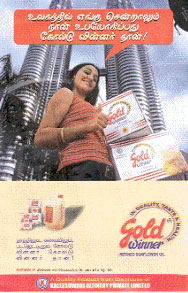
It is aimed at in this chapter to study the relationship between choice of language and the advertising situation. The advertising situation chiefly consists of four aspects namely participants, relevant object, medium and purpose. The primary participants of an advertisement are the advertiser as addresser and the consumer as the addressee. Sometimes, the secondary participants are introduced in between the advertiser and the consumer. The secondary participants may be introduced by the advertiser or may assume the role of the advertiser. The advertiser represents a small group of individuals belonging to a firm or institution while the consumers include millions of people from different cross sections of the population. The relevant object refers to the product advertised in commercial consumer advertisements, the service in commercial prestige advertisements and the moral advocated in noncommercial advertisements. The medium used for the advertisements may be magazines, radio or television. Writing is involved in magazines while speech or scripted speech is involved in radio and television. The purpose is always to sell the product, promote the service, or instruct moral among the consumers. Of the four aspects of the advertising situation, the kind of participants involved and the medium chosen are closely related to the choices made in respect of form of address and style of discourse, which are in turn linked with the choice of language.
4.1. Form of Address
On the basis of the kinds of participants involved in the advertising situation, a distinction is made between direct and indirect form of address. The direct form of address includes the advertiser as the first person and the consumer as the second person. The indirect form of address is marked with the presence of one or more secondary participants. The involvement of a single secondary participant indicates the choice of monologue form and two or more participants indicates the choice of dialogue form within indirect address.
4.1.1. Direct Address
As pointed out above, the direct address includes the advertiser and the consumer as participants. In advertising copies involving direct address, the advertiser, i.e., the first person does not appear usually in the form of expression. This is indicated by the absence of first person singular/exclusive plural pronouns in the direct address. However, in certain instances, first person inclusive plural form of pronoun naam we, or its oblique forms may be used to indicate the involvement of both the advertiser and the consumer. The consumer is usually referred to by the use of the second person plural/honorific singular form of pronoun niinka(L) 'you' or its oblique forms or the corresponding imperative forms of verbs. The direct address is largely preferred in the advertisements of magazines, to the extent of 90%, while its preference is to the extent of 50% in television and 30% in radio. The specimens of the advertisements involving direct address are illustrated below:
picture
In illustration 1, both second person pronoun and the imperative form of verb are present. In 2, the occurrence of first person inclusive plural is found. In 3, the second person pronoun alone is present.
4.1.2 Indirect Address
The indirect address is distinguished from the direct address by the inclusion of secondary participant(s). Both monologue and dialogue forms are found to appear in the advertisements of all the three media. Monologue is represented by the use of first person singular pronoun naan 'I' or its oblique form and/or the corresponding pronominal termination in the verb. In dialogue, it may or may not appear. The preference for indirect address in radio is to the extent of 70% while it is to the extent of 50% in television and 10% in magazines. Between monologue and dialogue, dialogue is preferred to the extent of 80% in radio and 70% in television. In magazines, monologue is more preferred than dialogue. Consider the following illustrations:
Pictures
In illustrations 4 and 7, the magazine advts, the direct address and indirect address are found to be mixed. In 4, the body copy is presented in monologue form of indirect address, while the headline and signature line are in direct address. In 7, part of the body copy is in dialogue form and the rest are in direct address.
In all the monologues above, the use of first person pronoun is involved. In illustrations 8 and 9 involving dialogue form, the presence of first person pronoun is explicit in 9 while it is implicit in 8.
4.2 Style of Discourse
The style of discourse here refers to the choice between the formal and colloquial style. The diglossic situation prevalent in Tamil is found to be significantly reflected in the use of language in advertising.
4.2.1 Formal Style
The formal style of Tamil, which is the superposed variety attached with 'prestige value' by its use in all formal domains of communication, is found to be widely preferred in advertising in all the three media. More than 90% of the advertisements in magazines are in formal style, which is used to the extent of 70% in radio and 50% in television. Consider the following illustrations.
10. Magazine - Mark Jewellery
Picture
11. RADIO - GOLDWINNER SUNFLOWER OIL
Tamil matter
12. TELEVISION - GOODNIGHT LIQUADATOR -
Tamil matter
The purely formal style of Tamil is found to be used in all the three illustrations - 10, 11 and 12 and they all represent the direct form of address.
4.2.2. Colloquial Style
The colloquial style, demarcated by phonological and morphological differences from the formal style, is found to be preferred mainly to make the advertisements realistic and simple. The colloquial style is quite often interspersed with formal style. The preference for colloquial style is predominant in the indirect.
13. MAGAZINE - K.K.R. PALM OIL
Tamil matter
14. RADIO-BINDU PAPAD
Tamil matter
15. TELEVISION - HIT
Tamil matter
In illustrations 13 and 15, the colloquial style is interspersed with formal style while illustration 14 represents a purely colloquial style. All the three illustrations involving the colloquial style belong to the form of indirect address. In illustration 13, the colloquial style is found to represent the Brahmin dialect of Tamil, which is identified with the use of the nouns tooppanaar 'father' and paTcaNankaL 'eatables' and the verbs cenciNTirukkeen 'I have been preparing' vantirukkoonnoo 'it has come, you know?' through their morphological composition different from the formal style. The use of Brahmin dialect here is in identity with the secondary participant, who is a member of that community.
The direct address and formal style are highly preferred in magazine advertisements. This is mainly due to the fact that the mode of expression involved is 'writing'. Since oral expression is involved in radio and television advertisements, it is found that the use of colloquial style is frequent in both these media. Between radio and television, the use of colloquial style is more frequent in the advertisements of the latter than in those of the former. However, in all the three media, not less than 50% of the advertisements are found to make use of the formal style.
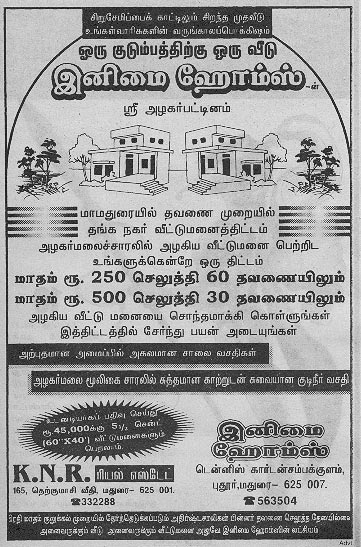
*** *** ***
CHAPTER 5
DISCUSSION AND CONCLUSION
The study on 'Language of Advertisements in Tamil Mass Media' has been reported in the preceding four chapters. In chapter 1, the importance of advertisements, the origin and evolution of advertising, media involved in advertising, definition and functions of advertisements, the role of language in advertising, earlier studies on language of advertisements, the purpose of the present study and the methodology used have the purpose of the present study and the methodology used have been dealt with. The analysis made at three levels - grammar, prosody and figures of speech, and discourse of the language used in the advertisements of the three media - magazines, radio and television has been presented and discussed in chapter 2, 3 and 4 respectively. The linguistic choices observed at each level of analysis and the differences identified in language use among the three media are interpreted and discussed in this chapter.
The choices in respect of grammar include topicalized versions of nominal and verbal sentences, imperatives and interrogatives, hypotaxis and parataxis, disjunctive mode of expressions involving clauses, phrases and compounds, nominal and verbal attributes of different kinds, intensifiers of different degrees, words and morphemes of conversational significance and morphemes related to euphony, emphasis and contrast. Alliteration, assonance, rhyme, rhythm and jingle form the choices in prosody and the choices related to figures of speech include simile, metaphor, personification, pun, hyperbole, litotes, antithesis, oxymoron, metonymy, rhetoric question, exclamation, climax reduplication, repetition, onomatopoeia and idiom. At the level of discourse, the choices are related to form of address (direct vs indirect address) and style of discourse (formal vs colloquial style).
All different choices mentioned above are closely linked with the five functions of advertising - attracting attention, arousing interest, stimulating desire, creating conviction and getting action. It is also found that these choices fulfil the different communicative functions of language such as informative, expressive, directive, contextual, interactional and poetic. There is no one to one correspondence always between linguistic choices and the advertising function. That is, one particular choice may overlap with different functions. As for instance, the use of rhyme or rhythm may serve to attract and arouse interest. Nevertheless, one to one correspondence is found between the use of interrogative and creating conviction and the use of imperative and persuading action. The use of parataxis and colloguial style are intimately connected with simplicity and comprehensibility of the advertising text. All the choices in general are directed towards the ultimate goal of introducing or increasing the sales of different goods or promoting different services.
No significant qualitative difference in choice of language in advertising among the three media is observed. Almost all the choices mentioned above are found to be attested in all the three media except one or two aspects. For instance, the copula aakum 'be', which is occasionally used in the body copy of magazine advertisements, is never used in radio and television advertisements. This is related to the fact that both radio and television involve the oral mode of expression, where the use of copula is mostly avoided. There are, however, a few instances where the three media differ among themselves with regard to the frequency of occurrences of certain choices. For instance, the use of nominal sentences are more frequent in radio than in magazines and television. The use of direct form of address is more frequent in magazines than in radio and television. The use of colloquial style is more predominant in television and radio than in magazines. A systematic stylistic study of words and structures used in the three media may throw light on the exact differences of language choice among the three media.
There is enough scope for undertaking further research in the area of advertising language. Each predominant linguistic aspect can be studied in isolation in relationship with its psychological impact on the consumers. The relationship between language use and non-linguistic aspects of advertisements such as typography, visuals, audio and video effects is another possible area for future research. In the case of magazine advertisements, the role of punctuation marks can be explored and errors related to grammar and sandhi identified.
*** *** ***
REFERENCES
Arokianathan, S. 1993. takaval toTarpiyal (Mass Communication). Villupuram : Muthu Pathippagam.
Chidambaranatha Chettiar, A. 1942. Advanced Studies in Tamil Prosody. Annamalainagar : Annamalai University (4th edition, 1977)
Chunawalla, Sethia. 1985. Foundations of Advertising Theory and Advertising. Bombay : Himalaya Publishing House.
Dhongde, Ashwini. 1987. "The Language of Advertisements", in Suresh Kumar (ed.), Stylistics and Text Analysis, New Delhi : Bahri Publication, pp.211-219.
Geis Michael. L. 1982. The Language of Television Advertising, New York : Academic Press Inc.
Gnanasundaram, V. 1985. Onomatopoeia in Tamil. Annamalainagar : All India Tamil Linguistics Association.
Gopal, A. 1980. " Some Linguistic Aspects of Tamil Advertisements" in S. Agesthialingom and K. Karunakaran (eds.), Sociolinguistics and Dialectology, Annamalainagar : Annamalai University, pp. 107-118.
Harris, R. and Seldon, A. (1962). Advertising and the Public. London: Longmans.
Hemamalini, R. 1989, A contrastive Sociolinguistic Study of Advertisements in Tamil and English. Unpublished M.A. Dissertation. Coimbatore: Dept. of Linguistics, Bharathiar University.
Jefkins, Frank. 1973. Advertising Made Simple. London : Rupa & Co.
Gopal, A. 1980. "Some Linguistic Aspects of Tamil Advertisements" in S. Agesthialingom and K. Karunakaran (eds.), Sociolinguistics and Dialectology, Annamalainagar : Annamalai University, pp. 107-118.
Kalidas, V. 1999. "Indian Advertising all agog through the Post-Independence era", in The Hindu, August 15, Feature B.
Kothandaraman, Pon. 1976. Modern Studies in Tamil. Madras : Tamil Nuulagam.
Kumar, Suresh. 1978. Hindi in Advertising - A study in Linguostylistic method. Chandigarh : Bahri Publications.
Leech, Geoffrey N. 1966. English in Advertising. London: Longmans.
Lehmann, Thomas. 1989. A Grammar of Modern Tamil. Pondicherry : Pondicherry Institute of Linguistics and Culture.
Madhu, S.R. 1996. "The Visible Persuaders - An Overview of Advertising in India and US", in Span xxxvii, 3, pp. 15-23.
Manian, Thanga. 1986. Pattirikai Mozinatai. Paranam : Manickap patippaham.
Manoharan, R. 1994. The Phonological Structure of Tamil Advertisements (with special reference to magazines). Unpublished M.A. Dissertation. Coimbatore : Dept. of Linguistics, Bharathiar University.
Mencher, Melvin. 1990. Basic News Writing. New Delhi : Brown Publishers.
Ogilvy, David. 1983. Ogilvy on Advertising. London: Multimedia Publications (UK) Ltd.
Quirk, R., Greenbaum, S., Leech, G., Svartvik, J. 1972. A Grammar of Contemporary English. London : Longman.
Ranade, Sudharshan. 1998. "The space between the ads", in The Hindu, April 19, M III.
Samuel, Suresh. E. 1992. Gender variations in the Languages used in Advertising. Unpublished M.A. Dissertation. Coimbatore : Dept. of Linguistics, Bharathiar University.
Satyanarayanan, C.S., 1990. A Linguistic Study of Election Advertisements in Tamil. Unpublished P.G. Diploma Dissertation. Coimbatore : Dept. of Linguistics, Bharathiar University.
Sherlekar, S.A. 1995. Marketing Management. Bombay : Himalaya Publishing House.
Thiruvalluvar. 100 B.C. Thirukkural with the commentary of Parimeelazhagar, Madras : Kazhagam (1973).
Venkatesa Raja, S. 1991. A Sociolinguistic Study of Tamil Advertisement with special Reference to Print Media. Unpublished M.A. Dissertation. Coimbator : Dept. of Linguistics, Bharathiar University.
Vestegaard, Torben and Schroder, Kim. 1985. The Language of Advertising. Cambridge, Massachusetts : Blackwell Publishers (Inc.)
Vinayaga Moorthy, A. 1989. ViLamparakkalai (Art of Advertising) Madurai : Balamurugan Pathippagam.
Zvelebil, Kamil V. 1989. Classical Tamil Prosody : An Introduction. Madras : New Era Publications.
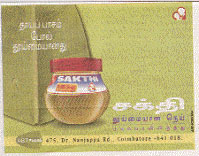
*** *** ***
APPENDIX
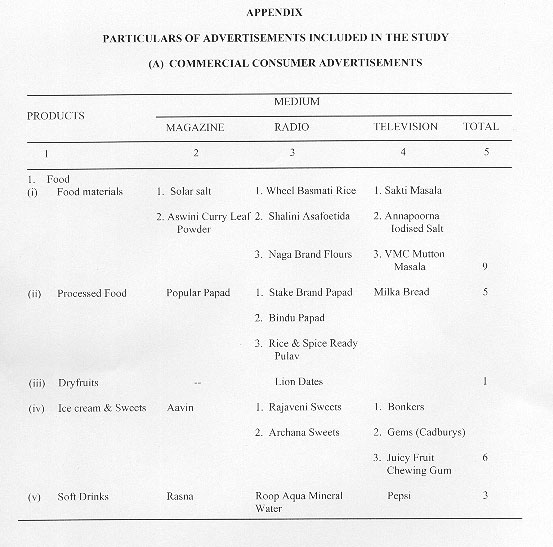
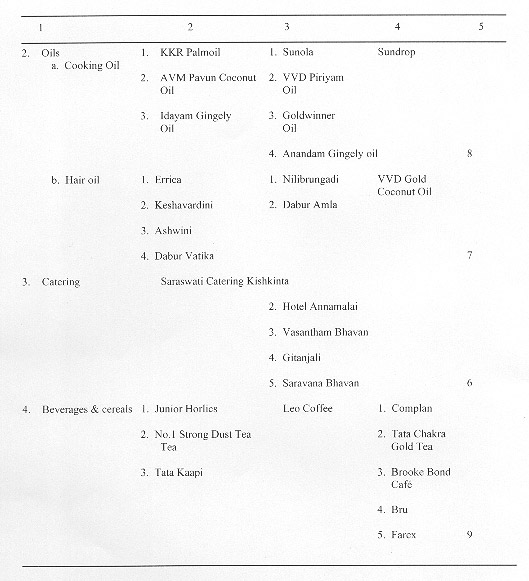
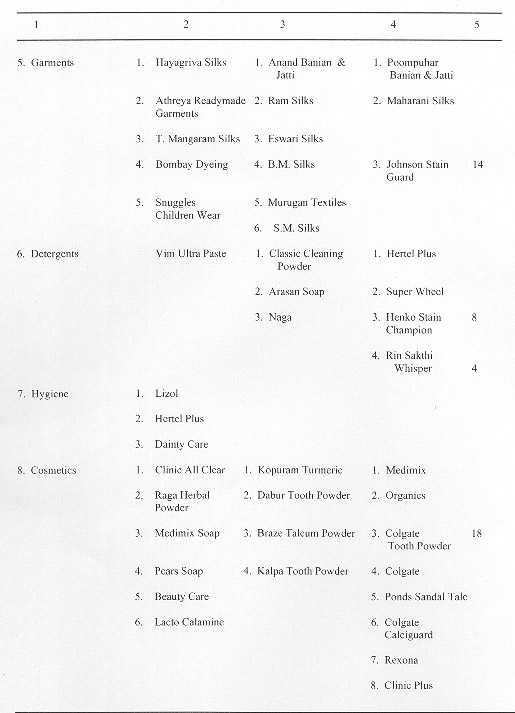
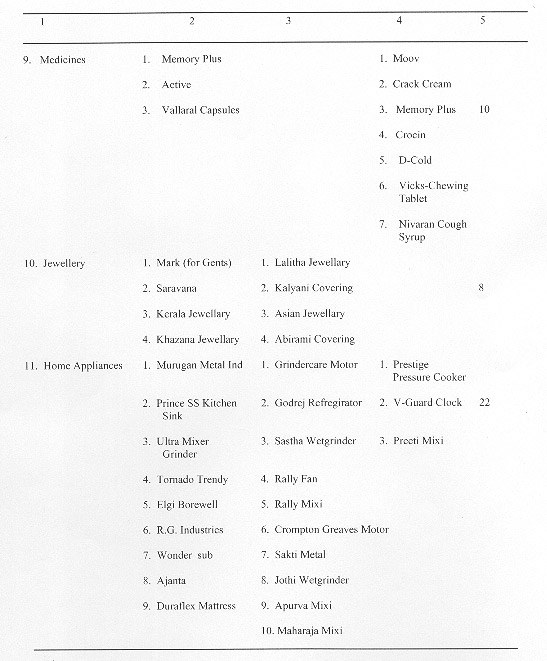
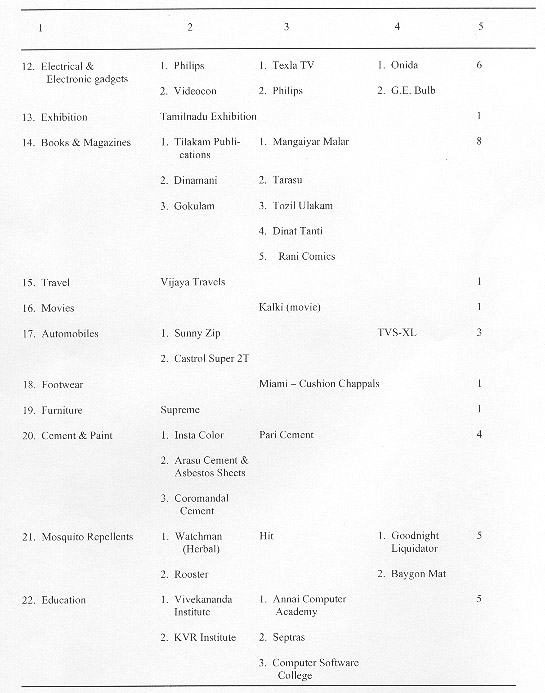
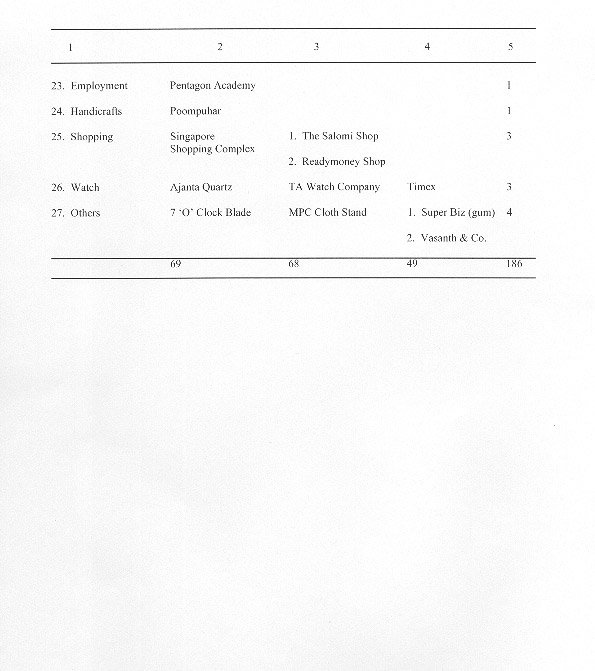
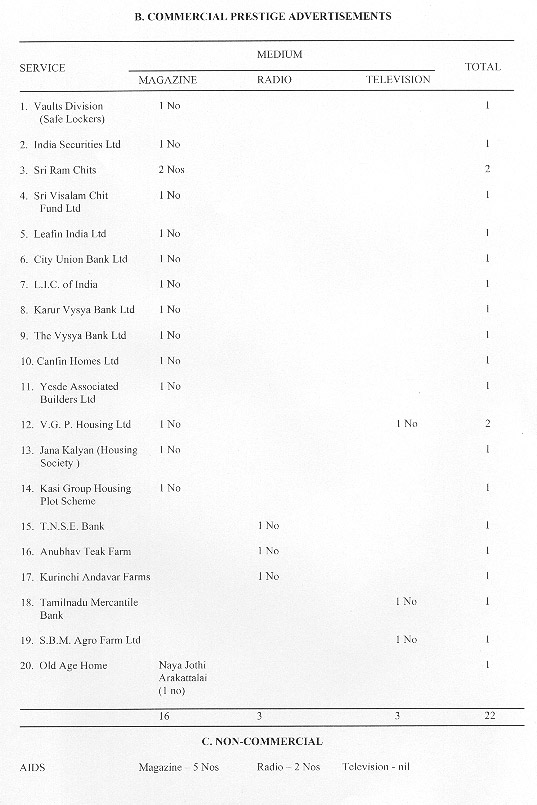
*** *** ***
HOME PAGE |Reconciling Linguistic Diversity: The History and Future of Language Policy in India | Teaching Materials for the Children with Hearing Impairment | English Only, English Plus, and Reconstructing Ethnic Identity Via Language: Language Movements in the U.S.A. | LANGUAGE OF ADVERTISEMENTS IN TAMIL MASS MEDIA | Language News This Month -- Judging Curses | | CONTACT EDITOR
Sandhya Nayak, Ph.D.
Central Institute of Indian Languages
Manasagangotri
Mysore 570006, India
E-mail: sandhyanayak@ciil.stpmy.soft.net