AN APPEAL FOR SUPPORT

- We seek your support to meet expenses relating to some new and essential software, formatting of articles and books, maintaining and running the journal through hosting, correrspondences, etc. You can use the PAYPAL link given above. Please click on the PAYPAL logo, and it will take you to the PAYPAL website. Please use the e-mail address thirumalai@mn.rr.com to make your contributions using PAYPAL.
Also please use the AMAZON link to buy your books. Even the smallest contribution will go a long way in supporting this journal. Thank you. Thirumalai, Editor.

BOOKS FOR YOU TO READ AND DOWNLOAD
- A STUDY ON THE LEARNING PROCESS OF ENGLISH
BY HIGHER SECONDARY STUDENTS
WITH SPECIAL REFERENCE TO DHARMAPURI DISTRICT IN TAMILNADU ...
K. Chidambaram, Ph.D. - SPEAKING STRATEGIES TO OVERCOME COMMUNICATION
DIFFICULTIES IN THE TARGET LANGUAGE SITUATION - BANGLADESHIS IN NEW ZEALAND ...
Harunur Rashid Khan - THE PROBLEMS IN LEARNING MODAL AUXILIARY VERBS IN ENGLISH AT HIGH SCHOOL LEVEL ...
A. Chandra Bose, Ph.D. Candidate - THE ROLE OF VISION IN LANGUAGE LEARNING
- in Children with Moderate to Severe Disabilities ...
Martha Low, Ph.D. - SANSKRIT TO ENGLISH TRANSLATOR ...
S. Aparna, M.Sc. - A LINGUISTIC STUDY OF ENGLISH LANGUAGE CURRICULUM AT THE SECONDARY LEVEL IN BANGLADESH - A COMMUNICATIVE APPROACH TO CURRICULUM DEVELOPMENT by
Kamrul Hasan, Ph.D. - COMMUNICATION VIA EYE AND FACE in Indian Contexts by
M. S. Thirumalai, Ph.D. - COMMUNICATION
VIA GESTURE: A STUDY OF INDIAN CONTEXTS by M. S. Thirumalai, Ph.D. - CIEFL Occasional
Papers in Linguistics,
Vol. 1 - Language, Thought
and Disorder - Some Classic Positions by
M. S. Thirumalai, Ph.D. - English in India:
Loyalty and Attitudes
by Annika Hohenthal - Language In Science
by M. S. Thirumalai, Ph.D. - Vocabulary Education
by B. Mallikarjun, Ph.D. - A CONTRASTIVE ANALYSIS OF HINDI
AND MALAYALAM
by V. Geethakumary, Ph.D. - LANGUAGE OF ADVERTISEMENTS
IN TAMIL
by Sandhya Nayak, Ph.D. - An Introduction to TESOL:
Methods of Teaching English
to Speakers of Other Languages
by M. S. Thirumalai, Ph.D. - Transformation of
Natural Language
into Indexing Language:
Kannada - A Case Study
by B. A. Sharada, Ph.D. - How to Learn
Another Language?
by M.S.Thirumalai, Ph.D. - Verbal Communication
with CP Children
by Shyamala Chengappa, Ph.D.
and M.S.Thirumalai, Ph.D. - Bringing Order
to Linguistic Diversity
- Language Planning in
the British Raj by
Ranjit Singh Rangila,
M. S. Thirumalai,
and B. Mallikarjun
REFERENCE MATERIAL
- UNIVERSAL DECLARATION OF LINGUISTIC RIGHTS
- Lord Macaulay and
His Minute on
Indian Education - In Defense of
Indian Vernaculars
Against
Lord Macaulay's Minute
By A Contemporary of
Lord Macaulay - Languages of India,
Census of India 1991 - The Constitution of India:
Provisions Relating to
Languages - The Official
Languages Act, 1963
(As Amended 1967) - Mother Tongues of India,
According to
1961 Census of India
BACK ISSUES
- FROM MARCH 2001
- FROM JANUARY 2002
- INDEX OF ARTICLES
FROM MARCH, 2001
- NOVEMBER 2005 - INDEX OF AUTHORS
AND THEIR ARTICLES
FROM MARCH, 2001
- NOVEMBER 2005
- E-mail your articles and book-length reports (preferably in Microsoft Word) to thirumalai@mn.rr.com.
- Contributors from South Asia may send their articles to
B. Mallikarjun,
Central Institute of Indian Languages,
Manasagangotri,
Mysore 570006, India or e-mail to mallikarjun@ciil.stpmy.soft.net - Your articles and booklength reports should be written following the MLA, LSA, or IJDL Stylesheet.
- The Editorial Board has the right to accept, reject, or suggest modifications to the articles submitted for publication, and to make suitable stylistic adjustments. High quality, academic integrity, ethics and morals are expected from the authors and discussants.
Copyright © 2004
M. S. Thirumalai
A STUDY ON THE LEARNING PROCESS OF ENGLISH
BY HIGHER SECONDARY STUDENTS
WITH SPECIAL REFERENCE TO DHARMAPURI DISTRICT IN TAMILNADU
K. Chidambaram, Ph.D.
Contents
ABBREVIATIONS
|
% |
- |
Percentage |
|
|
[ ] |
- |
Phonetic Symbol |
|
|
{ } |
- |
Morphemic Symbol |
|
|
�.. |
- |
Pause |
|
|
Adj. |
- |
Adjective |
|
|
Adv. |
- |
Adverb |
|
|
Aux. |
- |
Auxiliary |
|
|
CC |
- |
Communicative Competence |
|
|
ED |
- |
Educated |
|
|
ELT |
- |
English Language Teaching |
|
|
F |
- |
Female |
|
|
HIG |
- |
High Income Group |
|
|
L1 |
- |
First Language |
|
|
L2 |
- |
Second Language |
|
|
LAD |
- |
Language
Acquisition Device |
|
|
LC |
- |
Linguistic Competence |
|
|
LIG |
- |
Low Income Group |
|
|
LP |
- |
Language Performance |
|
|
LSRW |
- |
Listening, Speaking,
Reading and Writing |
|
|
LT |
- |
Language Teaching |
|
|
M |
- |
Male |
|
|
MIG |
- |
Middle Income Group |
|
|
N |
- |
Noun |
|
|
NP |
- |
Noun
phrase |
|
|
O |
- |
Object |
|
|
Oc |
- |
Object complement |
|
|
OD |
- |
Direct object |
|
|
OI |
- |
Indirect object |
|
|
R |
- |
Rural |
|
|
S |
- |
Subject |
|
|
SC |
- |
Social
Context |
|
|
SLA |
- |
Second
Language Acquisition |
|
|
SOV |
- |
Subject Object Verb |
|
|
SVO |
- |
Subject Verb Object |
|
|
U |
- |
Urban |
|
|
UED |
- |
Uneducated |
|
|
V |
- |
Verb |
|
|
VP |
- |
Verb Phrase |
|
DEDICATION
Dedicated
To
My Beloved Parents and Sister
CERTIFICATE
This is to certify that the thesis, entitled A STUDY ON THE LEARNING PROCESS OF ENGLISH BY HIGHER SECONDARY STUDENTS WITH SPECIAL REFERENCE TO DHARAMAPURI DISTRICT, submitted to the Bharathiar University, in partial fulfillment of the requirements for the award of the Degree of Doctor of Philosophy in Linguistics, is a record of original research work done by Mr. K. CHIDAMBARAM, during the period from November 2000 to October 2004 in the Department of Linguistics at Bharathiar University, under my supervision and guidance and that the thesis has not formed the basis for the award of any Degree/Diploma/ Associateship /Fellowship or other similar title to any candidate of any University.
V. Thayalan, Ph.D.
Suprviser, Guide and Chairman, Doctoral Committee
APPROVED BY
Dr. C. Shanmugom Pillai
Professor and Head of the Department of Linguistics
Bharathiar university
Coimbatore 641045, Tamilnadu
India
DECLARATION
I, K. CHIDAMBARAM, hereby declare that the thesis, entitled "A STUDY ON THE LEARNING PROCESS OF ENGLISH BY HIGHER SECONDARY STUDENTS WITH SPECIAL REFERENCE TO DHARAMAPURI DISTRICT", submitted to the Bharathiar University, in partial fulfilment of the requirements for the award of the Degree of Doctor of Philosophy in Linguistics is a record of original and independent research work done by me during from November 2000 to October 2004 under the Supervision and guidance of Dr. V. THAYALAN Department of Linguistics, Bharathiar University, and it has not formed the basis for the award of any Degree/Diploma/ Associateship/Fellowship or other similar title to any candidate in any University.
K. Chidambaram
Signature of the Candidate
ACKNOWLEDGEMENT
I am deeply indebted to Dr. C Shunmugom, Professor and Head, Department of Linguistics and Dean, Faculty of Arts, for permitting me to carry out this study and for his insightful direction and parental affection shown to me for accomplishing the present task.
I express my immense gratitude to my Research Supervisor Dr. V. Thayalan, Reader, Department of Linguistics, for having opened me the door of opportunity to do research under his guidance. He is the torchbearer of the march of my research. He is, in my opinion, a guiding star in the wilderness.
I am also grateful to Dr. C. Sivashanmugam, Professor, Department of Linguistics, for his invaluable suggestions during the course of my study and for his timely help rendered to me whenever I approached him with a research problem. He lavishly spent his time to mould me and to better my academic activities.
I specially thank Dr. C. Sivakumar, Member of the Syndicate, Senior Lecturer, Department of Linguistics, Bharathiar University, for having spent his valuable time to academically and non academically chat with me.
I am extremely grateful to Dr. T. Muthukrishnan, Visiting Faculty (Telugu Chair), for his immense help and valuable suggestion from the beginning of my research work. The drafts were refined and enriched by his insights. I would gladly characterize him as a great scholar in the field of linguistics.
My heart-felt thanks are due to Dr. V. Jaya, Reader, Department of Tamil, Bharathiar University, for her motherly affection shown to me. That enabled me to feel at home even when I am away from my home.
My genuine thanks are expressed to Ms. Brunda Ravikumar, a fellow researcher who patiently went through the drafts of the study. The lucidity achieved in the thesis is largely attributed to her.
The fruitful discussions I had with Dr. K.Ramasamy and Dr. Sam Mohan Lal, Deputy Directors, CIIL, Mysore, and Dr. G. Subbiah, Professor, Department of Linguistics, Madurai Kamarajar University, have to be gratefully mentioned. They helped me in visualizing new perspectives in the area of language teaching. I take this opportunity to record my deep sense of gratitude to all of them.
It is my duty to thank the authorities of the Bharathiar University for awarding me the University Research Fellowship, which enabled me to carryout the research successfully.
I deem it as a pleasure to thank my fellow researchers, Mr. R. M. Bharanitharan, Mr. M. R. Mani, Ms. Rathna Devi, Ms. Kamala Suganya Kumari, Ms. P. Mangayarkarasi, Ms. S. Santhi, Ms. K. Sathiyapriya, Ms. R. Ramya and Mr. A. Chandra Bose who have been rushing to help me always in all ways.
I specially thank Mr. C. Anbalagan, and Mr. K. Sivaprakasam, Research scholars, of the Departments of Zoology and Tamil respectively, for their perennial source of encouragement and constant help.
My thanks are also due to Mr. N. Nanjappan, President, Tamil Nadu Tribal People's Association and N. Mohankumar, Secretary, People's Union for Human Rights Coimbatore, for their moral support and motivation.
I thank all of my friends who extended their helping hands to me directly or indirectly in ameliorating the quality of the present work.
I, with all sincerity, record my sense of gratefulness to my mother Ms. Muniammal, my father Mr. Kuppusamy, my loving sister Ms. Manjula and my lovely brother-in-law Mr. Kuppan. Their blessing, invocation, love, affection and dreams placed me in the high seats of learning to broaden my mental horizon and to acquire academic acumen to accomplish the present task. The present work is, thus, dedicated to them with affection and admiration.
I thank M/s Sree Kumaran Computers for neat execution of typing work and M/s Vasanthi Printers for beautiful binding works.
K. Chidambaram
CHAPTER 1 INTRODUCTION
1.1. Language
Language enables people to express their feelings, ideas, wishes and so on. It is a tool of knowledge through which the worldly knowledge is acquired and preserved, and language is one of the indicators of cultural identity of a linguistic community as well as individual personality. Each language contains its own people's culture and customs. The degree of cultural similarities varies from language to language. Thus, the cultural gap may not be much wider between the languages of a family, but may be much wider between the languages of different families. There exists not only the cultural gap but also variation of linguistic system. Therefore, the process of acquiring / learning a language belonging to another linguistic family includes internalization of culture in addition to the linguistic features of that language.
'Language is the medium through which the child acquires the cultural, moral, religious and other values of society' (Klein, 1986:6).
Further, every language plays a crucial role in maintaining social relationship between and among the people of the same linguistic community and of the various cultures, customs and beliefs.
1.2. First Language and Second Language
A language is 'first'-and so is its acquisition-if no other language was acquired before; otherwise it is second (Klein, 1986:3). Thus, the mother tongue which is acquired primarily by a child when his language cells are empty is first language (L1), and the language which is acquired / learnt in addition to the L1 is second language (L2). In this context, the term 'second' can refer to any language that is learnt subsequent to the mother tongue. Thus, it can even refer to the learning of third (L3) or fourth Language (L4).
Further, pedagogically or from the point of view of language policy of India, the terms 'first language' and 'second language' are defined (Chaturvedi and Mohale, 1976:21) as: The first language, broadly is the language introduced in the school as a subject from grade I to X, and it is commonly used as a medium of instruction at the school level and as a medium of expression by learner in his social communication. It is usually the mother tongue or regional language of the child. The second language is the language which is introduced compulsorily either at the end of primary stage or in the beginning of the lower secondary stage after the attainment of sufficient proficiency in the first language by the learner.
The main objective of the second language is to enable the speaker for wider participation in society and the nation leading to secondary socialization. Hence, the second language is usually the official language of a state or national language.
1.3. Foreign Vs Second Language
The phrase 'foreign language' is used to denote a language that is learnt through instruction where it is not used. 'second language', on the other hand, is one that becomes another tool of communication along with the first language. It is typically acquired / learnt in a social environment in which it is actually spoken or in tutored settings. Thus, English has been taught as a second language in most of the countries, i.e. India, Nigeria, etc., where English has an internal function in all the domains, and in the countries like China, Japan, etc. English is taught as foreign language where English has no internal function, but it is learnt there for employment opportunities and to be adapted themselves with the computerized world.
1.4. Process and Learner Process
The term 'process' which is common in acquisition / learning studies is used in two related meanings. It refers both to the sequence of development (i.e., to the incremental nature of acquisition / learning) and to the factors that determine how acquisition / learning takes place.
Ellis (1985:17) implies that the learner process may be cognitive or linguistic. Cognitive learner processes can be divided into three categories. Learning strategies are used to internalize new L2 knowledge; production strategies are the means by which the learner utilizes his / her existing L2 knowledge, and communication strategies are employed when there is a hiatus caused by the need to communicate a message for which the learner lacks L2 resources. These strategies are general in nature and mediate between the linguistic input and the language that learner produces. Linguistic process involves an universal principle of grammar with which the learner is innately endowed. They provide learner with a starting point. The task is then to scan the input to discover which rules of target language are universal and which are language specific.
1.5. Acquisition Vs Learning
There are different opinions about the acquisition of language and learning of language. Krashen's (1981) opinion is one among them. He distinguishes between 'acquisition' and 'learning'. The former refers to the subconscious process of picking up a language through exposure and the latter refers to the conscious process of studying it. According to this view, if a language is internalized subconsciously through exposure in a natural environment the process becomes acquisition. In contrast, if a language is internalized consciously through instruction in class room settings the process becomes learning. When a language is internalized subconsciously by a learner, he may not have grammatical competence but he may have communicative competence in a particular context, and when a language is internalized consciously by him, he may have grammatical competence, but need not have communicative competence.
1.6. First Language Acquisition Process
There are two different approaches about the acquisition process of language. Linguists like Chomsky and his followers, assume that language is innate, and children acquire only the corpus of the language from the environment and not the structure. Psychologists assume that language is learnt like other behaviors. Further, they claim that both the corpus and structure of language are acquired from environment. However, both the approaches accept the importance of the environment for acquiring a language.
First language acquisition occurs when the learner-usually a child-has been without a language so far and now acquires one (Klein, 1986:4). Hence, the acquiring process of language takes place, subconsciously in a social environment, in several stages. The studies (Dromi, 1979; Ingram, 1989; Redford, 1990) reveal the stages of acquiring first language. Those stages are prelinguistic stage, single word stage, early multiword stage, later multiword stage. In the later multiword stage, children produce unlimited number of sentences using their linguistic competence.
1.7. Second Language Acquisition Vs Second Language Learning Process
'Second language acquisition' (SLA) is used in the applied linguistic studies to refer to the internalization process of an L2 through exposure in a social environment where the real communication takes place; where the learner focuses on only meaning not the structure of L2. For example, a prototypical case is that of an Indian tribal man who settles in New York city not knowing even a single word of the local language and who manages to acquire through his sporadic and systematic social interaction with the broader society. Whereas, the 'second language learning' is used to refer to conscious study of an L2; the focus of learning is both on structure and pragmatics of the L2.
Further, Ellis (1986:6) says that second language acquisition is the subconscious or conscious process by which a language, other then the mother tongue, is learnt in a natural or a tutored setting. It covers the development of phonology, lexis, grammar and pragmatic knowledge.
1.8. Spontaneous Learning Vs Guided Learning
Klein (1986:16-20) has distinguished the internalization of L2 as spontaneous learning and guided learning. The term 'spontaneous learning' is used to denote the intake of second language in everyday communication in a natural fashion, free from systematic guidance. And 'guided learning' is used to refer to the systematic and intentional intake of L2 through regular language instruction in the schools.
Further, Ellis (1994:12) has distinguished the process of internalizing L2 as 'naturalistic' and instructed. The former refers to the internalization of L2 through communication, which is naturally occurring in social situation. Later refers to intake of L2 through study with the help of 'guidance' from reference book or classroom.
Hawkins (2001:18) differentiates the process of L2 intaking on the basis of the sample of second language data presented to the learner or the input, and the way that L2 learners respond to that input as 'classroom learning' and 'naturalistic learning'. Further, he argues that the input environment may be different, but classroom learning is not itself a homogeneous one. Some classrooms may be very formal, in the sense that emphasis is placed on the conscious learning of grammatical properties of the L2 via instruction, with reinforcing drills, exercise, translations and so on. Others may be communicative, where emphasis is placed on using the L2 naturally to communicate speaker's intentions, rather than on considering the properties of the language itself. Classroom input to second language learners can be quite different from naturalistic input available and also vary from one classroom to another.
1.9. Language Acquisition Device
Chomsky's (1959, 1965, 1975) proposition is that the acquisition of the structure of language depends upon an innate recognition device. He calls it as language acquisition device (LAD). That is, in effect programmed to accept its surface structure of any natural language as input and to recognize its deep structures by virtue of the kinship of all natural language to an universal deep structure that human beings know innately.
Hence, Chomsky argues that any normal child comes to know the grammar of the native language within an amazingly short time span. This cannot be accounted for in the framework of behavioristic learning theories of the kind postulated by Skinner (1957) for verbal behavior. So, one has to assume that human beings are endowed with a language acquisition device which:
- is species-specific, i.e. distinguishes man from other species,
- is specific for language learning as opposed to the acquisition of other forms of behavior or knowledge,
- prestructures the properties of grammar to an extent (consequently many structural properties of grammar are innate and need not be learnt.
The most important one in this context is item 'c' which claims that certain structural properties of grammar are innate. The language data available to the child serves to activate the latent components of grammar.
The general form of a system of knowledge is fixed in advance as a disposition of the mind and the function of experience is to cause this general schematic structure to be realized and more fully differentiated (Chomsky, 1965:51-52).
The obvious conclusion is that each new born baby is capable of acquiring any human language, and the innate structures of language must be common to all languages, and these constitute what Chomsky calls universal grammar. However, the specific features of each language, as for instance those that distinguish Tamil from English, must be differed from the data made available to a child in the course of first language acquisition.
1.10. Competence and Performance
Linguistic creativity is the ability of a native speaker to produce and comprehend sentences of the language which he has never heard before, and he can produce unlimited novel sentences which are grammatical, and he is assumed to be able to distinguish from ungrammatical ones. This reveals that he has inherited knowledge more than an accumulation of previously heard utterances. Chomsky (1965) argues that a native speaker has innate knowledge about the structure of his language which operates him in his language use. He calls this knowledge as linguistic competence. He distinguishes this from language performance; the use of his language by a native speaker in a particular social context.
The way in which Chomsky visualizes linguistic competence and language performance can be represented schematically as:
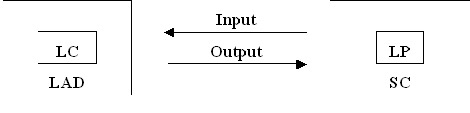
LC-Linguistic competence, LAD-Language Acquisition Device, SC-Social context, LP-Language performance.
The diagram shows that the linguistic competence is embedded in LAD. The LAD receives input, the language data, from the society, and using this input the linguistic competence which is in the LAD generates the grammar of the language (performance) in social context.
1.11. Second Language Acquisition/Learning Theories
Theories of SLA talk about the acquisition/learning process of L2 in different ways. Some of the important theories are short listed as follows.
1.11.1. Contrastive Theory
The contrastive theory claims that the acquisition of a Second language is largely determined by the structure of an earlier acquired language. Those structures, of the Second language that coincide with corresponding structure of the first language are assimilated with great ease as a result of 'positive transfer'. Contrasting structures on the other hand, present considerable difficulty and give rise to errors as a result of 'negative transfer' or 'interference'.
Identity theory is contrasted with the contrastive theory which asserts that the acquisition or availability of language has little or no influence on the acquisition of another language. Thus, in other words, first and second language learning are basically one and the same process governed by the same law.
1.11.3. Acculturation Theory
According to the acculturation theory, SLA is determined by the degree of social and psychological distance between the learner and the target language culture. That is, the social factors like situation, social relationship with the target language group. Psychological factors like language shock, (the learner experiences, doubt and possible confusion when using the L2) cultural shock, (the learner experiences, disorientation, stress fear, etc. as a result of differences between his own culture and that of the target language community) motivation, and ego boundaries play major role in the process of acquiring/learning of L2.
1.11.4. Monitor Theory
According to the monitor theory, the learner gains proficiency in a Second language in two ways: 'subconscious acquisition' and 'conscious learning'. The former focuses on only meaning not the form whereas the later refers to the internalization of explicit rules under conscious control. The crucial point of the theory is that 'learning' in this sense is always effected through a 'monitor', or an effort on the part of the learner to control his language output and to self-correct it whenever necessary. We can enumerate three conditions that decide the effective use of monitor:
- Time. There must be enough time to operate learned rule.
- Focus on form. The speaker must be concerned with correctness or with the form of the output.
- Knowledge of rules. The speaker must know the rules. The monitor does its best with rules that are simple in two ways. They must be simple to describe and they must not require complex movement and rearrangements.
1.12. Teaching English as a Second Language
Realizing the importance of English, it has been taught in the schools and the colleges as second language or third language compulsorily in India in general and in Tamil Nadu in particular English has been included as one of the subjects in school and college curriculum and also occupies as a medium of instruction in certain schools, Hence, it is the predominant tool of instruction in higher studies.
In the state board schools, English has been introduced as one of the language subjects from the third standard along with other subjects, and it is the medium of instruction in certain schools of the state board after primary education. In the matriculation schools, English is the medium of instruction in addition to the English language subject where all the subjects i.e. science, social sciences, commerce, etc. are taught through English starting from the primary education.
Further, the higher secondary English syllabus includes the prose, poetry, grammar exercises, listening and reading comprehensions, speech practice and communication and other tasks. The teaching of English as a second language at higher secondary level aims (as the preface of the higher secondary text reveals):
- to develop abilities of young learner in terms of right expression and apt communication in English,
- to develop appropriateness and fluency in both oral and written expressions,
- to enhance reading and listening comprehension ability, and
- to inculcate in the learners mind, the sense of aesthetics, appreciation, human values and administration things, beautiful and joys.
1.13. Language Skills
Learning a language comprises of four skills. They are listening, speaking, reading and writing (LSRW). The former two skills are known as oracy and the later two are known as literacy; both oracy and literary form linguacy.
Among these four skills, listening and reading are used as the channels of receiving Information. Thus, these two skills are called as receptive skills.
The remaining two skills, speaking and writing, are used as channels of sending information. Thus, these two skills are labeled as productive skills.
1.13.1. Listening Skill
Listening is a prerequisite to other skills of language. The activity of listening is not an act of just recording the speaker's utterances and repeating them as a tap recorder as they are. It is a process of making meaning out of spoken language. Listening involves:
- receiving the systematic sounds of the language,
- processing and constructing sounds into words,
- giving meaning to the words and getting meaning from the words received,
- ability to interpret and comprehend the speaker's utterances, etc.
1.13.2. Speaking Skill
Speaking is a more complex skill than listening. It is an act of creativity.
In addition to knowing the language, the speaker must think of an idea he wishes to express, either initiating the monologue, or conversation or responding to previous speaker. The activity of speaking involves:
- the consciousness of the grammatical, lexical and cultural features of the language,
- ability to speak without grammatical errors,
- where, when, why, how, what to speak awareness,
- correct pronunciation and ability to present in understandable way, etc.
1.13.3. Reading Skill
Reading is nothing but an understanding of written symbols which consist of recognition and comprehension skills. To perform the reading activity one should have:
- the knowledge of the language,
- the knowledge of the writing system,
- ability to recognize the phonemes,
- the ability to interpret and comprehended the texts, etc.
While reading, a reader interacts with a text, decodes it, and constructs meaning in the process. The reading activity updates one's knowledge and it is an important tool for academic success.
1.13.4. Writing Skill
Writing is the process of conveying one's thought through written symbols. It is a difficult process. The writing skill includes:
- ability to shape the letters,
- ability to convert the ideas using the written symbols,
- ability to write without grammatical errors,
- ability to present and organize in a readable fashion, etc.
All these four skills of language are the bases for communication. Hence, they form the base for the language proficiency-the ability to use the knowledge in different tasks.
1.14. Statement of the Problem
It is indeed bitter to notice that even though various serious efforts have been taken by the educationalists for improving the state of affairs of English language teaching for the past few decades in India in general, in Tamil Nadu in particular, a sorry state of affairs is still found to exist in the achievements of English linguistic behaviour among the students of all levels. So, it is really imperative to unearth real reasons behind the poor achievements of the students in English. Before that, it is also important to identify the level of achievement by the students in all skills of the English language and the problems, they encounter in the process of learning English.
1.15. Review of the Literature
There are many works wriiten on this line. Some of the important works are reviewed here.
Kothainayaki (1994) has observed the classroom interaction in second language teaching among students and teachers in VI, VII and VIII standards. She has observed, in her study, some of the pattern of teacher - students and student - student interaction both in side of the classroom and out side of the classroom. Further, she has investigated the errors in the use of articles, prepositions, particles, etc.. Hence, she recommends that grammar teaching should have been started right from the first standard and enforcing the lot of grammatical drills will enhance the students interpersonal communicative competence.
Karthiyayani (1995) has studied the reading comprehension of the students studying at the higher secondary level. She has found, that the reading performance of the students in English (L2) is better when the answers are explicitly stated in the passage, and the students found difficulty if the answers scattered in the passage. Further, she has observed that the parental economical position and the students previous academic record play a crucial role in the performance of the students, but the gender and location play a less roll in the performance of the reading comprehension of the students.
Nisha (1995) has investigated the areas of hindrance in acquiring communicative competence and the areas of incompatibility between the language syllabus, language teaching and linguistic performance of the first year degree students in English who had Tamil as medium of Instruction. She has identified some of the communication strategies followed by the learners when they had encountered problem in the process of communication. Further, her study reveals that the socio - economic factors play less role and parental education, situational and psychological factors play a crucial role in the advancement of the communicative competence of the learners.
Baskaran (1996), in his study, has investigated the orthographical errors in second language committed by the under graduate students. He has identified the errors due to addition, omission, substitution and inversion of the spelling. Further, the orthographical errors due to L1 influence also have been specified in the study. Hence, he recommended that the spelling drill with special emphasis on confusing words and practice of dictionary-using will lessen the orthographic errors in writing of the students.
Ravi (1998) has explored the motivational problems in teaching - learning English as a second language at the high school level with particular reference to the 6th, 7th, 8th standards. This study revealed that the motivational problems are relatively less in the higher classes than that of the lower classes. Further, he has also identified that the quantum of vocabulary used in the text books also determines the quantum of motivation achieved.
Rangasamy (1998) has evaluated the techniques of teaching English, text materials used for the higher secondary students and their performance in speaking and writing. He has identified, in his study, the phonological, grammatical and discourse based errors. Based on his finding, he has suggested that the examination should test the mastery of the students over the four skills of language including spelling test, word building, grammar, phonology, reading and writing comprehension. Further he recommended that the text should contain more lessons written by Indian writers and the poems should be minimized in the text.
Chandran (1999) has investigated the communicative ability in speaking English of the higher secondary first year students. He has identified, in his study, the phonological, lexical and grammatical errors, and also he has proved that the communicative ability of speaking of the students with English as their medium of instruction is better than that of the students of Tamil medium. Further, he recommended that the syllabus designers and material producers may give top most priority for the communicative activities in the syllabus so that the learners would develop the acquired knowledge.
Jayanthi (2002) has observed the classroom interaction of the graduate students. This study revealed that the factors like smartness of the students, shyness, evaluative, capacity, commitment, psychological conditions, observation of world knowledge, time factor, interactional awareness, interaction with text, etc., play some role over the effective and efficient interaction of the students. Further, she has said shyness of the students' psychological conditions of the students especially past failures, etc. lead to the avoidance of the interactive performance and other above said factors enhance the interaction of the students in English literature Teaching classes.
Subramanian (2002) has evaluated the linguistic skills of the graduate students in English. He has evaluated all the four linguistic skills, listening, speaking, reading and writing. However, he has dealt within detail only the writing skill of the graduate students. He has identified, in his study the phonological, grammatical and orthographical errors in productive skills and in the comprehension skills he has identified the recalling ability of words and sentences. Moreover, he recommended that the group discussion, language games should be encouraged in the class hours and introducing the audiovisual instrument for language teaching would be good and wise at collegiate level.
Sobana (2003) has explored the communicative competence in written English among secondary students. She has evaluated the competence based achievement of the students on the basis of the marks obtained by them to the given tests items like identification of sounds and letters, identification of word meanings, application of word meaning in sentences, letter writing and composition. Further, the study revealed that the instruction and parental economical and educational background have a direct impact on the competence based achievement and ability to use written English.
All the above mentioned works have not studied the learning process of English adopted by the higher secondary students. Thus, the present study is made on this subject.
1.16. Aim and Scope of the Present Study
The present study thus tries to identify the performance and areas of problems in the process of learning of four linguistic skills of English language by the higher secondary students studying in the schools of Dharmapuri District and to suggest certain remedial measures to overcome the problems or hindrance encountered by them.
1.17. Objectives of the Study
- To identify the communication strategies adopted by the L2 learners whenever they find linguistic gap, and while they encounter the problems during the process of learning the oral communication.
- To identify the inter and intra lingual communication strategies adopted by the students while making oral communication and to evaluate their speaking skill.
- To identify the problems encountered by the students in the process of learning the writing skill.
- To identify the L1 interference on L2 writings of the students.
- To evaluate the reading ability of the students.
- To identify the students' understanding capacity of the vocabulary and discourse in the process of reading comprehension.
- To evaluate the listening ability of the students.
- To identify the students' recognizing ability of sounds, vocabulary, grammar, number and information in the process of listening comprehension.
- And to suggest remedial measures to improve all the four skills of English.
1.18. Hypotheses Tested
The following null hypotheses have been drawn keeping in view with the data collected.
- The medium of instruction has direct impact on the achievement of second language skills.
- None of the variables (sex, region, parental education and income) plays any role in the development of second language skills.
- If a student is better in listening, he will be better in speaking only, and if a student is better in reading, he will be better in writing only.
In order to validate the hypotheses 1 and 2 the variables medium of instruction, sex, region, parental education and income were identified and for the hypothesis 3, the mean scores of the students performance in each skill is considered.
1.19. Coverage of the Present Study
The present work tries to study language skills of the students who are studying in higher secondary classes of various schools of Dharmapuri District of Tamil Nadu, India. Both the matriculation and state board schools have been covered for the present study. Certain important social variables have also been considered for the present study. Reason for the selection of this district is that it is a socially, economically, and educationally backward one.
1.20. Limitation of the Study
As said earlier, the present study covers only the students studying in the Dharmapuri District. Effort has not been taken to evaluate the text book, the teaching methods, teacher, etc. Only the students performance in the English language, communication strategies adopted and problems encountered by the learners have alone been taken into consideration, and the remedial measures for all the problems identified have been suggested centering and focusing the students.
1.21. Social Relevance of the Study
- Since the present study concentrates on all the four skills of the English language, it will present a total picture about the English language of the higher secondary students.
- As it also talks about the process of English learning by the higher secondary students it will find reasons for some of the learning problems of English. Based on the findings of the present study, certain apt remedial measures can be advocated.
- In the Indian educational span of the students, the stage of the higher secondary class plays a crucial role which determines the students further and future education. This terminal course should provide the students a strong foundation for their English language development. Therefore, English has to be properly developed for strengthening it. The present study therefore gains a social vitality and validity as it provides enough insights about the English learning of the higher secondary students.
1.22. Selection of the Sample for the Study
For the present study, 300 students (both XI and XII taken as a unit) have been selected from five matric and five government higher secondary schools located in different areas of Dharmapuri District. Considering the variables of the present study, 30 students from each school have been selected at random.
|
S. No. |
Name
of the schools |
Medium of
instruction |
Number of
the students selected |
|
Boys
|
Girls
|
|||
|
1. |
Athiyaman Govt. Boys
Higher Secondary School. |
Tamil |
30 |
- |
|
2. |
Avvaiyar Govt. Girls
Higher Secondary School. |
Tamil |
- |
30 |
|
3. |
Seventh Day Matric Higher
Secondary School. |
English |
15 |
15 |
|
4. |
Good Shepherd Matric
Higher Secondary School. |
English |
15 |
15 |
|
5. |
Government Boys Higher
Secondary Schools, Pennagram |
Tamil |
30 |
- |
|
6. |
Government Girls Higher
Secondary School, Pennagram |
Tamil |
- |
30 |
|
7. |
CBM Matric Higher
Secondary School |
English |
15 |
15 |
|
8. |
Government Higher
Secondary School, Banda Hally. |
Tamil |
15 |
15 |
|
9. |
Vijay Vidyalaya Matric
Higher Secondary School for Boys |
English |
30 |
- |
|
10. |
Vijay Vidyalaya Matric
Higher Secondary School for Girls. |
English |
- |
30 |
1.23. Variables of the Study
For the present study, sex, region, economical position of the parents, parental education and medium of instruction have been taken as variables.
The variables are further divided as in the table.
|
S. No. |
Variables
|
Sub � Division
|
|
1. |
Sex |
1.
Male 2.
Female |
|
2. |
Region |
1.
Rural 2.
Urban |
|
3. |
Economical position of the
parents |
1.
Low income (below 5000) 2.
Middle income (5000, to
10,000) 3.
High income (above 10,000) |
|
4. |
Parental education |
1.
Literates 2.
Illiterates |
|
5. |
Medium of instruction |
1.
Tamil 2.
English |
1.24. Methodology of the Study
The present study adopts certain modern methods and approaches available in the field of linguistics in general and applied linguistics in particular. They are:
Questionnaire method. For the present task, four questionnaires (each one for each skill) have been prepared and the students have been tried out in the field through pilot study and based on the results drawn through the pilot study, the questionnaire have been modified and finalized. The finalized questionnaires were used for data collection (Questionnaires are added in the appendix).
Interview method also was adopted to carryout the study. Thus, a structured questionnaire was used to elicit data from the students through interview method, (or) conversation, and the responses of the students were recorded using the tape recorder (Questionnaire - I).
Observation method. Along with the questionnaire and interview methods, observation technique was followed with the aim of filling the gap in the corpus drawn by the questionnaire and interview methods.
Personal data sheet. In addition to the above tools, a personal data sheet was developed to collect the information from the students related to the variables included for the investigation.
1.25. Data Elicitation
The finalized questionnaires were administered with the informants and the testing procedures were carried out in two phases. In the first phase, speaking and writing tests were conducted. The questions which were constructed in the interview schedule were asked and then the students were instructed to speak on any one of the given topics or of their own interest. The responses of the students were also recorded using a tape recorder. For these two types of speaking tests,30 minutes were allotted (20 and 10 minutes respectively). After 15 minutes gap, the writing test questionnaire was given and for that 40 minutes were allotted.
After two days gap in the second phase, the reading and the listening comprehension tests were carried out. To test the reading comprehension, the questionnaire of reading comprehension was given to the informants. For this test 20 minutes were allotted. After the completion of reading test, the listening comprehension questionnaire was given. To test the listening comprehension of the students, the answer sheets were given separately to the informants and then the listening questions were posed to the students using tape recorder and in certain circumstances questions were read out by the researcher.
Further, instruction about the each questionnaire was given to the students. In this way, the data collection was carried out in all the schools under study. In addition to this, the students-teachers classroom interaction, and peer group interaction were observed and their quarterly, monthly test papers were also examined. Moreover, data have also been updated then and there in order to fill the gap found in the corpus and to verify the authenticity of the data.
1.26. Analysis of Data
The data collected for each skill viz. speaking, writing, reading and listening were processed and analyzed separately. The speaking performances of the students recorded during the field works were transcribed and then the transcribed items were analyzed keeping in view with the finding communication strategies followed by the students while they encountered linguistic gap and the strategies were classified. The data of writing skill were systematically analyzed and errors were identified and classified in all the linguistic aspects of L2. The data of reading comprehension and of listening comprehension were analyzed and classified as comprehensible and non-comprehensible items. Eventually, the remedies were given for all the problems encountered by the students in the process of leaning English. The detailed analysis of the data, discussion, findings and remedies are presented in the succeeding chapters.
1.27. The Scoring Procedure
For every skill, the percentage of the score was calculated as follows:
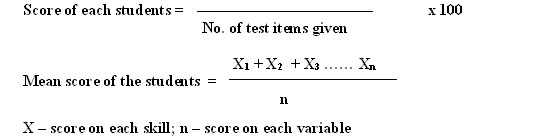
1.28. Plan of the Study
This present study entitled "A study on the learning process of English by higher secondary students with special reference to Dharmapuri District" contains the following chapters.
Chapter 1 : Introduction
The introductory chapter of this study begins with a general introduction on language, then it talks about various views of the first and second language, acquisition / learning, language acquisition device, competence and performance, second language learning theories, skills of the language, statement of the problem, review of the literature, aim and objectives of the study, variables of the study and plan of the study.
Chapter 11 : Speaking Skill
The second chapter presents a general view on communication, process of communication, definition of communication strategy, communicative competence data analyses and communication strategies followed by the students and provide apt remedies for eliminating the problems encountered by the students in the process of learning oral communication.
Chapter III : Writing Skill
The third chapter provides a general introduction on writing, various definitions of writing, the process of writing, loss in encoding and decoding process etc. It also presents the analyses of the errors in the use of Articles, Preposition, Pronoun, adjectives, noun and numbers, verb, adverb, auxiliary, verb, concord and syntax and provides the general problems encountered by the students in writing and suitable remedies for solving those problems.
Chapter IV : Reading Skill
The fourth chapter brings out the general introduction on reading, various definition of reading, process of reading, types of reading, teaching / learning reading etc. After that, it presents the analyses and problems / difficulties encountered by the students in reading comprehension and finally gives appropriate remedies to the problem encountered by the students in the process of reading comprehension.
Chapter V : Listening Skill
This chapter presents the general view on listening and listening process. then it talks about the types of listening, sub-skills of listening, difficulty factors in the process of listening, data analyses, the problems and difficulties encountered by the students in the process of listening comprehension, and at the end it gives relevant remedies for those problems.
Chapter VI : Conclusion
The concluding chapter presents the findings of the present study and tests the hypotheses. It also advocate remedies for those problems and the areas to be explored further in this field.
CHAPTER 2 SPEAKING SKILL
2.1. Introduction
Speech is the first and foremost form of communication. It occupies a predominant position in enlightening the minds of the people. Information is understood and processed easily through speech rather than writing. Speech is a biologically endowed behaviour of human beings.
Speech is an activity. Whilst language is the structural pattern of system we use to convey our message in speech. The pattern of the language exists of words and of the structured relationship between words and phrases, which is known as grammar (Mitchel, 1973: 1)
Spoken language has wider range of functions to perform than the written language. They start from casual spontaneous conversations ending with formal speeches and so on. Written language tends to serve rather specialized functions at the formal level.
One may possess mono-or bi-or multilingual potentiality. He may express his inner speech fluently through all the languages he knows. But, a monolingual cannot express his views other then the L1. If he wants to become a bilingual, he should learn a language in addition to his L1. The additional or second language may be learned in school atmosphere or in society where it is used in real communication. Learning/acquiring spoken mode of an L2 is different from that of L1 as said earlier. If an L2 user has linguistic skills to steer the language fluently with the native speaker of that language, he may be considered as an actual speaker of that language, otherwise he is not. In the process of learning spoken mode of L2, the learner encounters difficulties because of the inter and intra lingual factors, language shock, cultural shock and so on. However, difficulties and problems are inevitable in the process of learning spoken or written mode of the L2.
2.2. Process of Communication
The term "communication" can be defined as the process through which inner speech of the communicator is conveyed to others. This process can be termed as human communication or oral communication. The activities of the communication maintain ecobalance, co-operation, tolerance, and bring the people in a common line.
Speech is the great method through which human co-operation is brought about. It is the means by which the diverse activities of man are co-ordinated and correlated with each other for the attainment of common and reciprocal ends (De Lauguna, 1927: 19).
The complete communicative process is the hierarchial arrangement of the various components of communication. They are as follows:
a. Intended message
b. Encoder
c. Signals
d. Decoder
e. The received message
In order to explain the above components in a nut-shell, it can be thought that the intended messages can be abstract ideas and feelings of speaker who whishes to communicate. The encoder is the person who has intended messages in the form of words and gestures. Signal is the encoded message transmitted in the form of the mechanical impulse. Channel is the medium through which a signal travels. Decoder is the person who receives communication signals into meaning and ideas. Received message is the result of decoding communication signals. Psychologically speaking, after receiving the message, the nervous system of the receiver is activated and subsequently interpreted, and appropriate meanings are assigned to the received codes to make the communication process complete.
2.3. Communicative Competence
The term 'communicative competence' is viewed by the scholar (Hymes, 1961) as the competence in communication which covers all modes of competence in linguistic behaviours by the speech community. This includes both social and grammatical behaviours. The term 'all modes of communication' (Hymes, 1962) can further be explained as the language competence that has total comprehension, and total verbal exposition in all modes of society, which includes group interaction - interpersonal interaction involving different dialectal areas. Also, the verbal exposition will encompass the non-verbal behaviour which has cultural compatibility. As it is evident from the above, one can think of two different kinds of competence, namely, grammatical competence and communicative competence.
The term grammatical competence is one which can be achieved by way of exposing one to the structure of language; whereas, the communicative competence can be achieved by exposing onself both to the structure of the language as well as the social behaviour which pivots around certain conventional rules as put forth by the society.
Richard (1979: 169) says that linguistic competence is a part of communicative competence as explained digramatically.
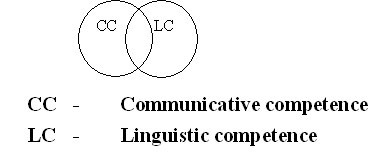
Hence, communicative competence is not just concerned with the tacit knowledge of language structure, but to expose them through performance in producing and understanding an infinite sets of sentences in real day-to-day life situation using the social experience.
2.4. Teaching / Learning Speaking
The development of spoken language is not merely expressing the structure of language. The development of spoken language involves the development of pragmatic usage in addition to the development of pronunciation, constructing words, phrases, sentences and discourses. Discourse in learning of second language, plays a vital role. The teaching of second language fulfills when the learner comes to know how the second language works in discourses. Barns and Seidlhofer (2001: 211) say that 'learning speaking involves developing subtle and detailed knowledge about why, how and when to communicate, and complex skills for producing and managing interaction such as asking question or obtaining in turn'. It is viewed commonly by the applied linguists that the second language is learned as the first language learning. The stages of the learning the speaking skill of L2 are same as learning of speaking L1. The problems encountered by the learners in the process of learning subtle, and detailed knowledge, show the gradual development of spoken language. The purpose of the learning second language fulfills when the learners use language with the real people for real purpose.
2.5. Communication Strategy
Communication strategy is a systematic attempt by the learner to express or decode meaning in the target language in the situations where the appropriate systematic target language rules have not been formed (Tarone et al., 1983: 5). Earlier it was called by Tarone and her colleagues (1976) as production strategy. Ellis (1985: 182) defines 'communication strategies are psycholinguistic plans which exist as part of the language user's communicative competence. They are potentially conscious and they serve as substitutes for production plans which the learner is unable to implement'. In the process of learning speaking, the learners adopt some kind of strategies like drawling, self repairing semantic avoidance, etc., to conceal their linguistic inadequacy as well as to achieve the task of communication. Various scholars (Tarone, 1980, Blaly Stock, 1984, Fzerch and Kasper, 1980) have formulated different typologies for the types of communication strategies adopted by the learners.
Cook (2001) says that the learners adopt certain strategies when they try to express things just beyond their current level of functioning L2. Further, he says communication strategy of L2 learners will enhance the learning', and the learners' strategy indicates that the learners are encountering the linguistic problems in the process of learning. The learners knowingly and unknowingly use the inter and intra lingual strategies to convey their message to others. But, they fail to convey the message as they are intended due to their linguistic inadequacy. By using the strategy they get satisfaction, assuming that they have conveyed the meaning completely to the questions asked by the researcher. The learners adopt the strategies whenever they encounter problems at all the levels of language like phonological, morphological, syntactical and discourse.
Further, Cook says that the conceptual strategies are not same as those used in native speech when speaker cannot remember the word he wants to use. That is, while describing the parts of his car need to be repaired to a mechanic, he says there is oil dropping from the sort of junction in the pipe behind the engine. This is an analytic strategy; this strategy allows him to communicate without knowing the correct words. This does not mean that the speaker adopts the strategy not because of his linguistic inefficiency. But the strategies followed by the L2 learners are different from the native speaker's strategy cited above.
2.6. Learning Strategy
Learning strategy is an attempt to develop linguistic and sociolinguistic competence in the target language (Tarone 1983 : 67). The strategy of learning adopted by the learner is different from communication strategy. The strategy of learning differs from learner to learner. However O'malley and Chamot (1990) have defined three types of strategy used by L2 students:
- Metacongnitive strategies involve planning and thinking about learning such as planning one's learning, monitoring one's own speech or writing, and evaluating how well one has done.
- Cognitive strategies involve conscious ways of tackling learning, such as note-taking, resourcing (using dictionaries and other resources) and elaboration (relating new information to old).
- Social strategies mean learning by interacting with other's, such as working with fellow students or asking the teacher's help.
2.7. Strategy - Process
Strategy is being used interchangeably with process . Strategy refers to the way the learner arrives at a certain usage at a specific point in time. Process being used with reference to the systematic series of steps by which the learner arrives at the same usage overtime. Bialy Stock (1978) distinguishes process from strategies by the criteria obligatory / optional. Process being obligatory, strategies, optional mental activities. Similar criteria are used by Fravefelder and Porqurer (1979) who classify process as universal, strategies as optional mechanism employed by individual L2 learners. Other researchers also defined process as continuing development involving a number of changes.
2.8. Testing Speaking
In second language research, a great deal of attention has been paid to related area of communicative behaviour. So, this chapter concentrates on communication strategies of the L2 learners. Further, communication strategy is not dealt with in this chapter as a learner's ability to communicate effectively and efficiently. It is only a tactic followed by the learners to conceal a gap in their communication. So, the objectives of the chapter is to test and identify when and how the learners make use of such strategies in speech.
2.9. DATA ANALYSIS
2.9.1. Avoidance
It has been observed that 7% of the selected informants avoided to speak or talk with the researcher in English. Reasons for the avoidance are that the learners do not want to show their inadequacy in the second language to others. So, to conceal their linguistic inadequacy, the learners follow the strategy of avoidance. Further, the anxiety, language shock and culture shock are yet another factors which lead them to the use the strategy of avoidance.
2.9.2. Syntactic Avoidance
Sentence avoidance is a strategy adopted by the learners to conceal their linguistic inadequacy. Upon questioning, the student has given one word answer instead of constructing sentence or giving complete answers as mentioned below.
happy
In response to
� What will you do if you get first rank in twelfth standard?
Serve poor
In response to
� What will you do if you become a doctor?
Stay home
In response to
� What will you do if it rains while going to school?
Join engineering
In response to
� What will you do if you don't get admission in the medical college?
The above samples are a part of conversation taken place between the researcher and the learners. Before starting the conversation, the students were instructed to respond elaborately to the questions. But, the students responses are in elliptical form instead of giving elaborate response. For example, some students' response is 'happy' for the question what will you do if you get first rank in twelfth standard ? The question itself expects answer in complex form; such as, if I get first rank, I will be happy, etc. The expected answer will be a complex sentence consisting of a main clause and a subordinate clause. Of course, the subordinate clause is not imperative as it exists in the question itself; however, the main clause which only carries the expected answer is obligatory. The student without taking risk of producing or repeating the sentence, the crux of meaning was conveyed by using only one words 'happy'. This, in a way, serves the purpose, but the task placed before the students was to produce sentence.
In the similar way, they responded to all questions in an elliptical form. So, it is evident that they have followed the strategy of sentence avoidance to conceal their linguistic inadequacy. And also, it is found that they have not experienced in the conversational English. Further, it is identified that about 38% of the students understudy have avoided to form complex as well as even simple sentence in the conversational discourse and that were compensated by using one word answer.
2.9.3. Semantic Avoidance
The learners evade from communicating a given content for which appropriate target language rules and forms are not available to them by talking related concepts which may presuppose the desired content.
Samples
My father go � in bike go to school
for
� What will you do if it rains while you are going to school?
I think that is first step
for
� How do you feel if you go to School?
Happy
for
� What will you do if you become a doctor?
The above samples show the semantically non co-operative relationship between the question of researcher and the response of the learners. The learner responded as 'my father go� in bike go to school' for the question what will you do if it rains while going to school?, and the response 'I think that is first step' is also semantically deviant one for the question 'How do you feel if you go to college? So, these examples show the fact that the learners for certain questions could not co-operate semantically in the conversational discourse with the researcher. Reasons for this kind of semantic avoidance are the learners linguistic inadequacy as well as ignorance of the pragmatic and semantic norms of L2 utterances they received. There are 29% of the learners who have followed the semantic avoidance strategy in their communication.
2.9.4. Literal Translation
The learners follow word for word translation from the native language to L2. The samples from the corpus are as follows.
1. My evening is cricket play.
na:n ma:laiyil krikettu vilaiyatukire:n
my - na:n
evening - ma:laiyil
cricket - krikettu
play - vilaiya:tukire:n
I play cricket in the evening times.
2. I am � very like the teacher's work
enakku mikavum pitittatu a:ciriar ve:lai
I - enakku
very - mikavum
like - pitittatu
teacher - a:ciriyar
work - ve:lai
I like teaching very much.
The appearance of word - for-word translation, while producing second language structure is due to the L1 interference. The learners relate the L1 words with the L2 words which are stored in their mental dictionary without considering or realizing the sentence structure of L2. Thus, the learners tend to express what they intended to say by translating the word for word applying the L1 structure as shown in the above sample. It is found that 33% of the students have adopted this strategy in their communication.
2.9.5. Fillers
In certain cases the students use the fillers to conceal the internal process taking place in the inner minds of them. The fillers may be of the user's pet words or expression which literally do not carry any meaning. The Tamil speakers also avail such fillers like appuram, marantupo:cci, vantu, etc., and a sound like mmmm., by which users take time to get the word they search for.
- It also estimate the cost of the buildings. mmm... appuram� the main aspect is the computer is graphics.
- It can be recorded many programmes and it can be recorded many programmes and it listed out many programmes � mmm� marantupo:cci � many programmes �appuram � ummm. that computer can type out the message.
- I will try to� get� then I will try to get mmm� the more � ennacolratu � then I will try my best for India to develop India first rank good country in the world.
The samples indicate that the students initiated to speak on a topic, but while they face difficulty in the process of communication, they use sounds like mmm� and then L1 words like appuram, marantupo:cci, ennacolratu, vantu etc., then again they continue their speech. So, the use of fillers indicates the learners' mental search. After getting linguistic elements and information from their mental dictionary, they continue their linguistic behaviour. This is another type of peculiar strategy adopted by the learners to fulfill the ontogenic linguistic developmental gap they face in the process of communication. In certain contexts, the learners use the sound mmmm� alone without L1 words as a gap filler as indicated below.
- He will encrage me to get� mmm� mmm it every time.
- I select the science group in � mmm� in medical group mmmmm� help to the mmmm� human being
- mmm� I spend my leasure time in my welfare of my pet animals � mmm� pet animals.
Further, in some other contexts the learners do not use fillers to fulfill the gap, instead of that, the learners take long pause. It can be seen explicitly in their linguistic manifestation.
- I don't like to � I don't like to � speak more.
- I fly � away
- I control of � myself.
The dots in the samples suggest the long pause and then the learners continue the sentence or passage after getting the clues. So, both the fillers as well as long pause signify the learners' mental searching processes for apt words or linguistic elements.
46% of the students under study have followed this strategy in their communication. Of the 46%, 37% of the students have used both Tamil words as well as sound mmmm as fillers, and 6% of the students have used only 'mmmm' sound without any Tamil words and remaining 3% of the students have taken long pause for searching apt word, etc., instead of using fillers in their communication.
2.9.6. Self Repairing
Self repairing is yet another strategy being adopted by the learners whenever they realize that there is something incorrect in their speech.
The learners felt that they have gone wrong somewhere during the execution of the sentence and so they adopted this strategy inorder to correct themselves.
- I will take more time and hard word for doing � (self correcting) completing.
- He will encourage me more � to get more marks in another test � (self correcting) other test also.
The learners have corrected the words as 'completing' for 'doing' and 'other' for 'another' the self corrected words in certain context go wrong.
The learners follow the strategy of self correction not only at the word level but also at grammatical level as given below.
- I saw many natural place � (self correcting) places.
- He would have give me advice � (self correcting) advices to study well.
The learners have self corrected the plural morpheme 'es' (advice as advices and place as places). Further, the learners follow the same strategy in the pronunciation also. Consider the following evidences.
- We see many pitiful � mmmm (self correcting) beautiful places.
- I like to draaa� draw many natural thring � (self correcting) natural things.
The learners pronounced the words as pitiful and 'thring' then they self corrected as right ones. 35% of the students have followed this strategy. It is to be noted that the students' self-corrected elements need not necessarily be correct in all contexts. Thus, the self-correcting process sometimes leads to the production of wrong linguistic elements.
2.9.7. Drawing
Drawling is nothing but prolongation or lengthening of the syllables. This gives time to the user to organize it and to decide what will be said next to it.
- Music issss� is very different of this post.
- I will try to helping mmm� the morrrr�. people becoming doctor.
- My home is in the busss� near bus stand.
- I like to draaaa� draw many natural things � natural things
The speakers have lengthened the syllables like 'isssss', 'morrrr', 'busssss', 'draaa', etc., which have given them time to organize next elements as shown in the samples. Further, it is found in the learners' data that not all the syllables are prolonged but the sounds like voiceless fricative [s] drill [r] and the vowel (a:) only are prolonged. It is found that 25% of the learners have adopted this strategy in their communication.
2.9.8. Repetition
Sometimes the learners tend to repeat a sound, word or several words and take time to think of the next word, for example:
- Computer can read out � read out to the blind people.
- I �I feel very happy.
- Eighteen � eighteen year old.
- mmm� I spend my leasure time in my nature of my pet animals � mmm... pet animals.
In the above samples, the words repeated by the learners are 'read out', 'I' 'eighteen' 'pet animals', etc. It is found that the words repeated by the students belong to various grammatical classes. They are verb, adjective, noun and pronoun. After repeating either one of these words, the learners continue the speech as shown in the above samples. Repetition is not only found in the word or phrasal level but also at the sentence level. That is to say that in certain contexts a part of sentence too is repeated. For example,
- Then I will try to get � then I will try to get engineering college.
- I don't like to � I don't like to speak more.
- Computer is a device which is � which is used from man in the faster world.
- I will try � I will try again to the medical college.
- He is � he is very happy.
Further, in certain contexts the learners repeat even the full sentence as mentioned below.
It can be recorded many programmes and it can be recorded many programmes and it listed out many programmes � mmm.. marandupocci �. many programmes � appuram � mmm� that computer can type out the messages.
The repeated items indicate the learners' searching process of the next words. This enables the learner to have time to think of the forth coming words. The repetition of partial or full sentence gives them more time than the word repetition.
In contrast, in certain contexts, the learners fail to find out the forthcoming words to complete the sentence. In such contexts, the learners stop their expressions with the words repeated without caring the completion of the sentence. For example,
mmm� I spend my leisure time in my nature of my pet animals � mmm� pet animals�
49% of the students have followed the strategy of repetition. Of 49%, 31% of the students have followed both the word as well as partial sentence repetition and remaining 18% of the students have repeated the full sentence.
2.9.9. Message Abandonment
Message abandonment is yet another type of strategy followed by the learners, whereby communication on topic is initiated but then cut short as the learner run into difficulty with target language form or rule. The learners stop in mid-sentence, with no appeal to authority to help finish the utterance.
Sample 1
- Computer is a device which is �.� which is used for man in the faster world. Without computer no searching no �.� anything can exist �.� appuram terilinga sir.
- Computer is an electronic device now �.� mmm without computer, the world is the world can't exist. Computer is an electronic device� now the without computer�.� computer play a vital role in mans life �.� mmm�.� ennacolratu�.�
With the help of the above samples it is identified that the students have initiated their speech on topic. After producing one or two sentences, they took long pause (it is realized by dots), then they continue and again they took long pause. After that they use even Tamil words like appuram, ennacolratu etc. With these Tamil words, they stopped in the mid of the speech.
Similarly, the learners stop their responses in the middle of the sentence the followings are some of the examples of this type.
Sample 2
Yes. I like for English �
for
� Do you like English? Why?
He will be advised to me and �
for
� What would your father have done if you had failed in 10th standard?
The learner initiated the sentence, but stopped in mid of the sentence.
The learner has responded the answers as "I like for English �" and "he will be advised to me and�". Both the answers are in incomplete linguistic forms. Further, in the response to the second question the learner used conjunction 'and' at the end of the sentence after that he failed to continue and stopped his speech with that word. So, reason for these types of incomplete response is that the learner finds difficulty with the target form.
41% of the students have followed this strategy. Within the 41%, 30% of the students cut short their speech on topic in the mid of speech and remaining 11% of the learners stopped in the mid sentences while making conversational discourse in response to the questions asked by the researcher.
2.9.10. Voice Reduction
Voice reduction is a strategy adopted by the learners when the learners feel what they are about to say is incorrect. Instead of avoiding to utter the word or seek help, they utter the word with their voice reduced. This makes the learners confirm that the hearers have not heard what has been told, and also they have the satisfaction of having completed the sentence. Samples from the learners data are as follows.
I want to be a bird if I a bird� I will (Voice reduces) . . . learn peace
for
� What will you for do if you were a bird?
My leisure time is � (voice reduces) � played cricket
for
� What will you do at leisure
Eighteen . . . eighteen year (voice reduces) � my old.
for
� How old are you?
In the above sentences, the strategy of reducing the voice has been observed as occurring in place where the informant is struggling to get the right word. In the first response, the informant is doubtful whether the use of words 'learn peace' is correct or not. So, he reduces his voice. Similarly, while uttering the words like 'played cricket' and 'my old', the learner reduces his voice doubtfully. It is evident that the learner has no confidence over his linguistic competence while using the second language. It is found that 28% of the students have followed the voice reduction strategy in the process of communication.
2.9.11. Resource Expansion Strategy
The learners attempt to increase their linguistic resources by one means or another in order to realize their communicative intentions.
Sample
I select the science group � mmm�. in Medical group� mmm�.help to the human being in the society of mmm� a� I� get up from the bedding � am more interest in zoology.
for
Why did you select science group?
The student response shows that she has attempted to express her linguistic resource available to her without considering the required response for the question asked. The learner/informant intention can be realized by the words which were used by her "more interest in zoology". The informant's intended response is "I am more interested in zoology, so I selected science group". Instead of giving this response she has expanded the related linguistic resources available to her. It is found that 15% of the students have followed this strategy in their communication.
2.9.12. Word Coinage
The learners create or coin certain new words in order to communicate a desired concept or whenever they find gap in the mental lexicon for expressing communication.
Ko:li+form > Koliform for poultry form
Progash + card > progashcard for progress report
There are 10% of the students who have invented new words in their communication.
2.9.13. Language Switching
The learners use the native language terms without bothering to translate it to the second language terms.
marantupo:cci for forgive appuram for next ennacolratu for what to say onnume:teriyila for know nothing
37% of the students understudy have used the native items in their L2 communication. These native items are also used as fillers as stated before.
2.9.14. Approximation
The learners sometime supply an appropriate similar vocabulary or structure instead of right word, but however that shares semantic features in common with the desired item to satisfy the researcher.
teacher's work for teaching bedding for bed medical group for medical science
There are 30% of the students who have used these types of approximated items in their conversational discourse.
2.9.15. Strategy of Inter Lingual Transfer
The learners adopt the strategy of inter-lingual transfer whenever they find differences between first and second languages. Due to the dissimilarities at the phonological level, the following types of strategies are observed in the performance of the learners.
- Phonological interference
- Diminishing diphthong
- Vowel lengthening
- Addition of vowel at the end position of word
- Gemination of constant sound
2.9.15.1. Phonological Interference
In Tamil, the fricative sound [f] is absent. So, Tamil speakers tend to substitute [p] in the place of [f] as in
Pe:s for [fe:s] 'face'
Peel for [fe:l] 'feel'
Pight for [fait] 'fight'
Pa:st for [fa:st] 'fast'
Inpermation for [inferme:tion] information
This type of phonemic transfer strategy has occurred due to the phenomic, allophonic or distributional dissimilarities between first and second languages.
2.9.15.2. Diminishing Diphthong
Phonetic differences of a phoneme too leads interferences. For example, Tamil has a mid, back rounded vowel [o] as observed in the word [po:] 'go' as found in English, but English[o] is phonetically different in certain environments from Tamil, because it has a prominent upward back glide. As a result of this phonetic differentiation, when the Tamil speakers speak English, they produce English words with the upglide vowel nature of Tamil. That is, the diphthong - two vowels which become contiguous are reduced to a single vowel which is called contraction.
As a result of this, the speakers tend to pronounce the following words as follows.
[no:] for [nu] 'no'
[so:] for [su] 'sow'
[ro:]
[ru] 'row
[ro:s] for [ruz] 'rose'
The result is occurrence of diminishing diphthong.
2.9.15.3. Vowel Lengthening
Another strategy is noted that the Tamil speaker have the tendency of lengthening the final vowels (mainly the diphthongs). This occurs especially in places where the English vowel is an upward back glide. In the data, it has been found that English words with the spelling 'u' 'oo' 'o' and 'ou' in some cases are pronounced by lengthening the vowels as there are no gliding sounds in Tamil.
Examples:
Words with spelling 'oo'
[ko:perate] for [kupreit] 'co-operate'
[pu:r] for [pu] 'poor'
words with spelling 'u' and 'ou'
[o:kku:pason] for [kjupeisn] 'occupation'
[tu:r] for [tu] 'tour'
words with spelling 'o'
[o :pen] for (upn) 'open'
2.9.15.4. Avoidance of Initial Consonant Cluster
Avoidance or dilution of consonant cluster is yet another strategy found among the learners who tend to include a vowel in between the consonant clusters like gr, kr, bl, cr, kl, lm, br, tr, pl, etc. as in the following examples.
[kiriket] for [krikit] 'cricket'
[pileasure] for [plez] 'pleasure'
[pirivate] for [praivt] 'praivate'
[kilancing] for [gla:nsin] 'glancing'
[pilim] for [film] 'film'
The dilution of the consonant clusters by inserting a vowel is due to the influence of native language. In Tamil, the above clusters are absent and as a result of which the students tend to put a vowel in between the two members of clusters.
2.9.15.5. Addition of Vowel Sound at the End Position
Another interesting strategy is that addition of 'u' sound at the end which end with words stop or fricative sounds.
Examples :
[attu] for [t] 'at'
[andu] for [nd] 'and'
[musttu] for [mst] 'must'
[booksu] for [books] 'books'
[housu] for [house] 'house'
This is due to the native language influence. Tamil words mostly do not end with stop and fricative sounds. So, the learners extent the Tamil rule to the L2 as indicated above.
2.9.15.6. Gemination of Consonant Sounds
Another peculiar strategy adopted by the learner is gemination or reduplication of identical consonant sounds as in :
[tinny] for [tini] 'tiny'
[attu] for [t] 'at'
[musttu] for [mst] 'must'
[pettition] for [petition] 'petition'
This is due to the interference of Tamil. The consonants in Tamil words mostly get doubled as :
[pa:ttu] 'song'
[ka:ttu] 'show'
So, this feature enables the speaker to double the consonant sounds in English words too.
It is found that there are 78% of the students who have adopted intralingual strategy. Of the 78%, 48% of the students have adopted strategies of phonological interferences, diminishing diphthong and vowel lengthening. Remaining 22% of the students have adopted the addition of vowel at the end position of words and gemination of consonant sounds.
2.9.16. Strategy of Intra Lingual Transfer
The learners adopt the strategy of intra lingual transfer wherever they find irregularities in the rules of target language.
For instance, the speakers have the tendency to add simply 's' to all singular nouns whenever the need for the use of plural arises.
Sample
Childs for children
Mans for men
Another strategy, in the area of morphology, adopted by the learner is anological creation. For instance, as for as English is concerned, the suffix 'ed' is mostly used while changing the verb into a past tense form. But, certain verbs are exceptional to this rule.
For example
buy - bought
see - saw
go - went
The learners have acquired the uniform change, namely, adding - 'ed' to the verb while making a present form as past form. But the exceptions are not properly learned or even after learning, they have difficulty in using them appropriately. As a result, the above mentioned words in English are conjugated by following the general rule of adding the past tense marker - 'ed' with the basic present tense form. Thus, the terms produced by the students are as follows.
buyed for bought
seed for saw
runned for ran
gived for gave
goed for went
68% of the students have adopted intra lingual strategy such as overgeneralizing plural suffix 'es' as well past tense marker 'ed' where they are not required as indicated in the above examples.
2.10. Summary on Speaking
2.10.1. Findings
Speech plays a vital role in maintaining the relationship between and among the people. Communication through English occupies predominant position in all the fields of the global village. Because of this, teaching/learning of English is inevitable in almost all the non-English society. India has long history for teaching/learning of English as a second language. Further, to enhance the teaching/learning of English, proper guidance and remedies also have often been provided with the help of the results drawn by research studies which have been carried out in this field. The research findings help to find out the remedies for the problems of teaching/learning of English.
The present research findings such as, strategies followed by the students and problems encountered by them are summarized, and remedies are given for eradicating or atleast minimizing the problems in the process of learning oral communication.
It is found that in the process of learning to speak, the students followed certain strategies in their communication to conceal their linguistic inadequacy. The avoidance is the first and foremost strategy followed by the students. 7% of the students avoided to talk with the researcher in English and to speak on given topic due to the anxiety, language shock, cultural shock and the linguistic inadequacy. Syntactic avoidance is yet another type of strategy, in which they have avoided to construct sentences. Instead of constructing sentences, they have given elliptical responses for the questions asked. The strategy of semantic avoidance is of peculiar type, in which the students have avoided to follow semantic co-operation for the questions asked.
The learners follow the word-for-word translation from the native language to L2, and use the fillers in their communication whenever they encounter gap and linguistic inadequacy. Selfrepairing, drawling and repetition are yet another types of strategies followed by them. In the strategy of selfrepairing, certain vocabularies, grammatical items are selfcorrected. Sometimes, the selfcorrected items have gone wrong. Drawling is of lengthening the syllables. This strategy provides time to the speaker to search for the forthcoming elements. Repetition, is also one of the strategies followed by them. In this strategy the students have repeated certain items such as words, partial sentence and full sentence. It is found that the repetition of full sentence gives more time to the learners than the word or partial sentence repetition.
Message abandonment is a strategy followed by the students. The students initiate the communication on a specific topic, but in the middle they cut short due to difficulty, and due to the anxiety about the linguistic elements in the target language system.
The students reduce their voice when they feel that they are incorrect.
The strategy of voice reduction shows that they have no confidence in L2. Resource expansion strategy is yet another peculiar strategy whereby the learners attempt to increase their linguistic resources instead of giving required enough response.
Further, it is observed that some of the students have invented certain new words in their oral communication, when they fail to find appropriate word or for the word which is absent in their mental lexicon. In certain contexts, the students follow the code switching strategy. That is, they use certain L1 words in L2. Approximation is another strategy in which the learners have used the approximate items instead of correct ones. However, this approximate words share near semantic feature.
It addition to the above strategies, the learners follow the inter and intra lingual strategies. The learners adopt the strategy of inter lingual transfer when there is a difference between first and second language. The inter lingual strategies are phonological interference, diminishing diphthong, vowel lengthening, avoidance of initial consonant cluster, addition of vowel at the end position of word and gemination of consonant sounds.
The fricative sound [f] is absent in Tamil, so the Tamil speakers tend to substitute [p] in the place of [f]. The phonetic difference of a phoneme too leads in interference. That is, Tamil has a mid-back rounded vowel [o] as observed in the word [po:] 'go' as found in English, but English [o] is phonetically different in certain environments from Tamil, because, it has a predominant upward backglide. As a result of this phonetic differentiation, when the Tamil speakers speak English they produce English words with the upglide vowel nature in Tamil.
And also, the Tamil speakers have the tendency of lengthening the word final vowels. This occurs especially in the places where the English vowels are an upward backglide such as the words with the spelling 'u' 'oo' and 'ou'. Avoidance of initial consonant cluster by including a vowel in between members the consonant cluster and addition of vowel sound at the end position of the words which end with stop and fricative sounds. Reduplication of the consonant sounds is an another peculiar strategy adopted by the learners. These are some of the inter lingual strategies adopted by the learners in their communication.
Further, it is identified that the learners have adopted the intra lingual strategy where there is an irregularity in the rules of target language. The learners have often overgeneralized the target language rules. For instance, the learners have the tendency to add simply 's' to all singular nouns whenever the need arises for the use of plural form. And also, the suffix 'ed' is mostly used while changing the verb into a past form. However, the students have conjugated the 'ed' morpheme even to the irregular verbs. These are the some of the intralingual strategies followed by the learners in their oral communication.
2.10.2. Performance of the Students
The performance of students are compared and contrasted on the basis of the variables chosen such as sex, region, economical, position parental education and medium of instruction. The table shows the overall performance of the students in the speaking skill of English language.
Students performance in %
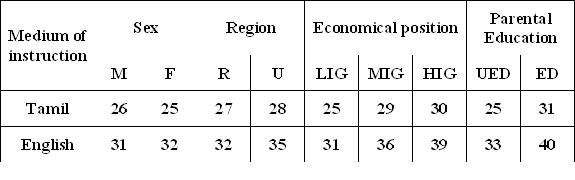
M - Male, F - Female, R - Rural, U - Urban, LIG - Low Income Group, MIG - Middle Income Group, HIG - High Income Group, UED - Uneducated, ED - educated.
It is found that the performance of English medium students is better than Tamil medium students. The reason for the low performance of Tamil medium students is that they are mostly first generation learners and they have less exposure to English. Further, the performance of students from urban, literate background, is better than the rural illiterate background; because, the students from urban background have choice of getting good exposure to English from their living atmosphere. The source of exposures are English dailies, weekly and monthly journals. Moreover, they have chances of watching and listening to English programs on TV and radio respectively and also in theatres, but the students of illiterate background from the same locality get less exposure to English. However, the economical factor plays less role in the performance of rural students but in the performance of urban students plays a vital role.
Among the students of various background, the performance of female students is better than the performance of male students. The reason for obtaining comparatively high score by the female students is that they have less diversion and mental disturbance than the male students. The socio-economical problems of the family also affect the learning achievements of the male students. However, the parental education too plays an important role. That is, the educated parents give proper guidance and give training to their children for the achievements of language skills. But the students of uneducated background have no choice of getting such kind of parental training and help in learning English. However, the overall performance of the students under study is very low in the productive skill of speaking English. The reason is that the district itself is an educationally and economically backward one and it gets less exposure to English language.
2.11. Remedies
To enhance the linguistic and communicative competence of the students in the English language, the following remedies will be helpful, and these remedies would eradicate or atleast minimize the problems encountered by the learners in the process of learning oral communication.
- To develop linguistic competence of the students, the language may be taught linguistically. That is, linguistic approach in teaching of English from the beginning may be helpful for the development of competence in English.
- Different types of conversational discourse of L2 may be taught, and the students may be given enough time for the development of conversational discourse in the school hours. The conversational discourse training will eliminate language shock and cultural shock. Further, that will help to develop communicative competence of the students.
- While teaching vocabulary of English, the grammatical functions of words should be taught. Further, the words should be distinguished and differentiated in addition to the semantic value of those words.
- The similarities and differences between L1 and L2 may be taught especially while teaching syntax which will eliminate the habits of literal translation from L1 to L2.
- While teaching pronunciation of words, the phonetic similarities and differences of the phonemes may be demonstrated in the class room, and practices may be given in this area properly. Further, the awareness about the interference of L1 in the pronunciation of foreign sounds should be given timely to the learners.
- The students may be motivated to interact with teachers and peer groups in second language in the home front in addition to the school atmosphere. Further, watching English programs, on TV listening to radio, local reading and reading dailies would help to develop the spoken language of English.
CHAPTER 3 WRITING SKILL
3.1. Introduction
Writing is a conscious, deliberate, and planned activity. A mono literate is a person who can read and write in a language and a biliterate or multi literate can read and write in more than one language. A literate person in a language can convey his inner speech through written mode. That is to say that one may be literate in one language and illiterate in another language. To become a literate in an another language he must learn the written form of that language. For learning written mode of second language, in addition to L1, one requires an additional ability and time. For learning writing of L1 one need not learn words and their meaning but their coherence. Thus, one can convert his inner speech into writing without any kind of hindrance if he has literacy skill in L1 to correlate the sounds with graphemes and to sequence the graphemes into words, and words into sentences, cohering the sentences with meaning and ability to organize them in a readable manner. But, for learning writing of L2 one requires to learn deliberately and consciously each and every linguistic element through instruction or proper guidance. Further, the learning experience of L1 is different from that of L2. In the process of learning L2 writing, previous experience (that is L1) gets in the way of learning of writing in all the levels of L2. But for learning of L1 writing there is no such experience.
3.2. Definition of Writing
Writing has been regarded as an alternative medium of language, as it gives permanence to utterances. Applied linguistics inherited the view of language as speech and writing as an orthographic. Many people would say that writing is an inaccurate representation of speech.
Lado (1971: 222) points out that "writing is graphic representation of a language. Pictures or symbols do not constitute writing unless they form a system representing the units of language and those pattern can be grasped by the reader". The message is conveyed through the written medium by the use of conventional graphemes. It is an universal activity through which an authentic communication takes place.
Elbow (1981: 369) puts "writing as a kind of 'magic' that can be performed by any one who is involved in and believes in his tale". It implies the fact that the mental representation by means of lexical manipulation is given in the form of script or marks in the process of writing. The process of translating the abstract ideas into a concrete form is the art of writing (the abstract into concrete).
This takes place in the process of transforming the abstract sounds into concrete scripts. Therefore it is an enigmatic one, which is otherwise called as magic.
Sampson (1985 : 26) says "writing is a system for representing utterances of spoken language by means of permanent visible marks". The phrase 'visible marks' does not include the ideas which are conveyed through artistic drawing and painting. Visible marks are the graphemes of language which form words and sentences. Through this mode, one's idea or his inner speech is conveyed properly. Hence, it is a permanent mode. Using this mode, knowledge and information can be preserved.
Bloomfield (1993 :21) observes that "writing is not language but merely a way of recording language by means of visible marks". It needs a systematized form by making use of the components namely graphemes vocabulary, syntax, etc. so as to make a decoder understand it clearly. Language is a storehouse of knowledge having many dimensions of production and reception, so a standard system is needed to record a language in coded form. Writing is a form of encoded symbols in the form of print or impression.
3.3. Writing and Writing Skill
Writing is an outcome of a writing skill which refers to the writer's linguistic ability in making use of the mechanics of writing. Writing is permanent, but writing skill is transitory. The use of writing skill differs according to mental ability and language proficiency of the writer. A writer cannot produce the same kind of work which he already produced a few years back. The external experience realized by the five senses of writer and the intellectual delight attained by the five senses of the writer develops or undergoes some changes. As this is the backbone of the writing skill, the outcome also changed accordingly. As a writer learns new themes by every moment that new knowledge makes him to change his views and approaches while practicing the writing skill. This in turn, enables him to steer the language in the written medium in an innovative fashion. Due to this, his writing style assumes various shapes.
In many cases, the earlier writings of the writer are not as good as his latter works. The experience he obtains in new writings cultivate the writer to handle different techniques for bringing out varieties of writing. But the changes that occurred in the manipulation of the writing skill do not necessarily lead to positive results, some times conceptual loss or loss of using the right word in the right content may also occur. Urban A lavery quotes one example from the life of the Jeremy Bentham, the father of English law, that during his earlier years he wrote clearly and well, but as the years went by and grew older, he gradually lost his sense of style until his latter works become most difficult to read. But in the case of Shakespeare, the latter works are mostly comedy and matured plays enriched with style and theme. Thus writing skill is not static but dynamic.
The writing skill includes a number of subskills. The subskills are (Sobana, 2003 : 26):
1. Mechanics - handwriting, spelling, punctuation
2. Word selection - vocabulary, idioms, tone
3. Organization - paragraphs, topic and support, cohension and unit
4. Syntax - sentence structure, sentence boundaries, stylistics, etc.
5. Grammar - rules of verbs, agreement, articles, pronouns, etc.
6. Content - relevance, clarity, originality, logic, etc.
7. The writing process - getting ideas, getting started, writing drafts, revising etc.
8. Purpose - the reason for writing, justification
3.4. Learning Process of Writing
Learning of writing is conscious and is thus non-spontaneous process (Thirumalai, 1990: 74). Learning of writing is often regarded as the learning of the mechanics of translating, either speech into writing, or meaning into visual symbols (Kress, 1982:5). Lado (1971: 143-47) says that learning to write a foreign language is learning to put down at a speed greater than that of drawing the conventional symbols of the writing system that represent the utterances one has in mind. Further, he has divided the learning process of writing into five stages as:
1. prewriting,
2. copying read texts,
3. transcribing,
4. composition and
5. literature.
6. Prewriting
The task of preparing students to learn to write in a foreign language varies according to what the students know from their native language writing.
Being sufficiently prepared involves knowing the symbols that will represent the utterances they have in their mind and how to put them down.
- Copying Read Texts
Pre school children or the beginners are taught different forms of printed letters and to copy them. - Transcribing
A more advanced practice in learning to write is to put down utterances in script without written text as a model. This requires the association between language units and script be recalled not merely recognized. - Composition
Students at first learn to write; Then they write to inform. They still learn but in a more advanced stage. They already know the language, and they know how to represent it in script. Thus, it is believed that the higher secondary students under study are in this stage. - Literature
Since it is assumed that writing literature is beyond the students level, it is excluded.
Learning of second language writing is not an easy task. In the process of writing, there are number of factors which influence the learner's writing both positively and negatively at every stage of learning process of writing. Sometimes, in addition to the complexity of the second language structure, the first language influences negatively at every stage of learning process. The L1 influences all the levels like grapheme, words and sentences in the learning process of writing.
3.5. The Writing Process
The task of writing is not a single stage process. After writing down one's inner speech on paper, it should be polished properly. Topkins and Hoskisson (1995: 211-22) provide five stages of writing process. They are : prewriting, drafting, revising, editing and publishing.
Prewriting is the stage of getting-ready-to-write. In this stage, the student or young writer chooses a topic, considers function, form and audience and generates and organizes ideas for writing. The second stage, drafting stage is the time to pour out ideas with little concern about spelling, punctuation and other mechanical error. The third one is revision stage; in this stage, the writer refines ideas in his compositions. The word revision means 'seeding again' and in this stage writer sees his composition again with the help of classmates and teachers. Activities in this stage are reading the rough draft, sharing the rough draft in a writing group and revising on the basis of feed-back. Next, the editing stage is the state of putting the piece of writing into its final form. Until this stage the focus has been primarily on the content of writing. The writer moves through three activities in this editing stage: getting distance from the composition, proof reading to locate the errors and correcting errors. The final stage is publishing; in this stage, an young writer brings his compositions to life by publishing them or sharing them orally with an appropriate audience. When he shares his writings with the real audience of classmates, other students, parents and the community, the student comes to think of himself as an author in this stage.
3.6. Mechanics of Writing
Mechanics of writing plays an imperative role in the productive skill of writing. In the process of writing, mechanism of writing involves the following activities.
1. ability to shape the letters (graphics),
2. knowledge of right combinations of letters (spelling),
3. skill of cohering words (sentence),
4. skill of composing sentences (discourse) and
5. control over punctuation (Stop, semicolon, colon, comma, etc.)
However, in the mechanism of writing, the mechanism of reading is also found. That is, one can acquire a particular letter after acquiring to read that one. Acquiring to write a letter without acquiring to read will be merely a process of copying: one of the mechanics of writing.
3.7. Types of Writing
The purpose of writing is to convey one's inner speech to others. According to the purpose, the writing methods vary. Writing a research article to a journal and writing a letter to the editor of a journal are not handled in the same way.
So, each and every type of writing has its own method of execution. Further, depending upon the time and space, the same matter by the same author may be presented in different forms to the audience. Some of the frequently used types of writing are:
1. Letter writing,
2. Essay writing,
3. Descriptive writing,
4. Narrative writing,
5. Informative,
6. Report writing,
7. Greetings, etc.
Moreover, a writer tends to adopt a form and a method of writing from the beginning to the end of his writing. There are certain rules and formal regulations to be observed in many written correspondences and all other writings. The formal expressions in letter writing are noteworthy. For example, expressions like 'sincerely', 'faithfully' are traditionally expected to be used before signing.
Thus the conventional rules have to be followed in determining the type of expression employed.
3.8. The Loss in Encoding and Decoding Process
While transforming the ideas conceived in the mind to the written mode, one cannot write exactly what he intends to write. The external factors like knowledge over the use of vocabulary, grammar, style, fluency etc. will affect one's writings. Some times the writer feels the transmission loss. In certain cases the writings are misunderstood and the readers do not comprehend the meaning. This transmission loss occurs in both the decoding and encoding process. In many a case, either because of the inability of the writer or because of the incapability of the reader, the expected message becomes difficult to receive. As a result, the purpose or intention of the writer is lost. This type of transmission loss will be called as loss in the decoding process.
3.9. Errors in Writing
Errors are the real indicators of the problem encountered by the learners.
By identifying the errors committed by the learners, the researcher can easily point out such areas which need to be focused more. It is generally regarded that the students commit errors in all the levels of language, namely,
1. Graphological level,
2. Morphological level and
3. Grammatical level
Further, it has been generally mentioned that the following are some of the reasons for the errors in the students' writing in addition to the complexity of the target language rule.
1. Analogical creation / overgeneralization,
2. Inappropriate use of the rules,
3. Simplification of the existing rules,
4. Mother tongue influence,
5. Non-learning, etc.
3.10. Testing Writing
Testing the learners' writing, implies identifying the errors and the mistakes found in writing of the students. Error analysis is followed to test and evaluate the responses of the informants to detect the processes involved in using the word, phrasal, syntactical, semantical categories of the language. Through identifying the areas of the errors, the areas where more concentration needed to be focused by both the teacher and the learners can be realized and relevant remedies can be suggested by which the difficulties and problems can be eliminated.
3.11. DATA ANALYSIS
3.11.1 Articles
The forms like 'a', 'an' and 'the' are usually called as articles. In English, articles belong to a subclass of determiners. 'a' and 'an' are indefinite articles, and 'the' is definite article. Usage of both the indefinite and definite articles depends upon the nature of the words that follow. The indefinite article 'a' is used before a word beginning with consonant or a vowel with a consonant sound, and 'an' is used before words beginning with a vowel (a,e,i,o,u) and words beginning with mute 'h'. The definite article 'the' occurs in the position where a person or thing or one already referred to. The following are some of the contexts in which the definite article 'the' occurs.
1. When a singular noun is meant to represent a whole class,
2. With the names of gulfs, rivers, seas, oceans, group of islands and mountain ranges,
3. Before the names of certain books,
4. Before the common nouns which are names of things unique of their kind,
5. With superlatives,
6. With ordinals,
7. Before musical instruments, etc.
I. Wrong substitution
i) 'an' instead of 'a'
an unique personality
an university
an European country
ii) 'a' instead of 'an'
a honest
a hour
The data show that the article 'an' is used before words beginning with vowels and 'a' before words beginning with consonant without considering the quality of letter or phoneme which begins in a word. It is evident that 'an' is used before the consonant 'h' which is silent or mute in the beginning of word, and 'an' is used before the vowels which have sound quality of consonant. The reason for the wrong substitution is that the 'strong pressures of the continuously drilled rules that an is used before nouns begin with vowel (Agnihotari, 1992) and vice versa due to such habit formation, the students extent these rules as
a sun
a world
an Atlantic ocean
II. Addition of 'the'
1. the cigarate smoking is injury in our body.
2. the air was polluted by the public in every part of the world.
3. the some people smoking the segrets
4. the petrol bunks should be regularly raided to avoid the adultration of petrol
III. Omission of 'the'
1. I will playing sometime in - morning
2. I will sleeping in my house sometime in - afternoon.
3. We are polluting - nature
4. The biggest problem in - twenty first century is the air pollution
IV. Addition of 'a' and 'an'
1. There only I breath a pure air
2. I told an advice to my sister
3. I saw a Mahapalipuram temple
V. Omission of 'a' and 'an' ------- Omission
1. I am - student ------ a
2. My father is - bus driver ------ a
3. I will become - doctor ------ a
4. It is - intelligent game ------ an
5. I saw - very poor boy ------ a
Above samples indicate that the definite and indefinite articles are indiscriminately used before noun phrases / nouns and are unnecessarily omitted where they are required. The article 'the' has not been used where it is necessarily required in the place of cataphorical reference. These types of errors has appeared due to the ignorance of the grammatical features of articles, influence of L1 and simplification strategy.
Further it is found that 'a' is predominantly used by the students rather than 'an' and 'the'. This may be because of the fact that 'a' is simple as well as first learned element. The students however find certain situations at which article of some kind is required; whenever they encounter such context or such gap, it is generally filled with 'a'.
60% of the students have committed errors in articles. Of the 60%, 25% of them have wrongly substituted the articles and remaining 35% of the students unnecessarily have added the articles where it is not required and have omitted where it is necessarily required.
3.11.2. Preposition
Preposition as 'a word' or group of words' (e.g. in, from, to, on behalf of) is often placed before a noun or pronoun to indicate place, direction, source, method etc., Further, it connects a noun or pronoun with some other words in a sentence and makes clear the relationship between the two.
Errors pertaining to the use of prepositions found in the students performance are classified into four categories as stated below.
i) Wrong selection of preposition
Sample
Incorrect selection ------ Correct selection
1. I am going on holiday on May ------ in
2. I can't sleep in night ------ at
3. Good bye! See you in Friday ------ on
4. I always feel good on the morning ------ in
5. Sumathi stayed with us in three days ------ for
6. We are going for Delhi next day ------ to
7. Jane usually goes to work with bike ------ by
8. Do you like traveling in train ------ by
The wrong selection of prepositions may be because of the semantic multiplicity of prepositions; for example, the preposition 'of' has sixty three meanings listed in the Oxford dictionary, and other prepositions have almost as many meanings as 'of' has.
In addition to the semantic multiplicity of the target language, the L1 too interferes due to the dissimilarities found between L1 and L2. For example, case markers in Tamil language, which is the mother tongue of the students under study, occur as post positions which are morphologically conditioned or governed.
For example
vi:ttil ------ 'in the house'
marattinme:l ------ 'on the tree'
ka:layil ------ 'in the morning'
ka:ttukku ------ 'to the forest'
kattia:l ------ 'by the knife'
Tamil equivalents for some English prepositions
Sl. No - English - Tamil
1. ----- in ----------- il
2. ----- at ----------- il
3. ----- by ----------- il
4. ----- of ----------- il
5. ----- on ----------- il
6. ----- at ----------- (k)ku
7. ----- for ----------- (k)ku
8. ----- to ----------- (k)ku
9. ----- with ----------- a:l
10. ----- of ----------- a:l
In certain contexts, the Tamil case marker 'il' is equated with many English prepositions like in, at, by, of and on. Because of it, the Tamil students studying English can not form a clear cut role to use all these prepositions in right contexts. As a result, they consider all these prepositions as free variant forms and use them sporadically.
ii) Extension of the preposition 'on'
1. I went Madras on yesterday.
2. On tomorrow if I became a doctor I will help the poor people by studying
3. I went a Mahapalipuram on last month.
In English, the preposition 'on' is used before the days like 'on Monday' 'on Sunday' etc. So, this rule tends the learner to extend the use of preposition where it is not possible in English, like 'on yesterday', 'on tomorrow', on last month'.
iii) Dropping of preposition ------ Dropping
1. I went - Madras ------ to
2. My family decided to go- Chennai ------ to
3. I will help- the poor people by in studying ------ to
iv) Addition of preposition
1. There were lot of peoples without food or in education
2. I will help the poor people by in studying
In English certain verbs co-occur with prepositions while certain other verbs do not. The verbs, which do not occur with preposition, can occur with article in the same slot (I bought a book, I went to Chennai). The students under study could not distinguish and differentiate these two types of verbs and have used them identically. Consequently in many a context, they have deleted preposition.
It is identified from the data that the students tend to learn certain co-occurring elements as an unit, this has resulted in using two prepositions in their writing. However, one can attribute improper learning, and semantic multiplicity are as the reasons for not performing well in the aspect of preposition.
63% of the students under study have used the preposition wrongly. With in 63%, 35% of the students have wrongly selected the prepositions, and 11% of the students have overgeneralized the preposition as given in the sample 1, and remaining 17% of the students have unnecessarily added and dropped the prepositions.
3.11.3 Pronoun
Pronoun is a word that could be used in sentence in the place of a noun. Pronouns can be classified as subject, object, genitive and reflective pronouns. Pronouns agree with the subject and object in number, since pronouns are used as substitutes of nouns. They must bear the same number, gender and person as the nouns for which they stand.
|
Category |
First person |
Second person |
Third person |
|||
|
Singular |
Plural |
Singular |
Plural |
Singular |
Plural |
|
|
Subject |
I |
we |
you |
you |
she/he/it |
they |
|
Object |
me |
us |
you |
you |
her/him/it |
them |
|
Genitive |
me/mine |
our(s) |
your(s) |
your(s) |
her(s)/his/its |
their(s) |
|
Relative |
myself |
ourselves |
your self |
yourself |
herself/himself/itself |
themselves |
i) Wrong usage of pronouns
Sample
1. My happy everyday at morning time language news paper reading.
2. My bought to by cycle
3. Library will be very useful myself
4. My going is to school
The students have wrongly substituted 'my' instead of I and 'myself' instead of 'me'. The reason is the lack of practice and ignorance of their linguistic features and meanings. Further, it is to be mentioned that the third person pronouns (he/she/it) are used almost properly by the students, and they find no problem in using them. The reason is that the students follow the strategy of positive transfer from Tamil. The Tamil pronouns also carry gender as that of L2. For example
He ------ avan She ------ aval It ------ atu
Pronouns have been wrongly used and substituted by 12% of the students understudy; However, majority of the learners have used the pronouns correctly.
3.11.4 Adjectives
Adjectives are typically described as words or phrases that modify nouns. The adjectives usually appear between the determiners and the nouns. Nouns are not only modified by the prototypical adjectives but also words from many grammatical classes like verbal participles and noun heads. The use of adjectives has been found to be very limited in students writings; However, some wrong usages of adjectives as found in data are given as follows.
i) Using noun instead of adjectives
Sample
1. It is nature place
2. We arranged a tour bus
3. The industries should be shifted to non resident area.
Errors of this type rarely occur in the writings of the students under review. It is because of the fact that both in English and Tamil languages, noun + noun combination and adjective + noun combination are relatively identical in the semantic aspect. This gives room for using N+N instead of Adj+N. It may also be claimed that this error is found to exist as the students follow the positive transfer of their first language structure. Consider the Tamil data.
i. oru ----- nalla ----- payyan
a ----- good ----- boy
ii. oru ----- putiya ----- vi:tu
a ----- new ----- house
Here, adjective appears before noun and after determiner. Moreover, the predicate adjective of Tamil does not precede the noun as of English.
inta vi:tu putusu - 'this house is new'
So, these kinds of structural similarities between L1 and L2 favour the learning of second language.
ii) Wrong use of adjectival intensifier
The intensifier very is used before the gradable adjectives and adverbs but in Tamil the intensifier 'rompa' which is equivalent to 'very / much' is used before both noun and verb forms as well as before adjectives and adverbs as:
rompa kettavar - 'very bad man' (before noun)
rompa sa:ppitu - 'eat much' (before verb)
rompa alaka:na pen - 'very beautiful girl' (before adjectives)
rompa ve:kama:ka pe:su - speak very quickly (before adverb)
Because of this strategy available in Tamil, the students have used the intensifier 'very' before the verbs of L2. Consider the following examples.
1. I very enjoyed the cricket match
2. Water game is very enjoyed
3. We very engaged the holidays
4. Water is compared to 'Amirda' but now times the water is very polluted.
It has been observed that 55% of the students have committed errors in using the adjectives, with in 55%, 30% of the students have used nouns in the place of adjectives and remaining 25% of them have used the adjectival intensifier wrongly.
3.11.5. Nouns
Nouns or noun phrases typically function as subjects, direct objects, indirect objects and subject complements (NPS also function as the object of preposition) A noun that denotes a single person or thing is said to be in singular form and that which denotes more than one person or thing is said to be in plural form. Plural nouns are formed by the addition of the suffixes which are otherwise called as plural morphemes (like '-s' '-es' '-en' '-ren' etc) to the singular form of the noun.
Formation of plural nouns
|
Singular form |
Addition of plural
morpheme |
Plural form |
|
|
Elsewhere at the end |
|
|
boy |
s |
boys |
|
place |
s |
places |
|
flower |
s |
flowers |
|
|
-es after � s/sh/ch/x |
|
|
bus |
es |
buses |
|
dish |
es |
dishes |
|
church |
es |
churches |
|
box |
es |
boxes |
|
Singular form |
Addition of plural
morpheme |
Plural form |
|
|
y-ies |
|
|
baby |
ies |
babies |
|
party |
ies |
parties |
|
|
if-fe-ves |
|
|
shelf |
Ves |
Shelves |
|
wife |
ves |
wives |
|
|
-en,ren |
|
|
ox |
en |
oxen |
|
child |
ren |
children |
|
Irregular plural forms |
||
|
Singular |
Plural |
Root modification |
|
tooth |
teeth |
oo-ee |
|
woman |
women |
a-e |
|
datum |
data |
um-a |
|
terminus |
termini |
us-I |
|
mouse |
mice |
ous-ic |
In learning to use a noun, one needs to pay attention to a variety of grammatical factors. In particular, one needs to know whether a noun is countable or uncountable and if countable what will be the plural form. So it is quite complex and difficult to the learners in processing all the nuances of noun simultaneously and to select a particular noun to use in a particular context.
The errors committed by the students in this context are presented below.
i) Overgeneralization of noun forms
The students tend to overgeneralize the rules where there is an irregularity in forming plurals as:
Sample ----- Correct form
childs ----- children
foots ----- feet
lifes ----- lives
newses ----- news
furnitures ----- furniture
Polices ----- police
Further, learner's first language also interferes in the manifestation of L2 noun forms. In Tamil, the plural suffix '(k)kal' is phonologically conditioned which is added to all the countable nouns uniformly. For example:
Singular ----- Addition ----- Plural
ceyti ----- -kal ----- ceytikal 'news'
ka:valar ----- -kal ----- ka:valarkal 'police'
pa:tam ----- -kal ----- pa:tankal 'feet'
kulantai ----- -kal ----- kulantaikal 'children'
The words like news, furniture etc. are treated as countable in Tamil but they are uncountable in English. Because of this difference in the morphological process of Tamil and English, the English learners whose mother tongue is Tamil make a negative transfer on certain elements to English morphology importing from Tamil morphology unknowingly. From the data, it is found that 62% of the students have committed errors in the use of nouns as indicated above.
3.11.6 Verb
The verb (phrase) is the heart of the sentence. Most of the English sentences contain atleast one verb. Verbs carry a great deal of information, they describe actions, events, and states and place these in a time frame. They state whether actions or events, have been completed or going on and they say whether a state is current or regulative. They help to command, request, speculate, wish and predict.
The students have not properly handled the verbs also. Most of the sentences produced by the students have lost their meanings and functions due to inappropriate use of the verb forms. Such types of erroneous sentences are as follows.
i) Use of double past in negative sentences
1. I did not forgot the summer holidays
2. I did not thinked such an examination is going to held in our school.
ii) Double past in interrogative sentence
1. When did you completed examination?
2. When did your father came Madurai?
3. Did you returned to home yesterday?
4. Did you wrote examination?
5. Did they came yesterday?
The samples 1 and 2 show the use of double past; a peculiar type of error, found in the student's writing. This type of error occurs because of the fact that in Tamil, tense is expressed in main verbs without splitting the verbs whatever may be the sentence type. But in negative or interrogative sentence of English, the tense is expressed with the help of both auxiliary and main verb (did + pronoun + verb or did + not + verb). The learners know the rule of using tense in auxiliary. However, by the influence of Tamil language, the learners are satisfied only when tense is expressed through main verbs. Thus, they use double tense in their writing, especially while writing interrogative and negative sentences.
iii) Use of past form where the past participle required
1. I had saw an accident yesterday
2. I and my family had went Chennai
3. Has he did the work
4. Had he ate the fruit
This type of error has appeared in the writings of the students understudy because of the fact that in English, some verbs have certain identical forms for the categories of past tense and past-participle. (work-worked - worked) most of the verbs have this pattern. Learners extent this rule to all types of the verbs and consequently, 'a past tense' form is substituted for past participle form of irregular type also (see-saw-seen).
iv) Wrong lexical selection
1. I bought the book from library and then study in my house (borrow)
2. Air pollution attacking our body (affects)
In any language, certain linguistic elements share commonness semantically, that is to say that all languages have synonymous, but there will not be any complete synonyms in any language. So certain words can be used in certain contexts. The students understudy have also wrongly substituted a word for another. This will happen only in the initial period of learning. Thus, it is considered as developmental error.
v) Overgeneralization of the irregular verb forms
Sample -- Correct form
becomed - became
binded - bound
bited - bit
Sample -- Correct form
thinked - thought
cutted - cut
seeked - sought
writed - wrote
finded - found
buyed - bought
seed - saw
sayed - said
The learners tend to overgeneralize the verb forms due to the irregularity found in the formation of the past tense. Some English verbs do not follow the regular morphological process. Instead of taking-'ed' as past tense marker they internally get changed or they take zeromorpheme of the formation of past form. Because of this deviant morphological process, the learners tend to overgeneralize already learned rule of affixing -ed with the present verb form to make past form. It is found that 65% of the students have committed errors in verbs. Out of 65%, 30% of them have used the past form where the past participle is required and remaining 20% of the students have wrongly selected the verbs and overgeneralized the irregular verb forms in addition to the use of double past.
3.11.7. Adverb
Adverbs specify the mode of action of the verbs. In English, many adverbs are signaled by the 'ly' ending. An adverb is 'a word used to add something to the meaning of the verb'. The function of an adverb in a sentence is significant because of its impact on the verb it qualifies. The effectiveness and vitality of the action reflected by the sentences is denoted by the use of adverbs. Some times adverbs qualify the adjectives also. The errors in the use of adverbs are given below.
i) Over generalization of - ly ending
Sample
1. He drived tour bus fastly
2. He drove bus very speedly
3. He went fastly
ii) Adjectives used as adverb
1. Today I came to school quick
2. She sing beautiful.
These types of errors may be considered as developmental errors.
The above data establish a fact that the students have got some confusion with regard to the grammatical categories viz. adverb and adjective. The students have to be properly taught the functional distribution of the above two categories. 20% of the students have overgeneralized- ly- ending and 21% of the students have used the adjectives as adverb in their writings.
3.11.8. Auxiliary Verbs
Auxiliary verb is subordinate to main verb. It helps to make distinctions in mood, tense, aspect, voice etc. It is used to frame questions especially tag questions. Normally a verb phrase consists of a main verb preceded by one or more auxiliary verbs. In a sentence, the appropriate selection of the auxiliary verb form is important for maintaining subject verb agreement. Students have difficulty in using the auxiliary forms also. The errors found in the students writing are classified and presented below.
i) Addition of auxiliary verb ----- Addition
1. I am went to the school ----- am
2. I am saw the humbing birds ----- am
3. I am saw you are in the shop ----- am
The students under study have unnecessarily added the auxiliary verb 'am' in between the subject 'I' and verb (past form). The student's intention was to convey the past event or action. He has conveyed the sense what he has done in the past, but 'am' is wrongly used with 'I'. This is due to the fact that the copula verb 'am' functions as a main verb in certain contexts (I am a student). Because of the impact of this structure, learners unconsciously use 'am' whenever they have to use 'I' in a subject position.
ii) Deletion of auxiliary verb --- Deletion
1. When - you go to home? --- 'do'
2. When - you come from Chennai? --- 'did'
3. How - you come from Chennai? --- 'did'
4. Where - you see Thirumurugan? --- 'did'
The sample shows that the students have deleted the auxiliary verbs in the interrogative sentences (when + sub+ verb+ noun). This deviant structure is unacceptable. The reason for the deletion of auxiliary verb in interrogative sentences is the mother tongue interference. In Tamil, the interrogative sentences can be framed as:
eppo:tu vanta:y
when come -past-PNG
eppo:tu vi:ttukku vanta:y
when home-case come-past.PNG
or
eppo:tu vanta:y vi:ttukku
when home+past -PNG home-case
Only pronoun, verb and noun (when + verb + noun) are used in the Tamil interrogative sentence. No auxiliary verb is used in it, so this structure appears in L2 also.
ii) Wrong substitution of auxiliary verb
Given instruction: Fill in the blanks with suitable auxiliary
Sample ---------- Correct form
1. I am working when she arrived. ----- 'was'
2. Now he was writing a letter to his friend. ----- 'is'
3. They were going to a meeting tomorrow evening. ----- 'are'
4. Six people are injured in the accident yesterday 'were'
The wrong substitution of auxiliary verbs 'am' instead of 'was', 'are' instead of 'were' and vice versa is due to the 'ignorance of the linguistic features of auxiliary verb and failure in understanding the meaning of the given sentences. As soon as the students see the verb in the 'ing' form, they tend to use auxiliary without considering the tense which is implied by the adverb. It is found that there are 52% of the students wrongly used the auxiliary verbs. Of the 52%, 32% of the students have wrongly added and deleted the auxiliaries, and remaining 20% of them have wrongly substituted the auxiliaries.
3.11.9. Concord
Concord is the grammatical agreement between words in number, gender, subject, verb etc. In English, number is a feature associated with nouns, demonstratives, personal pronouns and verbs. Nouns have singular or plural numbers and present tense verbs when they come with 3rd person singular will occur in agreement with the subject (noun). Errors identified in the student writing are classified and presented as follows.
i) Demonstrative adjectives and noun agreement
Sample
1. This gases causes holes in ozone layer.
2. The scientists said that due to this holes world will be destroyed with in 200 billion years.
3. Especially industries favors these air pollution.
4. Therefore in order to these types of pollution the government should take act regarding pollution
The errors in the aspect of agreement between the demonstrative adjective and noun may be because of the ignorance of the functions of the demonstrative adjectives and interference of first language. In Tamil, there is no singular and plural distinction in demonstrative adjectives as in English. For example,
inta - this, these
anta - that, those
inta puttakam 'this book' (singular)
inta puttakankal 'these books'(plural)
anta puttakam ' that book (singular)
anta puttakankal 'those books' (plural)
iii) Subject and verb agreement
1. Petrol powered vehicles causes most serious problem
2. Especially industries favours these air pollution
3. This gases causes holes in ozone layer
4. Preventive measures against air pollution saves our country
The above sentences show the agreemental problem between verb and noun. The students have used the third person singular marker 's' (es) without considering the noun which proceeds the verb. The words like 'vehicles,' 'Industries' 'gases' and 'preventive measures' are in plural forms which require plural verb form but students have predominantly used the singular verbs form. So, the third person singular marker is overgeneralized where it is not required.
iii) Relative pronoun and verb agreement
Sample
i. Air is mainly polluted by the vehicles which emits smoke by burning fuels.
ii. Government should check the vehicles and industries which leads largely harmful to living things.
This type of agreemental errors have appeared due to the ignorance of the linguistic feature of the relative pronoun, 'which'. In the above said examples 'which' functions as the relative pronoun and it shares the grammatical features of noun which is preceded to it. The students consider the relative pronoun 'which' as a singular linguistic element, so this kind of misconception leads to the use of singular verb after the relative pronoun whatever the noun preceded to 'which'.
It has been found that there are 67% of the students committed errors in concord. Of 67%, 29% of the students have committed errors in the agreement between demonstrative adjective and noun. 28% of students have committed errors in agreement between subject and verb and remaining 6% of the students have committed all types of errors.
3.11.10. Syntax
Syntax includes the ways words are combined into larger structures including sentences. The distinction between the subject and predicate is the basic division within the sentence. The generative grammar of the 1970s exploited tree diagrams in which the subject (called the NP for noun phrase) branches left and the predicate (called VP for verb phrase) branches right. S stands for sentence.
The syntactical errors committed by the students are categorized and presented as below.
i. Mother tongue influence on syntax
Sample 1
1. The next day going to Madurai Meenakshi temple
2. The last time going to Chennai
The student has used the adverbs like 'next day' 'last time', as the subjects in the place of subject positions and the required subjects are deleted. This kind of expression may be due to he mother tongue influence.
In Tamil, sentences can be produced without subject and the adverb is placed in the place of subject position. The subject can be realized in the PNG marker, for example,
1. na:laikku varuki re:n
- 'tomorrow, I am coming'
tomorrow coming PNG
2. ne:rru po:n na:n
- 'yesterday he went'
yesterday went PNG
So, this type of L1 syntactical structure appears in the L2 learner performance as shown above.
Sample 2
1. Next evening home work do
2. I will going body clean doing
3. My happy everyday at morning time Tamil languages news paper reading.
Sample 2 indicates that the verbs are placed in the end position of the sentences. This reflects Tamil syntax pattern. In Tamil both SOV and SVO patterns are possible, but mostly the SOV pattern is followed in the formal context as
1. na:n ka:laiyil tamil pattrikkai patikki re:n
I morning Tamil newspaper reading PNG
"I read Tamil news paper in the morning time"
2. na:n ka:laiyil pa:l kutikki re:n
I morning milk drink PNG
"I drink milk in the morning"
So, it is evident that the similar L1 structure is appeared in the L2 learners' writings as shown in sample 2. So, this type of error is considered a transfer error.
ii. Order charge in question 1. Where he was going?
2. When you will come from Bombay?
3. Why you didn't come yesterday?
4. Why you didn't told the reason for master?
The sample shows that the interrogative sentences have been used in the reverse order as where + sub + aux + verb (where he was going) instead of where + aux + sub + verb (where was he going). This is due to the influence of spoken form on writing. The deviant word order of question found in the learners performance is least acceptable in the spoken mode of Indian English and it is also expressed through intonation using the similar pattern. But previous one is unacceptable order in the written mode.
(iii) a) Incomplete sentences
1. My bought to the by cycle
2. I am decide to the bag
3. Selva is told the Malathi
4. She decide the meeting
5. I ran to the people
b) Discourse with full of incomplete sentences
Sample
My life ambis a teacher I can't be any life or vizetion so I cannot be teacher of life so happy the childrens life the teacher life I am like the childrens I am hat reati reavs the life of teachers my life is the last time of teacher the childrens the tomorrow do yesterday so was doind my life tomorrow the saffaden are mtelyert s and late they happy pongal is my life amsion.
Reason for the projection of the incomplete sentences is that some L2 learner at the beginning stage just memorize the passage or linguistic elements for the examination purpose then they try to project it completely in the examinations, but it seems to them impossible to project completely what they have memorized. Then, they import the linguistic elements improperly whatever it comes from their memory as shown in the above sample. This type of error may be considered as error due to linguistic vomiting or it is an outcome of rote learning.
61% of the students have committed errors in the sentence level. Of the 61%, 30% of the students have changed the orders in the interrogative sentence, 21% of the students have committed errors due to the influence of L1, and remaining 10% of the students have just vomited the linguistic elements in an illogical fashion.
3.11.11 Spelling
Spelling plays an important role in the formation of words. Meaning of a word depends on the graphemes or letters which occupy in it. Graphemes also distinguish and differentiate the meaning of words. The spelling rules of the language enable both the encoder and decoder to comprehend appropriately in the written mode. The spelling rules of English are quite complex, and there are some regularities and irregularities and exceptional nature in the rules. Further, one or more than one letters correspond to one sound. In addition to the first language system, the complexity of the spelling rules too tends the students or learners to produce misspelt words. If the letters used in the words are changed or altered, the meanings of the words will be lost. Alternations or dropping of letters in words lead to confusion. Sometimes, misspelt words will make one comprehend some other meanings. The erroneous words found in the students corpus are classified and discussed as follows.
(i) Mother tongue influence on spelling
In Tamil, consonant clusters like pr, tr, st, tr, pl, etc. are not possible. Because of it one can find errors in spelling of L2. The evidences are as follows:
Sample ----- correct form
Firiend ----- Friend Piravent ----- Pravent Piraivate ----- Praivate respiratory ----- respratory piroballam ----- problem
The vowels like 'i' and 'a' are inserted in between the two members of a cluster due to the L1 transfer as indicated above. Further the voiced phonemes are substituted by voiceless as stated below.
Sample ----- Correct term
proplem ----- problem potternical ----- botanical discriped ----- described
In Tamil, voiced sounds are absent, so the L2 users tend to substitute the voiceless letters instead of voiced ones.
ii) Influence of spoken form on spelling
The students have transferred their incorrect speech habits to writing as follows:
Sample ----- Correct form
arrived ----- arrived
betiful ----- beautiful
butefull ----- beautiful
butifull ----- beautiful
survices ----- service
Sample Correct form
difficult difficult
parasonal personal
facotories factories
witch which
scientests scientists
sintists scientists
papper paper
docter doctor
tenes tennis
descriped described
iii) Words showing dropping letters
Sample ----- Correct form ----- Dropping<br /> arrived ----- arrived ----- 'r'
betiful ----- beautiful ----- 'au'
droped ----- dropped ----- 'p'
equalent ----- equivalent ----- iv
impretive ----- imperative ----- e
iv) Words showing addition of letters
Sample ----- Correct form ----- Addition
unblievable ----- unblivable ----- 'e'
playying ----- playing ----- 'y'
distrouid ----- distroid ----- 'u'
dailiy ----- daily ----- 'i'
becomeing ----- becoming ----- 'e'
parrants parents 'r'
complexcity ----- complexity ----- c
secound ----- second ----- u
v) Words showing modification of letters
Sample ----- Correct form ----- Transfer
heppy ----- happy ----- a-e
parrants ----- parents ----- e-a
haleday ----- holiday ----- i-e
impretive ----- imperative ----- a-e
famile ----- family ----- y-e
discriped ----- described ----- e-i
The analyzed and classified data show that both the interference of L1 and learner's incorrect speech habits have paved the way for the spelling errors in the place of consonant clusters. Only the incorrect speech habits mirror in their spelling in the place of vowels and vowel clusters. It is identified in the students' data that 71% of the students have committed orthographical errors in their writings.
3.12. Summary on Writing Skill3.12.1. Findings
It is observed that the students under study have used the articles 'an' before words beginning with vowels, and 'a' before words beginning with consonant without considering the quality of letter or phoneme which begins in a word. Further, both definite and indefinite articles are indiscriminately used before noun/nounphrase and are unnecessarily omitted where they are required.
Another type of error found out in the students writings is the use of prepositions. That is, the preposition 'on' is used before 'yesterday' 'tomorrow' 'last month', etc. This error has occurred because of the overgeneralization of the rule that 'on' is used before days as 'on Monday', 'on Sunday', etc. and also, the prepositions are unwantedly deleted and added.
The errors in the use of pronouns and adjectives are also identified. That is, the pronouns are wrongly substituted as 'my' instead of 'I' and 'myself; instead of 'me'. And also, the nouns are used where the adjectives require. The errors are also identified in the usage of nouns. The students tend to over generalize the rules whenever there is an irregularity in forming the plural noun forms. Another peculiar type of error was in use of the verbs. That is, in the negative sentences and interrogative sentences the double past was used; this is due to the L1 interference. Past forms were used where the past participles are required. Further, the learners tend to overgeneralize the verb forms due to the irregularity found in the formation of the past tense forms.
Moreover, errors have also been unearthed in the grammatical items like adverbs and auxiliaries. The auxiliary verb 'am' is unnecessarily added in between the subject 'I' and verb (past form). This is due to the fact the copula verb 'am' functions as a main verb in certain contexts (I am a student). Because of the impact of this structure, learners unconsciously use 'am' whenever they have to use 'I' in a subject position. Further, the auxiliary verbs are wrongly substituted as 'am' instead of 'was', are instead of were and vice versa. The another problem area to the learners is concord; the grammatical agreement between words.
The agreemental problems are enormously found between demonstrative adjectives and noun, subject and verb, and relative pronoun and verb.
It has been identified that more number of errors are committed by the learners in sentence level also due to the dissimilarity of syntax pattern between L1 and L2. Further, it is found that the interrogative sentences are used in the reverse order as where + sub + aux + verb (where he was going) instead of where + aux + sub + verb + (where was he going). This is due to the influence of L2 spoken form on writing. And also there are a number of incomplete sentences found in the learner's writings. Hence, another problem area is orthographical, that is spelling. It is the fact that the English spelling rule is one of the reasons for the spelling errors in addition to the L1 interference and learners incorrect speech habits.
3.12.2 Performance of the Students
Writing performance of both Tamil and English medium students was evaluated keeping the data on the basis of the social variables. The following table shows it explicitly.
Comparison of students 'performance in %
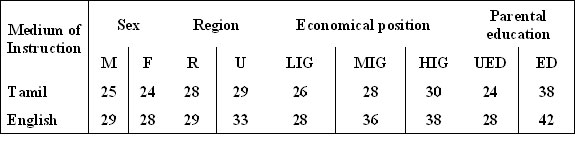
The data analysed show that the English medium students from educated family background have received the highest score 42%. The Tamil medium female students have received the lowest score 24%. The Tamil medium rural students and the English medium students of low income group have received the same score 28%. The English medium rural and Tamil medium urban students have received the same score 29%. Further, the students of English medium from high economical background is better than that of the low economical background. The difference between low and high income group is 10%. And also, the difference between Tamil and English medium students from middle income background is 4%.
Totally, the writing performance of male students is better than the female students in both Tamil and English medium. The difference between male and female is 1%. It is very least difference, So it is evident that the gender plays very less role in the writing performance of the students. But the parental education and medium of instruction play a very major role than all other social variables.
3.13. Remedies
- To avoid errors in writings, students should be practiced to write stories and the written items should be spotted by the teachers and than the reasons for the errors should be indicated to the students. Further, editing practice should also be given to the students.
- To prevent L1 interference on L2 sentence, various sentence types of both L1 and L2 should be differentiated and distinguished and that should be demarked to the students. The awareness about sentence types of both languages will automatically eliminate the errors in syntax. Thus, effort has to be taken to create syntactical awareness among the students.
- To avoid the overgeneralization of verb forms and other grammatical items the regularity and irregularity of the language rules should be taught and reinforced.
- To prevent the agreemental problems, the relationship between words should be taught and if the problems are due to L1 structure, the relationship and variation between words of L1 and L2 in sentences should be indicated to the students.
- To avoid orthographical errors, an appropriate pronunciation drill should be given to the students. By the prevention of L1 sounds in their L2 pronunciation, the spelling errors can be minimised in the learners writings.
CHAPTER 4 READING SKILL
4.1. Introduction
Reading is one of the language skills and one of the gateways of getting worldly knowledge. Traditionally, reading was considered as a passive skill, but it is today considered as an active one, and one's reading ability decides his academic success.
Education of a child is incomplete unless he is equipped with the ability to read, to decipher, to interpret and to understand properly the content of a reading material. The intellectual advancement of a child is strictly limited, if he is unable to read (Yadov, 2002 : 45).
Reading is a good source of self education. By reading, a person can keep himself informed of all the news and knowledge, literature and science of world.
4.2. Definition of Reading
Reading is a complex and conscious activity using the written symbols meaning and ideas are obtained. However, the readers' background knowledge is necessary for complete understanding of a text.
The field experts on reading have defined reading in different ways.
Betts (1966) has defined reading as a thinking process. No doubt thinking is an important aspect of reading process but not the whole of it. According to Goodman (1970) "the purpose of reading is the reconstruction of meaning. Meaning is not in print, but it is the meaning that the author begins with when he writes. Somehow, the reader strives to reconstruct this meaning as he reads". Reading is hence taken to include all the comprehension process necessary to arrive at the reconstruction of authors' meaning.
Jenkinson (1973) adds a new dimension to this definition when he writes about reading. "Reading has been defined as an act of responding to printed symbols so that meaning is created. It has long since been recognized, however, that getting meaning from the printed page is too limited as a definition of reading. Bringing meaning to the printed page indicates more accurately the reciprocal process between the printer symbols and the mind of the reader". Constructing meaning is also a form of thinking. Problem solving or reasoning involves analysis and discriminating, judging, evaluating and synthesizing. All these mental processes are found in the past experience, so that in the context of reading, the material must be scrutinized in the light of the reader's own experience.
Any definition of the reading process therefore must include interpretation and evaluation of meanings as well as construction of meaning.
Widdowson (1979) says that "reading is the process of getting linguistic information 'via-print' through reading; the information conveyed by the writer through the print medium is retrieved by the reader". Needless to say that the amount of information retrieved from the printed matter may differ from reader to reader. Here, the definition also needs some specification about the amount of information a receiver gets from the text. Written text not only provides linguistic meaning but also contextual meaning. Linguistic meaning involves represented information and this is called literal. Contextual includes the socio-cultural and intentional meaning incorporated in the text. A literal meaning of a text is accessible to the ordinary reader whereas to obtain the pragmatic meaning of the encoded matter, one must have rich exposure to the ethnolinguistic aspect of the reading materials. The efficient reader can only retrieve both his literal and pragmatic meanings from a text.
4.3. Psychologists and Sociolinguists Views of Reading
Psychologists consider that reading is a guessing game and a sort of thinking activity. Reading activity includes perception, recognition, association, understanding, organization, and finding meaning, so the process of reading is complex in nature and related to mental ability of the reader. Hence, reading is a psycholinguistic process. It starts with a linguistic representation encoded by a writer and ends up with meaning, which a reader constructs. Thus, it is an interaction between the language and thought. The writer encodes thought in the form of language through the words. If the reader is not able to interact with the words, the meaning will be lost.
According to sociolinguists views, the experience of the reader, interests and efforts play a role in decoding process. When a reader starts to read, he feels comfortable, and he easily understands the meaning. Hence, he gets meaning, and easily matches the information he gets from the text with that which is within his fund of knowledge he possesses.
4.4. The Reading Process
Reading is a visual process. It is the ability to see symbols clearly with the eyes. It is a perceptual process-perception meaning that our thought process are able to take these symbols and to invest them with meaning. It is an experimental process; because, without experience the mind will be unable to invest meaning to the symbols that we see. Reading comes about when we take meaning to the printed page, not just the act of taking meaning from the printed page (Berg, 1971 : 10).
Reading is a transactive process in which readers negotiate meaning or interpretation. During reading, the meaning does not go from the page to the reader; instead, it is a complex negotiation between the text and the reader that is shaped by the immediate situational context and broader socio linguistic contexts (Weaver, 1988). The immediate situational context includes the reader's knowledge about the topic, the reader's purpose for reading, and other factors related to the situation. Broader socio linguistic contexts include the language community that the reader belongs to and how closely it matches the language used in the text, the reader's culturally based expectations about reading, and the reader's expectations about reading based on his other previous experiences.
The Reading Process
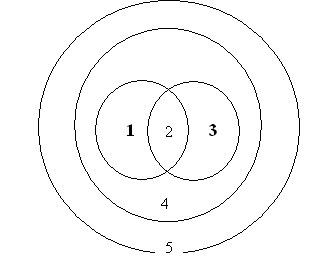
Adapted from Weaver, 1988: 30.
1. Reader; 2. Transaction; 3. Text; 4. Immediate Situational Contexts and
5. Broader Socio Linguistic Contexts.
4.5. Bottom up and Top down Processing in Reading
In the case of reading, as with other cognitive process, psychologists have distinguished two kinds of processing. They are bottom up and top down processes. Bottom up processes are those that take in stimuli from the outside world-letters and words, for reading and deal with that information with little recourse to higher level knowledge. With top down processes, on the other hand, the uptake of information is guided by an individual's prior knowledge and expectations. Teriman (2001) says that in most situations, bottom up and top down processes work together to ensure the accurate and rapid processing of information.
4.6. Reading and Reading Skill
Reading in general is an ability. The reader decode meaning from the printed or written words. In the process of reading, the reader employs his reading skill. The degree of reading skill varies from person to person according to the linguistic competence and background knowledge he possesses. However, the following are some of the important components of reading skill.
1. Recognition of the graphemes.
2. Recognition of the correlation of graphemes within words.
3. Recognizing word boundaries and sentence boundary.
4. Recognizing the meaning of words and its relationship in sentence.
5. Recognizing relationship between and among sentences in a discourse.
6. Deducing meaning of unfamiliar words
7. Inferring implicit and explicit information and ideas of text, etc.
4.7. Reading Comprehension
Reading means reading with comprehension. In the process of reading comprehension, the printed words are not just decoded as it is, but it is decoded by a reader using his linguistic competence, socio linguistic and existing knowledge about the topic. Reading is not only the activity of merely decoding the writer's meaning, but also it is the activity of more than that. That is, sometimes the reader goes beyond that or understands nothing from that.
It is the fact that one's comprehending ability can be decided by the internal and external factors. Under the internal factors, linguistic competence (what the reader knows about the language) motivation (how much the reader cares about the task at hand as his general mood about reading), schooling and accumulated reading ability, how well the reader can read are included.
Under the external factors, the elements on the printed page, the qualities on the reading environment, factors related to textual characteristics like text readability and text organization are included. Further, the qualities of the reading environment include factors like teacher activity that incorporates what a teacher does before, during or after reading in order to help the students understand the information found in the text. Moreover, the way peer groups react to the reading task and the general atmosphere in which the reading task is completed are also included.
4.8. Types of Reading
Reading may be classified as oral and silent reading, informational and recreational reading, observational, assimilative, reflective and creative readings. Yoakem (1955) has classified reading according to the form, purpose and the psychological process involved. On the basis of 'form', reading is categorized as silent and oral reading. The reader either reads to himself or to others. On the basis of the factor 'purpose' reading may be classified as recreatory or leisure reading and informational or educational or professional reading. Further, on the basis of psychological process, reading can be classified into four types. The first one is observational reading, where the reader makes note of what the writer intends to write but makes no special efforts to analyse it or to remember the words or ideas. The second one is assimilative reading, where the reader tries to understand fully and remember what he reads. The third one is reflective reading, where the reader reads with a critical attitude. The last one is called creative reading, where the reader tries to discover ideas so that he can use them subsequently in oral written expression.
Classification of reading (Yoakem)
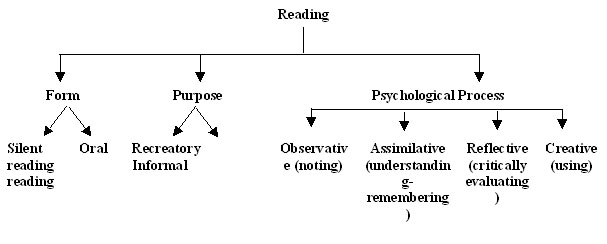
In another way, reading is classified as skimming, scanning extensive and intensive reading.
Skimming involves quickly running one's eye over at text to get the risk of it.
Scanning involves quickly going through a text to find a particular piece of information.
Extensive reading is nothing but reading longer text usually for one's own pleasure. This is a fluent activity, mainly involving global understanding.
Intensive reading involves reading shorter texts to extracts specific information. This kind of reading is otherwise known as reading for details.
4.9. Science of Reading
Reading is a fairly new science, much of the research in reading has been done in the past years unlike other sciences which have a long heritage of research. The first study of how people learn to read was done by JAVAL in 1879. He studied the eye-movements in reading. He discovered that unlike reading, the eyes move in discrete jumps across the line of print. The eye does not sweep across the page smoothly. Rather it moves and stops, then moves and stops. That is, the eyes focus and stop, see what they stop on, and then move to the next word or words and stop again. The eyes move and stop as many as five or six or seven times across a line of print. Then there is a return sweep. Then the eyes do it all over again. There is also a duration of fixation - That is, the time the eyes stay still during a fixation. The eyes must remain stationary in order to record words. Then they jump to the next point and then there is another duration of fixation and so on. The average length of fixation, when the words are seen is from 1/8 to 1/4 second.
4.10. Effective Reading
The reader's proficiency depends upon his linguistic competence, background knowledge about the subject and the words employed in the text.
A successful reader is a person who can handle large amount of written material. The following are the characteristics of a successful or effective reader (Berg, 1971:7-8). A reader is one who
- � has purpose
- � can concentrate
- � comprehend what he reads
- � remembers what he reads
- � has a good vocabulary, and
- � can read rapidly, but with rate depending on the material.
Further, he says that knowing how to select the right combination of skills for a particular purpose - to change the rate of reading in a co-ordinated reaction to purpose and difficulty is the mark of the effective reader. This skill is called flexibility.
The flexible reader is a purposeful reader. He knows how to skim for previewing an article before reading, and he knows how to scan for specific information in a selection. He learns from his preview skimming, to know whether to read the selection rapidly, at an average rate, or slowly.
4.11. Poor Reading
One's reading capacity normally fails due to his inability of recognising words and deducing its meanings. Apart from word recognition, the knowledge about the subject of the written matter also controls the reading ability of the reader. Berg (1971: 5-7) says that the following are the causes of poor reading habits:
- � lack of effective techniques
- � lack of effective practice
- � not a direct translation between word symbol and comprehension; word is compared to one in the more common spoken language
- � insufficient background
- � technical details which demand a slower reading and
- � visual problems.
4.12. Teaching / Learning Reading
One cannot become an effective or fluent reader as soon as he enters into the school. He have to pass through several stages to become an effective reader. Generally the stages of learning of reading are categorized that at the first stage, the learner learns to read the alphabetic orders ABC upto XYZ. Then he learns to read its combinations (like h.e, s.h.e). In the third stage, the learner learns to read the words and its combinations with other words in a sentence and understand its meaning. In the fourth stage he extent his reading ability at the sentence level.
In the fifth stage, he begans to comprehend the discourses. Only at this stage, he uses his both linguistic and socio linguistic knowledge for complete understanding of the text.
The learning of reading is a conscious process which is taught to learn deliberately. However, reading is taught by adopting different methods in school curriculum which are categorized (Yadov, 2002) as:
- alphabetic method
- syllabic method
- word method
- phrase method
- sentence method
- story method and
- phonic method.
In alphabetic method, the name of the letters are taught to the students in alphabetic order and then combination of two or more letters and words combination in sentences. In the syllabic method, the unit of teaching is the syllable not the letter. Syllables are used directly and words and sentences are framed combining syllables. In word method, word is the unit of teaching and as well in phrase method, phrase is the unit of teaching. In sentence method, sentence is the unit of teaching. In story method, the students are taught story in four or five sentences which are illustrated with pictures. The story is learnt by rote and then the students reads it. The students recognize sentences and then words. The last one, the phonic method, this method is based on phonology and is used in combination with the alphabetic method. The unit of teaching is sounds of letters. However, every method has its own merits and demerits.
4.13. Testing Reading Comprehension
To test the reading comprehension ability of the students, ten test items were given. The items were in incomplete sentences, narrative, tabular, passage, word, telegraphic form and pie graph.
Broadly two types of questions were asked. They were text based questions and knowledge or competence based questions. Text based questions expected from the students' answers of different types:
- selection of appropriate answers from the given answers,
- deciding the statements given are true or false,
- getting the answers from the text.
Knowledge based questions required the subjects to recognize the parts of the sentences, to complete the incomplete sentences and recalling vocabularies and grammatical information from their memory.
|
Test item |
Type of the Text |
Mode of answering |
Type of skill |
|
1. |
Incomplete sentences |
Complete the sentences by using the options given |
Competence based |
|
2. |
Passages narrative |
True / false |
Text based |
|
3. |
Matching table |
Match these parts of sentences to make complete sense. |
Competence based |
|
4. |
Word |
Choose the correct synonym |
Competence based |
|
5. |
Word |
Fill in the blanks with the correct word choosing from the options
given within brackets |
Competence based |
|
6. |
Sentence |
Pickout the segment that has error in the given sentences |
Competence based |
|
7. |
Telegram |
Choosing the options given |
Text based |
|
8. |
Sentence |
Labelling the parts of the sentences |
Competence based |
|
9. |
Passage |
Choosing the options given |
Text based |
|
10. |
Pie graph |
Choosing the answers given |
Text based |
4.14. DATA ANALYSIS
4.14.1. Test Item 1
Given text - sentences
Instruction
Complete the given incomplete sentences by using the options given below.
|
i) |
Incomplete sentence |
: |
He did not like their help;
However, . . . . . |
|
|
Given options |
: |
1)
he accepted it |
|
|
|
|
2) he kept quiet |
|
|
|
|
3) he denied it |
|
|
Expected response |
: |
he accepted it |
|
|
Students responses |
: |
he accepted it / he kept quiet / he denied it |
|
|
|
|
|
|
ii) |
Incomplete sentence |
: |
He heard an explosion, so�� |
|
|
Given options |
: |
a) he did not invite the police |
|
|
|
|
b) he will call the police |
|
|
|
|
c) he rang up the police |
|
|
Expected response |
: |
he rang up the police |
|
|
Students responses |
: |
a, / b, / c� |
|
|
|
|
|
|
iii) |
Incomplete Sentence |
: |
He must either escape or ���. |
|
|
Given options |
: |
a) surrender |
|
|
|
|
b) nor surrender |
|
|
|
|
c) to go somewhere |
|
|
Expected response |
: |
surrender |
|
|
Students responses |
: |
�surrender / nor surrender |
|
|
|
|
|
|
iv) |
Incomplete sentence |
: |
She can both sing and |
|
|
Given options |
: |
a) but not read |
|
|
|
|
b) dance� |
|
|
|
|
c) not singer |
|
|
|
|
d) but dance |
|
|
Expected response |
: |
dance |
|
|
Students responses |
: |
And dance / not singer / but dance |
|
Test No. |
Given Text |
Mode of Questioning |
Mode of answering |
Comprehension level |
Performance in % |
||
|
Expected |
Partially correct |
Incorrect |
|||||
|
1 |
Sentence |
Complete the sentence from the options
given. |
Objectives |
Sentence |
45.5 |
20 |
54.5 |
45.5% of the students have responded correctly. 20% of the students answered partially, and 34.5% of the students have responded incorrectly.
The poor performance may be because of the failure of the understanding of the meaning of the conjunctions. The students assume that the conjunctions merely link the sentences and words. The students are not familiar with the grammatical functions of the conjunctions which compare or contrast or add the ideas between sentences and between words.
Thus, the given conjunction 'however' carries with it the idea of contradiction. It connects the two independent clauses of having contrast information or idea. Of the given options to the incomplete sentence,
(i), the option (a) 'he accepted it', is only carrying the contrast information to the sentence 'he did not like their help'. Remaining options are not carrying contrast idea to the given sentence. So, the conjunction 'however' requires only the option(a) which the contrast meaning to the sentence preceded to it. Similarly, conjunction 'so' is used in the sentence
(ii) (He heard an explosion, so �.). That expects an immediate result to the preceding part of it. So, the required response to the conjunction 'so' is the given option (c) - 'he rang up the police' (He heard an explosion, so he rang up the police).
Further, in the given incomplete sentence (iii) the verb 'escape' is placed in between the 'either' and 'or' (either � or) So it requires another verb of having an alternative information or idea to express alternatives emphatically. So, the required option to complete the incomplete sentence is the given option(a) 'surrender'. (he must either escape or surrender). And also, in the given incomplete sentence (iv), the verb 'sing' is placed in between the 'both' and 'and ' (both �. and). So to complete the sentence (she can both sing and �) an another verb is required for combined expression. The verb 'dance' is the acceptable one, and remaining options are not used in combination. So, it is evident that the failure of understanding meaning of the 'conjunction' whether it contrasts or compares or adds the idea or information in a compound sentence will lead to the failure of understanding not only the sentence but also discourse.
|
4.14.2. Test Item 2 |
: |
|
|
Given text |
: |
Passage |
|
Instruction |
: |
Read the passage and tick true
or false against given sentences or statements. |
|
Statement 1 |
: |
Siva is a English teacher |
|
Expected response |
: |
False |
|
Students responses |
: |
True / False |
|
|
|
|
|
Statement� 2 |
: |
Parimala is not a teacher of
G.K. School |
|
Expected response |
: |
False |
|
Students response |
: |
True / False |
|
|
|
|
|
Statement 3 |
: |
Parimala does not like Tamil
teacher |
|
Expected response |
: |
True |
|
Students responses |
: |
True / False |
|
|
|
|
|
Statement 4 |
: |
Both the teachers have no
experience in teaching |
|
Expected response |
: |
True |
|
Students response |
: |
True / False |
Test
No. |
Given
Text |
Mode
of Questioning |
Performance
in % |
||
|
Expected |
Partially
correct |
Incorrect |
|||
|
2 |
Passage |
True
/ false |
59.5 |
10 |
30.5 |
59.5% of the students have responded correctly. 10% of them have answered partially, and remaining 30.5% of the students have answered incorrectly.
This sorry state of affairs may be because of the failure on the part of students in understanding the words like 'both�. and' 'so' 'inspite of being' and except. Due to the inability of understanding these words, they could not perceive the intersentential relationship existing within the given discourse. So it is evident that to understand the intersentential relationship, the knowledge of connectives is imperative. Lack of it leads to the misunderstanding of the discourse.
4.14.3. Test Item 3
Given passage : Matching table
Instruction : Match these parts of sentences to make a complete sentence.
|
1. |
He gave up |
a) |
The mountain
|
|
2. |
She climbed
up |
b) |
The bridge |
|
3. |
They called
on |
c) |
The river |
|
4. |
It went
under |
d) |
Smoking |
|
5. |
My uncle
jumped into |
e) |
The Prime
Minister |
Expected responses
1. He gave up smoking
2. She climbed up the mountain
3. They called on Prime Minister
4. It went under the bridge
5. My uncle jumped into the river
Some wrong response samples
1. He gave up Prime Minister
2. He gave up river
3. She climbed up bridge
4. She climbed up river
5. They called on mountain
6. They called on river
7. It went under river
8. It went under mountain
9. My uncle jumped into mountain
10. My uncle jumped into bridge
|
Test No. |
Given Text |
Mode of Questioning |
Performance in % |
||
|
Expected response |
Partially correct |
Irrelevant |
|||
|
3 |
Matching table |
Matching |
15.5 |
64.5 |
20 |
Only 15.5% of the students have matched all the sentences correctly. 64.5% of the students have answered partially and remaining 20% of the students have given irrelevant responses.
It is the consequence of the fact that the students experience problems in understanding the collocational complexity of the phrasal verbs like 'gave up' climbed up' 'called on' etc.. Yet another reason may be their poor vocabulary load and their inability to infer the delicate shades of meaning of words occurring in different contexts.
Thus, the students tend to trace out the meanings to the phrasal verbs without considering the particles, 'up', on, etc. which are conjugated with verbs. They pay their heed on only the main part of the verbs and not on the particles. Taking the meaning of the main part of the verbs alone, they try to trace out the equivalent parts which are given in the options. So, this kind of habit leads them not only to the failure of understanding the meaning of the phrasal verbs but also failure of finding equivalents to them. Further, without considering the sentence meaning, they have matched the parts of the given sentences blindly as indicated above.
|
4.14.4. Test Item 4 |
: |
|
|
Instruction |
: |
Choose the correct synonym for
the underlined word (bolded) from the options given. |
|
Given item 1. |
: |
Ratha is a co-worker of
Ramkumar |
|
Given options |
: |
a) an advocate |
|
|
|
b) a disciples |
|
|
|
c) colleague |
|
Expected response |
: |
Colleague |
|
Students responses |
: |
Colleague / a disciples |
|
|
|
|
|
Given item 2. |
: |
The street lights in Indian cities adjust automatically at dusk |
|
Given options |
: |
a) in the middle of the night |
|
|
|
b) in the middle of the day |
|
|
|
c) in the evening just before the dark |
|
Expected response |
: |
In the evening just before the
dark |
|
Students responses |
: |
In the evening just before the
dark / in the middle of the night / in the middle of the day. |
|
Given item 3. |
: |
The meditations may be full of rich and fruitful things |
|
Given options |
: |
a) useful |
|
|
|
b) tasteful |
|
|
|
c) sweet |
|
Expected response |
: |
useful |
|
Students responses |
: |
useful / tasteful |
|
|
|
|
|
Given item 4. |
: |
Chachin is a famous sportsman
|
|
Given options |
: |
a) popular |
|
|
|
b) unpopular |
|
|
|
c) active |
|
Expected response |
: |
popular |
|
Students responses |
: |
popular / active |
|
Test No. |
Given Text |
Mode of Questioning |
Performance in % |
||
|
Expected response |
Partially correct |
Irrelevant |
|||
|
4 |
Word |
Choose the correct one from the given
options |
49 |
31 |
20 |
49% of the students have responded correctly and 31% of the students have responded partially and remaining 20% of the students have given incorrect responses. The poor vocabulary knowledge of the students understudy may be the reason for this condition.
Hence, there is a possibility of understanding and not understanding the contextual meanings of the bolded words (Co-worker, dusk, fruitful and famous) in each sentence, and also synonymous words given in the options. So, failure of understanding either the contextual meaning of the bolded words or meaning of the optional words should have driven them to choose incorrect synonymous words.
|
4.14.5 Test Item 5 |
: |
|
|
Instruction |
: |
Fill in the blanks with the
correct word choosing from the options given with in brackets. |
|
Given item 1. |
: |
My friend is very ���� (week, weak) in mathematics |
|
Expected response |
: |
Weak |
|
Students responses |
: |
Weak / week |
|
|
|
|
|
Given item 2. |
: |
Women have long �� (hair, heir) |
|
Expected response |
: |
hair |
|
Students responses |
: |
Hair / heir |
|
|
|
|
|
Given item 3. |
: |
He prefers ���. Cloths (loose,
lose) |
|
Expected response |
: |
Loose |
|
Students responses |
: |
Loose� / lose |
|
|
|
|
|
Given item 4. |
: |
Radha is the ���. (principal,
principle) |
|
Expected response |
: |
principal |
|
Students responses |
: |
Principal / principle |
|
|
|
|
|
Given item 5. |
: |
She fixed the ��� of the picture at fifty rupees (price, prise) |
|
Expected response |
: |
price |
|
Students responses |
: |
price, prise |
Comments
|
Test No. |
Given Text |
Mode of Questioning |
Performance in % |
||
|
Expected response |
Partially correct |
Irrelevant |
|||
|
5 |
Fill in the blank |
Fill in the blank from the options given |
50 |
26.5 |
23.5 |
50% of the students have responded correctly and 26.5% in the students have responded partially and remaining 23.5% of the students have responded incorrectly. The incorrect responses occur due to the failure in recognizing the differences of the vowel clusters found in the words given and failure in recognizing word boundaries. So, failure of recognizing the vowel clusters in words and inability to recognize the word boundaries might have driven them to choose incorrect responses.
|
Test No. |
Given Text |
Mode of Questioning |
Performance in % |
||
|
Expected response |
Partially correct |
Irrelevant |
|||
|
5 |
Fill in the blank |
Fill in the blank from the options given |
50 |
26.5 |
23.5 |
4.14.6 Test Item 6
Instruction : Pickout the segment that has error in the following sentence. If you do not find any error write D.
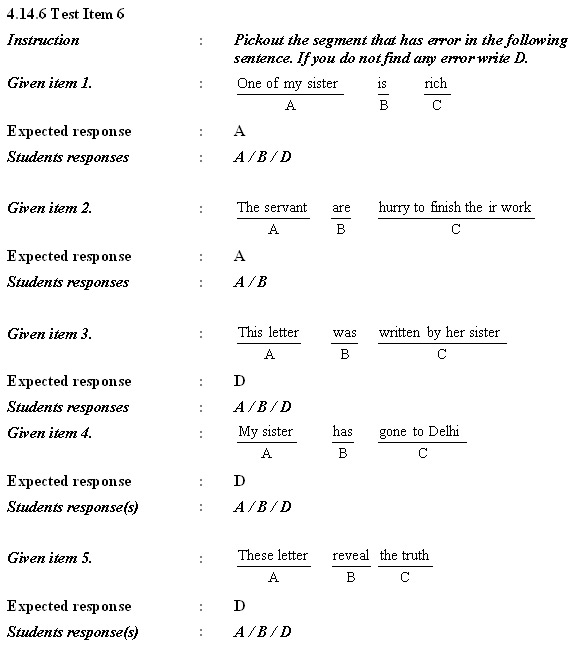
|
Test No. |
Given Text |
Mode of Questioning |
Performance in % |
||
|
Expected response |
Partially correct |
Irrelevant |
|||
|
6 |
Spot the error |
Pick out the error from the sentences
given |
35 |
40 |
25 |
35% of the students have responded correctly, 40% of the students have answered partially and remaining 25% of the students have responded incorrectly. This happened since the students have poor grammatical knowledge.
That is, the learners could not identify the erroneous parts given in the test items. In the test items 1, 2 and 5 the errors are in the first parts(A) of the sentences. Thus, the plural marker 's' is missed in the noun forms like 'one of my sister, the servant, and 'these letter'. So, failure in recognizing the grammatical features of the noun forms indicates their poor reading comprehension skill and linguistic competence.
|
4.14.7 Test Item 7 |
|
|
Given text |
Telegram |
|
Instruction |
Read the following and fill in
the blanks with correct word choosing from the questions given within
brackets. |
|
Given item 1. |
: |
The given item is ���.. (an
advertisement, a letter, a telegram) |
|
Expected response |
: |
a telegram |
|
Students responses |
: |
a telegram� / a letter |
|
|
|
|
|
Given item 2. |
: |
The information is given to Reena who is at ���.. (Dharmapuri, Coimbatore, Erode) |
|
Expected response |
: |
Coimbatore |
|
Students responses |
: |
Coimbatore / Dharmapuri |
|
|
|
|
|
Given item 3. |
: |
He was admitted in ���. (G.H.,
Vimala Clinic, Kamalam Clinic) |
|
Expected response |
: |
Kamalam Clinic |
|
Students response sample |
: |
Kamalam Clinic |
|
|
|
|
|
Given item 4. |
: |
Reena father needs ��� (Meditation, rest treatment) |
|
Expected response |
: |
treatment |
|
Students responses |
: |
treatment / rest |
Comments
|
Test No. |
Given Text |
Mode of Questioning |
Performance in % |
|
|
Expected |
Partially correct |
|||
|
7 |
Telegraphic passage |
Fill up the �blanks using the options given |
59.5 |
40.5 |
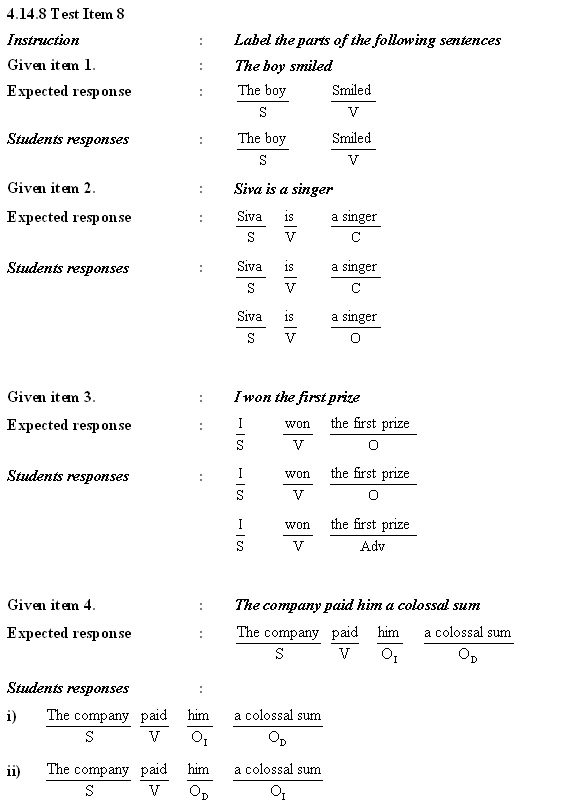
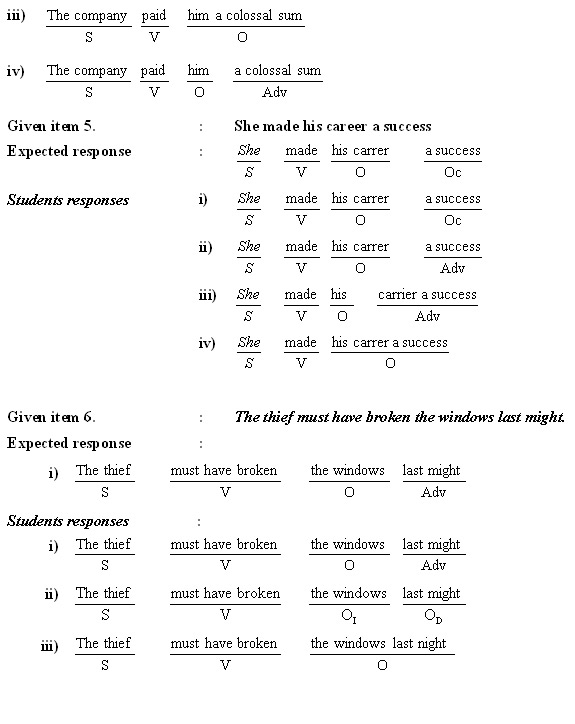
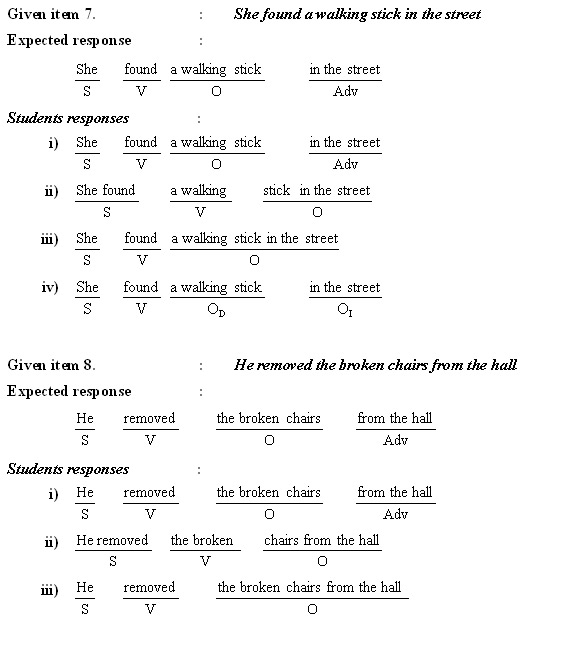
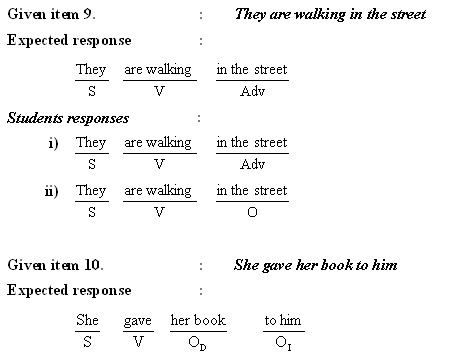
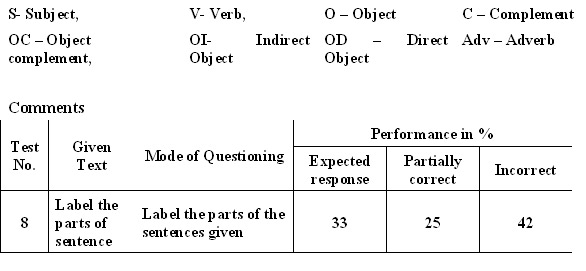
33% of the students have labelled all the given sentences correctly, 25% of the students have labelled partially and remaining 42% of the students have labelled incorrectly. Reason for incorrect labelling is due to the students' poor grammatical knowledge. That is, the students could not distinguish the difference between past participle 'broken' in the noun phrase 'broken chair', and verb 'broken' in the verb phrase 'have broken'; the students have labelled for these two phrasal words as only verb. Similarly, they could not distinguish the difference between object pronoun (him) and possessive pronoun (his), and they have failed to differentiate the direct object and indirect object and so on as indicated in the samples given above.
|
4.14.9. Test Item 9 |
|
|
|
Given text |
: |
Passage |
|
Instruction |
: |
Read the given passage and
answer the questions carefully. |
|
Question 1 |
: |
What does the passage mainly
discuss? |
|
Given Options |
: |
a) Alfered Bernhand Nobel |
|
|
|
b) The Nobel Prizes |
|
|
|
c) Swedish Philanthropy |
|
Expected response |
: |
b) The Nobel Prizes |
|
Students responses |
: |
b / a |
|
|
|
|
|
Question 2 |
: |
Why were the prizes named after
Alfered Bernhand Nobel? |
|
Given Options |
: |
a) He left money in his will to establish
a fund for the prize |
|
|
|
b) He won the first prize for his work in philanthropy |
|
|
|
c) He is now living in Swedon |
|
Expected response |
: |
a |
|
Students responses |
: |
a / b |
|
Question 3 |
: |
How often the Nobel prizes
awarded? |
|
Given Options |
: |
a) five times a year |
|
|
|
b) once a year |
|
|
|
c) Twice a year |
|
Expected response |
: |
b |
|
Students responses |
: |
b /c |
|
|
|
|
|
Question 4 |
: |
Why are the awards presented on
December 10? |
|
Given Options |
: |
a) Because it is a tribute of the King of
Sweden |
|
|
|
b) Because Alfred Berhand Nobel died on that day |
|
|
|
c) Because that date was established in Alfred Nobel�s will |
|
Expected response |
: |
b |
|
Students responses |
: |
b /c / a |
|
Test No. |
Given Text |
Mode of Questioning |
Performance in % |
|
||
|
Expected |
Partially correct |
Incorrect |
||||
|
9 |
Passage |
Read the give passage and answer the
questions |
39 |
45 |
16 |
|
39% of the students have answered correctly and 45% of the students have responded partially and remaining 16% of the students have answered incorrectly. Occurrence of some hard words like 'bequeathed', endowed, 'unworthy', contribution, etc in the test passage is responsible for wrong responses. So, it is evident that hard words found in the reading materials place the students in trouble in understanding the concept of the texts.
|
4.14.10. Test Item 10 |
|
|
|
Given text |
: |
Pie-graph |
|
Instruction |
: |
Study the pie-graph shown
below. Answer the questions that follow |
|
Question 1 |
: |
This pie-chart stands for
_________ |
|
Given Options |
: |
a) The land share of different continents |
|
|
|
b) The position of gold production by these continents |
|
|
|
c) The possession of gold by these continents |
|
Expected response |
: |
b |
|
Students responses |
: |
b / c |
|
|
|
|
|
Question 2 |
: |
The largest producer of gold is
___________ |
|
Given Options |
: |
a) Africa |
|
|
|
b) North America |
|
|
|
c) Kolar Gold Field |
|
Expected response |
: |
b) The Nobel Prizes |
|
Expected response |
: |
a |
|
Students response(s) |
: |
a |
|
|
|
|
|
Question 3 |
: |
Gold producing countries of
Asia mentioned are ____ |
|
Given Options |
: |
a) North America |
|
|
|
b) India |
|
|
|
c) India, Philippines |
|
Expected response |
: |
c |
|
Students responses |
: |
b / c |
|
|
|
|
|
Question 4 |
: |
The gold production of all the
other countries except Africa is _______ |
|
Given Options |
: |
a) 60% |
|
|
|
b) 40% |
|
|
|
c) 27.5% |
|
Expected response |
: |
b |
|
Students responses |
: |
b / c |
|
|
|
|
|
Question 5 |
: |
The third largest gold
producing continent is _____ |
|
Given Options |
: |
a) Asia |
|
|
|
b) North America |
|
|
|
c) South America |
|
Expected response |
: |
b |
|
Students responses |
: |
b / c |
Comments
|
Test No. |
Given Text |
Mode of Questioning |
Performance in % |
|
||
|
Expected |
Partially correct |
Incorrect |
||||
|
10 |
Pie graph |
Study the pie graph and answer the
questions given |
40 |
35 |
15 |
|
40% of the students have responded correctly 45% of the students have responded partially, and remaining 15% of the students have answered incorrectly. The uniqueness of the test item may be the cause of this state of affairs.
4.15. Summary on Reading Skill
4.15.1. Findings
It is found that in the test of completing the incomplete sentences, 54.5% of the students have failed to complete the incomplete sentences using the options given. The reason for the incorrect response is the ignorance of the grammatical functions and ignorance of meaning of the conjunctions, like co-ordination conjunctions, subordinating conjunctions, etc. used in the sentences. And in the test of answering the questions using passage, 30.5% of the students have answered incorrectly because of the failure in understanding the meaning of the words, like 'both', 'inspite of', 'except', etc. And also in the test item 3, 'matching table', there are 20% of the students wrongly matched the given parts of speech to make complete sentences. This is due to the failure in understanding of the phrasal verbs like 'gave up', 'climbed up' 'called on' etc.
Further, in the test of finding synonymous words, 20% of the students have responded incorrectly. It is because of poor vocabulary knowledge of the students. And in the test of recognizing homophonous forms 23.5% of the students have responded incorrectly. It happens as the students find problem in recognizing phonemes and vowel cluster differences within the given words. In the test of finding errors in sentences, there are 25% of the students who have responded incorrectly. This indicates their poor grammatical knowledge. In the telegram mode of testing, 40.5% of the students have responded incorrectly. This is due to the fact of unfamiliarity of the test passage.
In the test of labelling the parts of the sentences, 42% of the students have labelled incorrectly. This is due to the poor grammatical knowledge of the students. That is, they could not distinguish the difference between past participle 'broken' in the noun phrase 'broken chair', and verb 'broken' in the verb phrase 'have broken'. The students have labelled these two phrasal words as only verb. Further, they failed to distinguish the difference between objective pronoun (him) and possessive pronoun(his) etc. In the test of answering the questions using the 'passage', 16% of the students have answered to the questions incorrectly.
The wrong responses have found to occur as complex and / or unknown words, like 'bequeathed', 'endowed', 'unworth', contribution etc., are found in the testing passage. In the test of answering questions using pie graph, around 15% of the students have responded incorrectly. This is due to the uniqueness of text item.
It is concluded that the use of phrasal verbs, hard words, complex sentences, lengthy sentences, unknown contexts, etc. in the reading materials of the students hinders the students in understanding the concepts of reading materials.
4.15.2. Performance of the Students
The performance of both Tamil and English medium students in reading comprehension has been compared on the basis of the social variables taken.
The following table shows it:
|
Medium of instruction |
Sex |
Region |
Economical position |
Parental education |
|||||
|
M |
F |
R |
U |
LIG |
MIG |
HIG |
UED |
ED |
|
|
Tamil |
26 |
27 |
25 |
28 |
25 |
27 |
29 |
27 |
35 |
|
English |
28 |
30 |
28 |
29 |
26 |
28 |
30 |
32 |
39 |
It is observed that overall performance of the English medium students in reading comprehension looks better than that of the Tamil medium students.
The score difference between Tamil and English medium male students is 2%, and between female students is 3%. Further, the score difference between the students of uneducated parents - Tamil and English medium is 5%. And the score difference between the students of educated parents - Tamil medium and uneducated parents - English medium students is 3%; between the students of educated parents - English medium and uneducated parents - Tamil medium is 12%. So, it is inferred that the parental education plays a vital role in the development of the reading comprehension of the students.
Further, the score difference between LIG and MIG of English medium students is 2%, difference between MIG and HIG is 2% and difference between LIG and HIG is 4%.
Hence, Tamil medium students score difference between LIG and MIG is 1%, between MIG and HIG is1% and between LIG and HIG is 2%. Further, the score difference between English medium HIG and Tamil medium HIG is 5%.
So, it is evident to strengthen the point that the parental economical position too plays an important role in the development of the reading comprehension.
So, it can be concluded that the parental education and economical position and the medium of instruction significantly contribute to the learning achievement of the students especially in second language learning. However, the gender and geographical location have less influence over the process of learning reading comprehension of the students.
4.15. Remedies
The following remedies will be helpful for the enhancement of reading comprehension of the higher secondary students.
- Practice of differentiating the lexical and grammatical items, recognition of unfamiliar words and understanding of their literal and contextual meanings with the help of the teacher or dictionary will enhance the reading comprehensibility.
- Practice of labelling parts of speech and recognizing the word boundaries and tense markers will develop the linguistic competence of the students. Further, that will be helpful for enhancing the understanding ability of texts.
- Easy and simple vocabularies may be used in reading materials. Further, the hard and unknown vocabularies may be introduced in familiar context of the students. If it is unfamiliar context, both the context and vocabularies and hard words give them trouble. So, the use of unknown and hard words in a familiar context of the students will increase the understanding ability of the students.
- Teaching of reading comprehension, has to be done. That is, how to read, how to understand a text and how to understand a contextual meaning as well as literal meaning of words will increase the reading ability of the students.
- The reading games may be introduced in classroom. That is, finding phrasal verbs, differentiating the mono, die and tri syllable words, differentiating the nouns like common, abstract, animate, inanimate, etc. and the verbs like transitive and intransitive in sentence or discourse will be helpful for the development of linguistic competence which will enhance the reading comprehensibility of students.
CHAPTER 5 LISTENING SKILL
5.1. General
Listening is the first and foremost language mode that children acquire which provides the basis for the other language arts (Lundsteen, 1979).
The activity of listening plays an important role in the process of acquiring / learning language whether it is first or second language. Any impediment in the listening activity, will affect the linguistic development of other modes. In the process of acquiring the first language, children naturally listen to the language spoken around them. That is, they involve in the activity of listening passively for about one year right from the birth, then they actively participate in the linguistic society in which they dwell. But in the process of learning L2, the listening is voluntarily made activity. Thus, in the deliberate learning, learners are made to involve in listening to L2 where the linguistic nuances are taught step by step.
The linguistic items like phonemes, morphemes, lexical items, grammatical items, syntax and semantics are taught to listen in order to develop other modes of language - viz., speaking, reading and writing.
5.2. Listening Process
Listening is a complex, multistep process by which spoken language is converted into meaning in the mind" (Lundsteen, 1979:1). Wolvin and Coakly (1985) have identified three steps in the process of listening which are receiving, attending and assigning meaning. In the first step, listeners receive the aural stimuli or the combined aural and visual stimuli presented by the speaker. In the second step, listeners focus on or attend to select stimuli while ignoring other distracting stimuli. Because, so many stimuli surround students in the classroom, they must be attractive to the speaker's message, focusing on the most important information in that message. In the third step, listeners assign meaning to or understand, the speaker's message.
Further, Andreson and Pamela (1986) have identified three phases or stages of listening process-perception, parsing and utilization. In the perceptual phase, language learners focus on the sounds of language and store them in their echonic memory. In the parsing phase, listeners use words and phrases to construct meaningful representations. They recognize the formation of words as meaningful units that can be stored in short term memory. The size of the chunk that listeners retain depends on several factors including knowledge of language, knowledge of topic and the quality of the signal.
In the final phase or utilization phase the listener probe long-term memory to connect what they hear with what they already know. Stored information is in the form of schemata. They must therefore rely on the quality of their background knowledge.
5.3. The Process of Encoding and Decoding
An act of communication requires encoder-the speaker and decoder-the listener. The speaker encodes the concept or message through a set of code.
The listener decodes the concept or message from the set of code used by the speaker. That is, on the one hand, the act of encoding involves cohering the sounds into words, words into sentences, sentences into discourses. On the other hand, the act of decoding involves identifying the sounds, understanding the utterances and their meanings, and recognizing the prosodic features like tone, intonation, pitch, stress, etc. used by the speaker.
5.4. Listening Comprehensive Process
Richards (1990) draws two way process of listening comprehension: bottom-up and top-down processing. Bottom-up process is the use of incoming data as a source of information about the meaning of the message. Top-down process is the use of background knowledge in understanding the meaning of a message.
5.5. Speaker Meaning : Hearer Meaning
It is a common notion that the speaker provides meaning and the listener receives it. That is, the speaker conveys meaning and the listener receives the meaning as it is conveyed by the speaker. But in certain contexts, the listener can not understand the speaker's utterances; because he takes direct literal meaning of word instead of contextual meaning. Where the speaker's meaning differs from the listener meaning. In a conversational discourse, both the speaker's and the hearer's co-operation in sending and receiving meaning is important. If the speaker is deviant from the context, where the listener's responsibility is less than speaker's. Segardahal (1996) has distinguished two types of meaning. One is constant linguistic meaning and the another one is varying situational meaning.
|
|
|
|
|
|
Linguistic systems of sentences
|
|
|
|
|
���� Hearer
|
|
|
Constant linguistic meaning
|
|
|
|
|
|
Varying situational speaker-meaning
|
||
|
|
||


Adapted from Segrdahal, 1996:111
That is, in a given context, the linguistic element provides one meaning; the constant linguistic meaning, to the listener. In another context, the listener takes another meaning, contextual meaning, to the same linguistic element used in the another context.
5.6. The Speaker-Listener Polarity
The event of communication very much depends on two polarities - the speaker and the listener. These two polarities are essential requirements of communication. Communication is in fact a confrontation between two individuals with a view of exchanging some information or getting some intention fulfilled.
For the effective exchange of information, both the speaker and the listener are expected to be equipped with the competence of the language which is used. That is, the same level of competence is expected from the listener and the speaker as well. Any short coming in the linguistic competence of the listener or the speaker, would affect the communication. So, both the polarities should be more or less equally equipped with the linguistic competence of that language for effective and efficient communication.
5.7. Types of Listening
Galvin (1985) has identified eight categories of listening with due general purpose.
- Transactional listening - learning new information (speeches, debates, political conventions).
- International listening - recognizing personal component of message (new piece of speech, report).
- Critical listening - evaluating reasoning and evidence (news broadcast).
- Recreational listening - appreciating random or integrated aspects or event.
- Listening for appreciation - information, making critical discrimination or selection.
- Selective listening - selecting certain features at a time (phonetic features).
- Intensive listening - for details (vocabulary, grammar).
- Extensive listening - general idea (stories, rhymes, songs.
Some of the types of listing are described as follows.
5.7.1. Listening for Appreciation
It can increase our enjoyment through radio and TV programs. Listening to those not only helps to decrease the tension in our daily life, but also enlarges our experiences and expands the range of what we enjoy. Close attention will enable us to increase our own use of language.
5.7.2. Listening for Information
The speeches of candidates for public office, political debates and proceedings at political conventions etc., presented on television particularly carry information pertaining to national and world level affairs. Through informative listening we can find answers to the problems, get directions, hear news of current interest and get the opinions of others. It provides food for conservation and examples for the expansion of ideas, speeches, letters and in other writings.
5.7.3. Critical Listening
The critical listener must remain objective. He should not be moved by emotions or subjective feelings. He should judge on the basis of information and facts. Critical listening involves discriminatory facts from opinion; detecting prejudice and bias; sensing the speaker's detecting purpose. The term "critical listening" means a questioning attitude, analysis and judgement of spoken material equivalent to "critical reading" of written materials.
5.7.4. Selective Listening
The technique of selective listening consists fundamentally in listening only to certain features at a time. One should listen for only one feature or set of features at a time. Then, one should listen successively to all the features of a language. It should be systematic. The feature of selective listening are :
(a) phonetic feature (only vowel sounds are available)
(b) vocabulary
(c) Grammar (i.e., morphology and syntax).
5.7.5. Extensive Listening
Stories, rhymes, songs, television advertisement, poems, fairy tales and legends are given for extensive listening. Through extensive listening, plenty of opportunity is given to develop and exercise one's listening skill in a natural way. The listener will be following the meaning simply; because, he is interested in getting the information or getting enjoyment.
5.7.6. Intensive Listening
If a teacher wants to train the listeners to have the ability for detailed comprehension of meaning and to get them to particular features of language such as vocabulary, grammar or pronunciation, they must train the listeners in intensive listening practice.
5.8. Relationship between Speaking and Listening
Speaking and listening are interdependent processes. The activity of speaking requires at least a listener, an individual or an audience. The speaker speaks keeping certain objectives in his mind. That is, speaking involves conveying meaning using a code and listening involves understanding the meaning with the help of code what the speaker used. If it is transaction, one way listening, the speaker does not receive feedback, but if it is interaction, two way listening, the speaker receives feedback from the listener. In transactional or conversational discourse, sending-receiving and receiving-sending are an alternative phenomena. The relationship between speaking and listening is schematically represented as follows.
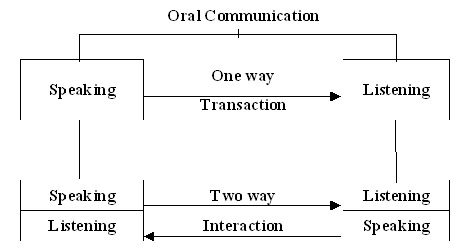
5.9. Purpose of Listening
Every activity of an individual or a group has purpose. Without purpose, there is no action in the linguistic society. Wolvin and Coakley (1985) delineate five specific purposes of listening as :
- Discriminative listening
- Aesthetic listening
- Efferent listening
- Critical listening
- Therapeutic listening
a. Discriminative Listening
People listen to distinguish sounds and to develop a sensitivity to nonverbal communication. Teaching discriminative listening involves teaching of different kinds of tape recorded sounds of animals, common house hold noises, etc.
b. Aesthetic Listening
People listen aesthetically for pleasure, to a speaker or reader when they listen for enjoyment. Listening to someone reading stories aloud or reciting a poem is a pleasurable activity.
c. Efferent Listening
People listen efferently to understand a message, and this is the type of listening required in many instructional activities, particularly in theme cycles. Students determine the speaker's purpose and then organize the information they are listening to in order to remember them. Note taking is typically the one efferent listening strategy generally taught in secondary and higher secondary grades.
d. Critical Listening
People listen to get information and then to evaluate a message. Critical listening is an extension of efferent listening. As in efferent listening, here listeners seek to understand a message to detect propaganda devices and persuasive language. Critical listening is used when people listen to debates commercials, political speakers and other arguments.
e. Therapeutic Listening
People listen to allow a speaker to talk through a problem. Children, as well as adults, serve as a systematic listener for friends and family members. Although this type of listening is important, it is less appropriate for the learners.
5.10. Sub-Skills of Listening
Each skills of language comprises a large number of sub skills, whose value and relevance vary from one situation to another. Rosts (1990) has distinguished two kinds of clusters of microskills of listening : 'Enabling skills' (those employed in order to perceive what the speaker is saying and to interpret what they intended to mean) and 'Enacting skills' (those employed to respond appropriately to the message).
5.10.1. Enabling Skills
5.10.1.1. Perception
Recognizing prominence within utterances, including:
- Discriminating sounds in words, especially phonemic contrasts.
- Discriminating strong and weak forms, phonetic change at word boundaries.
- Identifying use of stress and pitch (information units, emphasis, etc.)
5.10.1.2. Interpretation
Formulating content sense of utterance , including :
- Deducing the meaning of unfamiliar words.
- Inferring implicit information.
- Inferring links between propositions.
Formulating a conceptual framework linking utterances, including :
- Recognizing discourse markers (clarifying, contrasting).
- Constructing a theme over a stretch of discourse.
- Predicting content.
- Identifying elements that help you to form an overall schema.
- Maintaining and updating the context.
Interpreting (possible) speaker intention, including :
- Identifying an 'interpersonal frame speaker-to-hearer.
- Maintaining charges in prosody and establishing (in) consistencies.
- Noting contradictions, inadequate information, ambiguities.
- Differentiating between fact and opinion.
5.10.2. Enacting Skills
Making an appropriate response (based on the above) including:
- Selecting key points for the current task.
- Transcoding information into written form (for examples, notes).
- Identifying which points need clarification.
- Integrating information with that from other sources.
- Providing appropriate feedback to the speaker (Adapted from Rost, 1990 : 152-153).
5.11. Difficulty Factors in Listening
Research over years has attempted to define which factors contribute to make a particular listening passage difficulty or easy to comprehend. Among the most notable works are that of Brown (1986, 1995b) and Rubin (1994). Rubin's excellent review of listening identified characteristics that affect listening:
- Text characteristics.
- Interlocutor characteristics.
- Task characteristics.
- Listener characteristics.
- Process characteristics.
By way of illustration, here is a brief synopsis of Brown's characterization of the first of those characteristics, those related to the text itself. It has been shown that a listening text will be easier:
- If there are few speakers and objects.
- If the speakers and objects are distinct and different from one another.
- If the order of telling the events matches the order in which the event occurred.
- If the inferences called for are those that one would have predicted.
- If the context of the text fits with what the listener already knows (exploiting and existing schema).
5.12. Teaching Listening Comprehension
In the classroom atmosphere, the students generally listen to the teacher who give directions and instruction, to the classmates during discussion and to someone reading stories and poetry aloud. Listening is not neglected; however, the students are in need of teaching listening strategies or instruction. Teaching listening can be categorized into two modes. The first one is teaching linguistic nuances like phonemic variations, discrimination of similar sounds in words, recognizing word boundaries, recognizing morphemes, distinguishing grammatical and lexical items in a sentence, etc. The second one is teaching how to listen a context, how to deduce meaning for an unfamiliar word, how to recognize theme over a discourse. These two modes are important and inseparable for teaching of listening comprehension. If any shortcoming is found in teaching of either of this mode, its consequences will be seen in other skills of language.
5.13. Testing Listening Skill
The test items: Dialogue, news, railway announcement, sentence, words, word pairs, numbers, telephone numbers, years, days were used to test listening comprehension of the students understudy. These test items aim at evaluating the ability and skills of listening such as : predicting text based information, deducing meaning of unfamiliar words, recognizing prominence with in utterance including : Discriminating sounds in words especially phonemic contrasts, phonetic changes, deducing the meaning of unfamiliar words, recognizing grammatical errors in sentences, recognizing word boundaries, etc.. The following table shows the number of test items used and purpose of testing.
|
Sl. No. |
Test Items
|
Purpose |
|
1. |
Dialogue |
Inferring
the text based information |
|
2. |
News |
Inferring
implicit information, deducing meaning of unfamiliar words |
|
3. |
Railway
Announcement |
Inferring
explicit information |
|
4. |
Sentence |
Grammar
error recognition |
|
5. |
Words |
Discriminating
phonetic change |
|
6. |
Words |
Recognizing
the phonemic contrast (voiced, voiceless) |
|
7. |
Word pair |
Recognizing
the phonemic variation (aspirated and�
unaspirated fricative) |
|
8.a. |
Number |
Recognition
of number� boundaries and recalling |
|
b. |
Telephone
numbers |
Discriminating numbers in
a series and recalling |
|
c. |
Years |
Recognition
and recalling |
|
d. |
Days |
Recognition
and recalling |
5.14. DATA ANALYSIS
5.14.1. Test Item 1
Given text : A dialogue (between an English scholar and a prudent boat-man in a boat while crossing rough waters) Appendix - IV. Instruction : Listen carefully to the dialogue and answer the question that follow each.
Question 1. The scholar found out that the boatman knew little English grammar by the latter ____________
Options : a) pronunciation b) expression of ideas c) use of double negative to express concurrence d) use of double negatives to express a denial Expected response : d Students responses : d / a / c
Question 2. The boatman seemed to ____________
Options : a) worry about his bad grammar b) respect the scholar for his wisdom c) worry about the safety of his boat d) be troubled by nothing Expected response : c Students responses: c / a / d
Question 3. The scholar had wasted all his life by ____________
Options : a) not learning how to swim b) learning only grammar c) not knowing how to move with other d) not learning how to soil a boat Expected response : d Students responses: a / b / d
Question 4. The danger that the scholar had to face was ____________
Options : a) to sink in the rough waters b) to fight with the boat man c) to row the boat for many hours d) to jump into the rough waters Expected response : a Students responses : a / b / d
Comments
|
Test item |
Given text |
Mode of questioning |
Task involved |
Performance in % |
|||
|
Correct response |
Partially correct response |
Incorrect response |
Unanswered |
||||
|
1. |
Conversation |
Objective |
Inferring text based
information |
37 |
49 |
17 |
9 |
Only 37% of the students have selected the correct responses, 49% of the students have answered partially, 17% of the students have responded incorrectly, and remaining 9% of the students have left without answering to the questions. The reasons for the correct responses are that the given conversational discourse is very simple one, and the words which are used in the conversation are not hard ones. It is evident that the easy and simple words make the learners to observe the information easily from the conversational discourse.
5.14.2. Test Item 2
Given text : News item
Instruction: Listen to the news item and answer the questions that follow.
|
Question :
1. |
The Prithvi
missile is meant for ____________ purpose. |
|||||
|
Options : |
a) |
testing |
b) |
civil |
|
|
|
|
c) |
spying |
d) |
attacking |
|
|
|
Expected
response : d |
|
|
|
|||
|
Students responses : c / d
/ a |
|
|
|
|||
|
|
|
|
|
|||
|
Question :
2. |
It was
test-fired at _____________ |
|||||
|
Options : |
a) |
Sriharikota |
b) |
Thamba |
|
|
|
|
c) |
Chandipur |
d) |
New Delhi |
|
|
|
Expected
response : c |
|
|
|
|||
|
Students responses : a / c
/ d |
|
|
|
|||
Comments
|
Test item |
Given text |
Mode of questioning |
Task involved |
Performance in % |
||
|
Correct response |
Partially correct response |
Incorrect response |
||||
|
2. |
News |
Objective |
Inferring the implicit information and deducing meaning of unfamiliar
words |
35 |
48 |
17 |
35% of the students have answered correctly and 48% of the students have answered partially. Of 48%, majority of the students have responded incorrectly to the first and third questions due to the failure in understanding the meaning of the words 'lethal' 'Missile' in the given news item. Further, 17% of the students have responded incorrectly to all the questions. Because of the hard words like 'test-fired', 'lethal', 'missile', interim, and so on found in the test item and because of the poor comprehending ability of the learners.
5.14.3. Test Item : 3
Given text : Announcement Instruction : Listen to the announcement carefully and answer the questions that follow.
|
Question :
1. |
Where can
one hear this kind of announcement? |
||||
|
Expected
response� : |
i) |
Railway
station |
|
||
|
Students responses :: |
ii) |
Railway station |
|
||
|
|
iii) |
Bus stand |
|
||
|
|
|
|
|
||
|
Question :
2. |
State the
train number announced? |
||||
|
Expected
response� : |
i) |
2627 |
|
||
|
Students
responses� : |
ii) |
2627 |
|
||
|
|
iii) |
2726 |
|
||
|
|
iv) |
6272, etc. |
|
||
|
|
|
|
|
||
|
Question :
3. |
Mention the
platform number from which the train starts? |
||||
|
Expected
response� : |
i) |
Two |
|
||
|
Students responses� : |
ii) |
Two |
|
||
|
|
iii) |
2, One, etc. |
|
||
|
|
|
|
|
||
|
Question : 4. |
When will
the train start? |
||||
|
Expected
response� : |
i) |
14 hours and
15 minutes |
|
||
|
Students responses� : |
ii) |
14 hours and 15 minutes |
|
||
|
|
iii) |
15 hours and 14 minutes |
|
||
|
|
iv) |
4.50 |
|
||
|
|
v) |
4.15, etc. |
|
||
|
Question :
5. |
What is the
name of the train? |
||||
|
Expected
response� : |
i) |
The
intercity express |
|
||
|
Students
responses� : |
ii) |
The
intercity express |
|
||
|
|
iii) |
The city
express |
|
||
|
|
iv) |
The express |
|
||
Comments
|
Test item |
Given text |
Mode of questioning |
Task involved |
Performance in % |
|||
|
Correct response |
Partially correct response |
Incorrect response |
Unanswered |
||||
|
3. |
Announcement |
Question / answer |
Inferring explicit information |
36 |
40 |
19 |
5 |
Only 30% of the students have answered correctly. 40% of the students have responded partially. 25% of the students have responded incorrectly and remaining 5% of the students have left the questions without answering. This is due to the failure in distinguishing and observing the train number as well as the time pronounced in the announcement. This is by virtue of the unfamiliarity with the railway announcement eventhough the answers are found explicitly in it.
5.14.4. Test Item 4
Given text : Sentences Instruction : You will hear five sentences read out once one after one; write down right or wrong depending on the grammar of the sentences.
|
Given
sentence� 1 �� : |
One of my sisters are doctor. |
|
Expected response �� :
|
Wrong
|
|
|
Students responses : |
Wrong / Right |
|
|
Given sentence�
2��� : |
He have
been working in a college since 1998 |
|
Expected response �� :
|
Wrong
|
|
|
Students responses� :
|
Wrong / Right |
|
|
|
|
|
|
Given sentence�
3��� : |
They are
going to Delhi to meet prime minister next week |
|
Expected response �� :
|
Right
|
|
|
Students responses� :
|
Right / Wrong |
|
|
|
|
|
|
Given sentence�
4��� : |
4. Although
he is rich, he is humble |
|
Expected response �� :
|
Right
|
|
|
Students responses� :
|
Right / Wrong |
|
|
|
|
|
|
Given sentence�
5��� : |
5. He play
cricket yesterday |
|
Expected response �� :
|
Wrong
|
|
|
Students responses� :
|
Right / Wrong |
|
|
|
|
|
|
Given sentence�
6��� : |
6. She go
to temple daily |
|
Expected response �� :
|
Wrong
|
|
|
Students responses� :
|
Right / Wrong |
|
Comments
|
Test item |
Given text |
Mode of questioning |
Task involved |
Performance in % |
||
|
Correct response |
Partially correct response |
Incorrect response |
||||
|
4. |
Sentence |
Findout the given sentences right or wrong depending or grammar |
Recognition of Grammar error |
30 |
21 |
49 |
Only 30% of the students have responded correctly. 21% of the students have answered partially and remaining 49% of the students have responded incorrectly. The student are not able recognize the grammatical errors which are found in the given items due to the poor grammatical knowledge of the students.
5.14.5. Test Item : 5
Given text : Words Instruction : Listen carefully and trace out the word which is add out from the following group of words in pronunciation.
|
1. |
Read out words
|
: |
caught, taught, ought, taught, doubt |
|
|
Expected response |
: |
doubt |
|
|
Students
responses |
: |
doubt /
ought / taught |
|
|
|
|
|
|
2. |
Read out words
|
: |
brake, ache, shake, streak break |
|
|
Expected response |
: |
streak� |
|
|
Students
responses |
: |
streak /
ache / shake |
|
|
|
|
|
|
3. |
Read out words
|
: |
care, near, wear, fear, tear |
|
|
Expected response |
: |
care |
|
|
Students
responses |
: |
care / near
/ wear / tear |
|
|
|
|
|
|
4. |
Read out words
|
: |
shower, power, cover, power, hour |
|
|
Expected response |
: |
pour |
|
|
Students
responses |
: |
power / shower
/ hour |
Comments
|
Test item |
Given text |
Mode of questioning |
Task involved |
Performance in % |
||
|
Correct response |
Partially correct response |
Incorrect response |
||||
|
5. |
Word� |
Trace out the |
Discriminating phonetic change |
28 |
40 |
32 |
There are 28% of the students responded correctly, 40% of the students have responded partially and remaining 32% of the students have responded incorrectly. This is because of the fact that the students are not able to discriminate the slight variations in the pronunciation of the words or phonetic changes of the words.
5.14.6 Test Item 6
Given text - Word Instruction : You will hear the following sentences readout once in each sentence, the speaker will use one of the underlined words. Listen carefully and encircle the word you hear.
|
Given
sentence ������ ����������� : |
I wonder why
he hit / hid the dog |
|
Readout word� ������������������� :
|
hit
|
|
|
Students encircled words �� : |
hit / hid |
|
|
|
|
|
|
Given
sentence ������������������ : |
He used to
keep bills / pills in that book. |
|
Readout word� ������������������� :
|
bills
|
|
|
Students encircled words �� : |
bills / pills |
|
|
|
|
|
|
Given
sentence ������ ����������� : |
Let�s go and
look at the cards / guards |
|
Readout word� ������������������� :
|
cards
|
|
|
Students encircled words �� : |
cards / guards |
|
|
|
|
|
|
Given
sentence ������������������ : |
Put all
these things in the back / bag |
|
Readout word� ������������������� :
|
bag
|
|
|
Students encircled words �� : |
bag / back |
|
|
|
|
|
|
Given
sentence ������������������ : |
They need at
least two more logs / locks |
|
Readout word� ������������������� :
|
locks
|
|
|
Students encircled words �� : |
locks / logs |
|
|
Given
sentence ������������������ : |
You need a
longer robe / rope than that |
|
Readout word� ������������������� :
|
robe
|
|
|
Students encircled words �� : |
robe / rope |
|
|
|
|
|
|
Given
sentence ������������������ : |
He expected
to get a bigger batch / badge |
|
Readout word� ������������������� :
|
badge
|
|
|
Students encircled words �� : |
batch / badge |
|
Comments
|
Test item |
Given text |
Mode of questioning |
Task involved |
Performance in % |
||
|
Correct response |
Partially correct response |
Incorrect response |
||||
|
6. |
Word |
Encircling the readout
word |
Recognition of Phonemic contrast (voiced, voiceless) |
38 |
20 |
32 |
Only 38% of the students have answered correctly, 20% of the students have responded partially and remaining 32% of the students have responded incorrectly. Reason for the incorrect response is the failure in recognizing and differentiating the voiced and voiceless sounds clearly.
5.14.7. Test Item 7
Given text : Word pair
Instruction : You will hear five pairs of words. Pair will be read out once to decide whether the two words one the same(s) are different (d) in pronunciation. Write S or D in the space against the number of the set.
|
1. |
Pair readout
|
: |
sip/ship |
|
|
Expected response |
: |
D |
|
|
Students
responses |
: |
D / S |
Comments
|
Test item |
Given text |
Mode of questioning |
Task involved |
Performance in % |
||
|
Correct response |
Partially correct response |
Incorrect response |
||||
|
7. |
Words |
Deciding the words whether
same or different in pronunciation |
Recognition of phonemic variation |
42 |
27 |
32 |
42% of the students have responded correctly. 27% of the students have answered partially, and remaining 32% of the students have given incorrect responses. Reason for the poor performance may be failure in recognizing the difference between aspirated and unaspirated fricative sounds.
5.14.8. Test Item 8
Given text : Numbers
Instruction : Listen to the recording and write down what you have heard on tape. Further, the items should be transcoded in letters or words (The test items were readout once one after one with time gap).
a) The readout items :
1. forty
2. fifteen
3. three thousand four hundred and eighty
4. twenty
5. three hundred and eighty
Students responses for item 1
Correct response :
i) forty
Incorrect responses :
ii) four
iii) fourteen etc,
iv) 40, etc
Students responses for item 2
Correct response :
i) fifteen
Incorrect responses :
ii) fifty
iii) five
iv) 50, etc.
Students responses for item 3
Correct response :
i) three thousand four hundred and eighty
Incorrect responses :
ii) three thousand four hundred and eight
iii) three thousand four eight
iv) four hundred eight
v) 3418, 3480, etc.
Students responses for item 4
Correct response :
i) twenty
Incorrect responses :
ii) twenteen
iii) twenty two
iv) two
v) 20, etc.
Students responses for item 5
Correct response :
i) Three hundred and eighty
Incorrect responses :
ii) three hundred
iii) eighty three
iv) three hundred eight
v) 318, 380
Comments
|
Test item |
Given text |
Mode of questioning |
Task involved |
Performance in % |
||
|
Correct response |
Partially correct response |
Incorrect response |
||||
|
8. |
Numbers |
Write down what you have head on tape |
Number recognition and recalling |
31 |
60 |
9 |
31% of the students have responded correctly to all the items readout; 60% of the students have answered partially, and remaining 9% of the students have given incorrect responses to all the questions. The wrong responses occurred due to the failure and recklessness of students in listening the numbers read out accurately. Further, they failed to differentiate the endings of numbers like forty, fourteen twenty, and so on. Of the 9%, 2% of the students have answered in numbers instead of answering in words without considering the instruction given.
5.14.9. Test Item 8a
Given text : Telephone numbers
The readout test items :
i) two four double two three zero two
ii) two five eight two nine three
iii) five six three eight zero one
iv) three one four three nine double two
v) three one four two eight double one
Students responses for test item 1
Correct response :
i) two four double two three zero two
Incorrect responses :
ii) two four double three zero two
iii) four two three zero two
iv) 2422302 etc.
Students responses for test item 2Students responses for test item 3 Correct response : i) five six three eight zero one Incorrect responses : ii) five six three eight zero iii) five six three eight one iv) six three eight zero v) 563801 etc.
Correct response :
i. two five eight two nine three
Incorrect responses :
ii) two five two nine three
iii) two five eight two three
iv) two eight two nine
v) two five eight two nine
vi) 258293, etc.
Students responses for test item 4
Correct response :
i) three one four three nine double two
Incorrect responses :
ii) three one four nine double two
iii) three one four nine two three
iv) one four three nine double two
v) 3143911, etc.
Students responses for test item 5
Correct response :
i) three one four two double two
Incorrect responses :
ii) three one four two double two
iii) three one four two eight double eight
iv) 2142822, etc.
Comments
|
Test Item |
Given Text
|
Mode of
questioning |
Task
involved |
Performance in %
|
||
|
Correct
response |
Partially
correct response |
Incorrect
response |
||||
|
8a |
Telephone numbers |
Write down what you hear
on tape |
Telephone number
recognition and recalling |
30 |
45 |
25 |
30% of the students have responded correctly, 45% of the students have answered partially and remaining 25% of the students have given wrong answers. Further, they have deleted certain numbers and changed the order of the number which are read out. Of 25%, 5% of the students have responded in number instead of answering in words.
5.14.10. Test Item 8b
Given text : Years
The read out test items :
i) Nineteen seventy - five
ii) Two thousand - two
iii) Nineteen forty - eight
iv) Fifteen seventy five
v) Two thousand twenty five
Students responses for test item 1
Correct response:
i) Nineteen-five
Incorrect responses :
ii) Nine seventy five
iii) Nineteen seventeen
iv) 1975, etc.
Students responses for test item 2
Correct response:
i)Two thousand - two
Incorrect responses :
ii) Two thousand
iii) Two thousand twenty
iv) 2002, etc
Students responses for the test item 3
Correct responses :
i) Nine forty-eight
ii) Nine four eighteen
iii) 1914, etc
Students responses for test the item 4
Correct response:
i) Fifteen seventy five
Incorrect responses : ii) Fifteen seventeen five
iii) Five seventy five
iv) 1575, etc.
Students responses for the test item 5
Correct response: i) Two thousand twenty five
Incorrect responses :
ii) Two thousand twenteen
iii) Two thousand twenty
iv) Thousand twenty five
v) 2005 etc.
Comments
|
Test Item |
Given Text |
Mode of
questioning |
Task
involved |
Performance in %
|
||
|
Correct
response |
Partially
correct response |
Incorrect
response |
||||
|
8b |
Years |
Write down what you hear
on tape |
Recognition of word
boundaries and recalling |
41 |
54 |
5 |
41% of the students have responded correctly. 24% of the students have responded partially to the read out items and remaining 5% of the students responded incorrectly. The poor performance may be because of the difficulty in recognizing the word endings (Nineteen, Ninety, twenty, fifty, fifteen, etc.).
5.14.11. Test Item 8c
Given text: days
The readout items :
i) The fourteenth of July
ii) The second of October
iii) The twenty - third of month
iv) April the tenth
v) The fourth of October
Students responses for the item 1
Correct response:
i) The fourteenth of July
Incorrect responses:
ii) The fourteen July
iii) The forty July
iv) The four July
v) 14, July, etc.
Students responses for the test item 2
Correct response:
i) The second of October
Incorrect responses:
ii) The second October
iii) October second
iv) The October second
v) 2, October, etc
Students responses for the test item 3
Correct response :
i) The twenty-third of month
Incorrect responses:
ii) Twenty third March
iii) March twenty third
iv) 24 March etc.
Students responses for the test item 4
Correct response :
i) April the tenth
Incorrect responses:
ii) April tenth
iii) April ten
iv) Ten April
v) 10, April etc,
Students responses for the item 5
Correct response:
i) The fourth of October
Incorrect responses
ii) October fourth
iii) Four October
iv) The October four
v) 4, October etc.
Comments
|
Test Item |
Given Text |
Mode of
questioning |
Task
involved |
Performance
in % |
||
|
Correct responses |
Partially
correct responses |
Incorrect
responses |
||||
|
8c |
Days |
Write down what you hear
on tape |
Recognition and recalling
|
45 |
49 |
6 |
45% of the students have responded correctly. 49% of the students have responded incorrectly and remaining 6% of students have responded incorrectly. Of 49%, 20% of the students have missed certain grammatical items i.e 'the' and 'of' and changed the orders of items pronounced due to the recklessness in listening the words pronounced and ignorance of the importance of ordering the date and month while recalling or writing them in words.
5.15. Summary on Listening Skill
5.15.1. Findings
It is unearthed that for the test of 'inferring the text based information', 49% of the students have answered correctly. 31% of the students have responded partially, 17% of them answered incorrectly and only 3% of them understudy have skipped this test item. The reason for the good performance of the students in this test item is that the given dialogue is constructed with simple and familiar words which enable the learners to comprehend the given dialogues easily. So it is inferred that the simple and familiar words facilitate the listening comprehension of the students. Further, it is found that the hard and unfamiliar vocabularies hinder them to understand the concept. That is, they are not able to deduce and guess the meaning of unfamiliar and hard words using the contextual clues.
The words 'test-fired' 'missile' and 'lethal' have troubled them in understanding the concept embedded in the discourse.
In the test of 'inferring explicit Information', there are only 24% of the students responded incorrectly. This is due to unfamiliarity with this context. That is, the students who have responded incorrectly are not exposed to the Railway announcement. So it is evident that the sociolinguistic knowledge also helps the language user to understand a discourse. Hence, for the test of identifying errors in the given sentences, 30% of the students have responded incorrectly. Thus, they failed to recognize the distinction found between plural and singular nouns, tense markers, verb inflections, and auxiliaries which are given wrongly in the sentences. It is a known fact that the recognition of grammatical features in the sentences is important. Any difficulty found in recognizing these linguistic features will affect the understanding the meaning of sentences.
Apart from this the students failed to distinguish the slight phonetic variation of the group of words given viz., brake, ache, shake, streak, break.
In the test recognizing phonetic variations and phonemic contrasts with in given words, there are 32% of the students responded incorrectly for each item.
It indicates that they are not too conscious to the sound variations with in the words. Further, they are not able to distinguish voiced and voiceless and aspirated and unaspirated fricatives and affricatives.
Finally, in the test of recognizing and recalling number, Telephone number, years, days, majority of the students have performed well. However, some of the students failed to recognize word endings of numbers (forty, fourteen, fifty, fifteen etc.). Further, they miss the numbers when they are given more than five digits and the grammatical items 'the' and 'of ' from the given test items.
5.15.2 Performance of the Students
The performance of both the medium students in listening comprehension is compared and contrasted keeping the social parameters taken. The table shows the overall performance of the students.
Comparison of students performance in %
|
Medium of Instruction |
Sex |
Region |
Economical position |
Parental education |
|||||
|
M |
F |
R |
U |
LIG |
MIG |
HIG |
UED |
ED |
|
|
Tamil |
28 |
29 |
26 |
28 |
28 |
29 |
29 |
29 |
32 |
|
English |
30 |
31 |
29 |
32 |
30 |
32 |
34 |
30 |
40 |
It is inferred on the basis of the data collected that the performance of the students from educated background and English medium is better than that of the educated background and Tamil medium. The score difference between them is 8%. However, the score different between Tamil and English medium with uneducated background is 1%. So, it is evident that the medium of instruction plays a vital role in the performance of listening comprehension. The performance score difference between Tamil medium, male and female is 1%. And also, English medium, male and female students score difference is 1%. However, the English medium female students scored 2% more than the Tamil medium female students. The English medium male students scored 2% more than the Tamil medium male students.
The score difference between LIG and HIG is 4%, and MIG and LIG is 2%.
The reasons for the good performance of the students of English medium with educated background are that they are highly motivated, encouraged, academically assisted, etc by their parents in addition to the Teacher. Further, they have good exposure to the English language at the home front also. So it is evident that the background knowledge of the students and parents' motivation and encouragement help for the better performance in the listening comprehension.
5.16. Remedies
Listening is the root-cause for the development of other skills of language. Any shortcoming of listening will affect the development of other skills eventually. However, to overcome the listening shortcoming, the following remedies will be helpful for the L2 listeners.
- Teaching listening comprehension should not be ignored. It may be taught in the following manner: That is, how to understand a context, how to deduce meaning of a unknown vocabulary in a context, and how to understand the contextual / situational meanings of words.
- The tape recorded dialogues could be played before the students, and they could listen them, then the theme as well as questions may be asked on the basis of the dialogue. This type of practice will help the students' understanding capacity as well as communicative competence.
- Introducing the listening games like sound discrimination (k, g, kh, gh), Recognition of minimal pairs (put, but), Recognizing morphemes (free and bound morpheme), Recognizing syllables in words, Recognizing silent letters in words, identification of parts of speech etc. will help to build up listeners ability to discriminate L2 phonemes, morphemes and phonetic variation of sounds.
- The students can be made to listen to different current vocabularies and allow them to write down the synonymous and antonymous words for those vocabularies. Further, practice of finding equal L1 words for L2 as well as translation of sentence from L2 to L1 and voice versa will help to develop the linguistic competence of the students.
- Watching TV programs, films and listening to radio programs will certainly help to understand how the native and non-native speakers use the English language. It will help them also in understanding the dialectal variations of the language.
- Observing public announcements (Railway announcement, corporation transport announcement, etc.) will help to strengthen the sociolinguistic knowledge and the presence of mind.
CHAPTER 6 CONCLUSION
6.1. General
The present study, entitled "A study on the learning process of English by higher secondary students with reference to Dharmapuri District," has proved its objectives on the basis of the empirical evidences. By this study, the role of the variables has been identified in the process of learning English as a second language. The results have been presented in the preceding chapters.
This concluding chapter presents the findings of the present study, besides presenting the hypothesis testing, remedies for the problem encountered by the higher secondary students in the process of learning English linguistic skills and direction for the further studies.
6.2. Findings of the Study
Findings of the present research (that is various strategies followed by the students and different types of problems encountered by them in the process learning English linguistic skills) are summarised as follows.
6.2.1. Findings on Speaking Skill
It is found that in the process of learning to speak, the students followed certain strategies in their communication to conceal their linguistic inadequacy. The topic avoidance is the first and foremost strategy followed. 7% of the students avoided to talk with the researcher in English and to speak on given topic due to the anxiety, language shock, cultural shock and the linguistic inadequacy. Syntactic avoidance is yet another type of strategy, in which they have avoided to construct sentence. Instead of constructing sentence, they have given elliptical responses for the questions asked.
The strategy of semantic avoidance is of peculiar type, in which the students have avoided to follow semantic co-operation for the questions asked.
The learners follow the word-for-word translation from the native language to L2, and use the fillers in their communication whenever they encounter gap and linguistic inadequacy. Selfrepairing, drawling and repetition are yet another types of strategies followed by them. In the strategy of selfrepairing, certain vocabularies, grammatical items are selfcorrected. Sometimes, the selfcorrected items have gone wrong. Drawling is of lengthening the syllables. This strategy provides time to the speaker to search for the forthcoming elements. Repetition, is also one of the strategies followed by them. In this strategy the students have repeated certain items such as words, partial sentences and full sentences. It is found that the repetition of full sentences gives more time to the learners than the word or partial sentence repetition.
Message abandonment is a strategy followed by the students. The students initiate the communication on a specific topic, but in the mid, they cut short due to the difficulty, and the anxiety about the linguistic elements in the target language system.
The students reduce their voice when they feel that they are about to say in wrong. The strategy of voice reduction shows that they have no confidence in L2. Resource expansion strategy is yet another peculiar strategy whereby the learners attempt to increase their linguistic resources instead of giving required enough response.
Further, it has been observed that some of the students have invented certain new words in their oral communication, when they fail to find appropriate word or for the word which is absent in their mental lexicon. In certain contexts, the students follow the code switching strategy. That is, they use certain L1 words in L2. Approximation is yet another strategy in which the learners have used the approximate items instead of correct one. However, this approximate word share near semantic feature.
In addition to the above strategies, the learners follow the inter and intra lingual strategies. The learners adopt the strategy of inter lingual transfer when there is a difference between first and second language. The inter lingual strategies are phonological interference, diminishing diphthong, vowel lengthening, avoidance of initial consonant cluster, addition of vowel at the end position of word and gemination of consonant sounds.
The fricative sound [f] is absent in Tamil, so the Tamil speakers tend to substitute [p] in the place of [f]. The phonetic differences of a phoneme too lead interference. That is, Tamil has a mid-back rounded vowel [o] as observed in the word [po:] 'go' as found in English, but English [o] is phonetically different in certain environments from Tamil, because, it has a predominant upward backglide. As a result of this phonetic differentiation when the Tamil speakers speak English they produce English words with the upglide vowel natural in Tamil.
And also, the Tamil speakers have the tendency of lengthening the word final vowels. This occurs especially in the places where the English vowels are an upward backglide such as the words with the spelling 'u' 'oo' and 'ou'. Avoidance of initial consonant cluster by inserting a vowel in between the two members of consonant clusters and addition of vowel sound at the end position of the words which end with stop and fricative sounds. Reduplication of the consonant sounds is an another peculiar strategy adopted by the learners. These are some inter lingual strategies adopted by the learners in their communication.
Further, it has been found that the learners have adopted the intra lingual strategy whereever there is an irregularity in the rules of target language.
The learners have often overgeneralized the target language rules. For instance, the learners have the tendency to add simply 's' to all singular nouns whenever the need arises for the use of plural forms. And also, the suffix 'ed' was mostly used while changing the verb into a past form. However, the students have conjugated the 'ed' morpheme even to the irregular verbs. These are the some intralingual strategies followed by the learners in their oral communication.
6.2.2. Findings on Writing Skill
It is identified that the students under study have used the articles 'an' before words beginning with vowels, and 'a' before words beginning with consonant without considering the quality of letter or phoneme which begins in a word. Further, both definite and indefinite articles are indiscriminately used before noun/noun phrase and are unnecessarily omitted where they are required. Another type of error found out in the students writings is in the use of prepositions.
That is, the preposition 'on' is used before 'yesterday' 'tomorrow' 'last month', etc. This error is occurred because of the overgeneralization of the rule that 'on' is used before days as 'on Monday', 'on Sunday', etc. and also, the prepositions are unwantedly deleted and added.
The errors in the use of pronouns and adjectives are also identified. That is, the pronouns are wrongly substituted as 'my' instead of 'I' and 'myself; instead of 'me'. And also, the nouns are used where the adjectives require. The errors are also identified in the usage of nouns. The students tend to over generalize the rules where there is an irregularity in forming the plural noun forms. Another peculiar type of error was in use of the verbs. That is, in the negative sentences and in the interrogative sentences the double past was used; this is due to the L1 interference. Past forms are used where the past participles are required. Further, the learners tend to overgeneralize the verb forms due to the irregularity found in the formation of the past tense form.
Moreover, errors have also been identified in the grammatical items like adverbs and auxiliaries. The auxiliary verb 'am' is unnecessarily added in between the subject 'I' and verb (past form). This is due to the fact the copula verb 'am' functions as a main verb in certain contexts (I am a student). Because of the impact of this structure, learners unconsciously use 'am' whenever they have to use 'I' in a subject position. Further, the auxiliary verbs are wrongly substituted as 'am' instead of 'was', are instead of were and vice versa. The another problem area to the learners is concord; the grammatical agreement between words.
The agreemental problems are enormously found between demonstrative adjectives and noun, subject and verb, and relative pronoun and verb.
It is observed that number of errors are committed by the learners in sentence level also due to the dissimilarity of syntax pattern between L1 and L2. Further, it is found that the interrogative sentences are used in the reversed order as where + sub + aux + verb (where he was going) instead of where + aux + sub + verb + (where was he going). This is due to the influence of L2 spoken form on writing. And also there are a number of incomplete sentences found in the learner's writings. Hence, another problem area is orthographical, that is spelling. It is the fact that the English spelling rules itself is one of the reasons for the spelling errors in addition to the L1 interference and learners incorrect speech habits.
6.2.3. Findings on Reading Skill
It has been observed that in the test of completing the incomplete sentences, 54.5% of the students have failed to complete the incomplete sentences using the options given. The reason for the incorrect response is the ignorance of the grammatical functions and unaware of meaning of the conjunctions, like co-ordination conjunctions, subordinating conjunctions, etc. used in the sentences. And in the test of answering the questions using passage, 30.5% of the students have answered incorrectly because of the failure of understanding the meaning of the words, like 'both', 'inspite of', 'except', etc. And also in test item 3, 'matching table', there are 20% of the students wrongly matched the given parts of speech to make complete sentences. This is due to the failure in understanding the phrasal verbs like 'gave up', 'climbed up' 'called on' etc.
Further, in the test of finding synonymous words, 20% of the students have responded incorrectly. It is because of poor vocabulary knowledge of the students. And in the test of recognizing homophonous forms, 26.5% of the students have responded incorrectly. It happened as the students find problem in recognizing phonemes and vowel clusters differences within the given words. In the test of finding errors in sentences, there are 25% of the students responded incorrectly. This indicates their poor grammatical knowledge. In the telegram mode of testing, 40.5% of the students have responded incorrectly. This is due to the unfamiliarity of the test passage.
In the test of labelling the parts of the sentences, 42% of the students have labelled incorrectly. This may be because of the poor grammatical knowledge of the students. That is, they could not distinguish the difference between past participle 'broken' in the noun phrase 'broken chair', and verb 'broken' in the verb phrase 'have broken'. The students have labelled these two phrasal words as only verb. Further, they failed to distinguish the difference between objective pronoun (him) and possessive pronoun(his) etc. In the test of answering the questions using the 'passage', 16% of the students have answered to the questions incorrectly.
The wrong responses are found to occur as complex and or unknown words, like 'bequeathed', 'endowed', 'unworth', contribution etc., were found in the testing passage. in the test of answering questions using pie graph, around 15% of the students have responded incorrectly. This is due to the uniqueness of text item. It is concluded that the use of phrasal verbs, hard words, complex sentences, lengthy sentences, unknown contexts, etc. in the reading materials of the students hinders the students in understanding the concepts of reading materials.
6.2.4. Findings on Listening Skill
It has been found that for the test of 'inferring the text based information', 49% of the students have answered correctly. 31% of the students have responded partially 17% of them answered incorrectly and only 3% of them understudy have skipped this test item. The reason for the good performance of the students in this test item is that the given dialogue is constructed with simple and familiar words which enable the learners to comprehend the given dialogues easily. So it is inferred that the simple and familiar words facilitates the listening comprehension of the students. Further, it is observed that the hard and unfamiliar vocabularies hinder the students in understanding the concept. That is, they are not able to deduce and guess the meaning of unfamiliar and hard words using the contextual clues. The words 'test-fired' 'missile' and 'lethal' have given them difficulty in understanding the concept embedded in the discourse.
In the test of 'inferring explicit Information', there are only 24% of the students responded incorrectly. This is due to the unfamiliarity with this context. That is, students who have responded incorrectly have no exposure to the Railway announcement. So it is evident that sociolinguistic knowledge too helps the language user to understand a discourse. Hence, for the test of identifying errors in the given sentences, 30% of the students have responded incorrectly. Thus, they failed to recognize the distinction found between plural and singular nouns, tense markers, verb inflections, and auxiliaries which are given wrongly in the sentences. It is known fact that the recognition of grammatical features in the sentences is important. Any difficulty found in recognizing these linguistic features will affect the process of understanding the meaning of sentences. Moreover, the students failed to distinguish the slight phonetic variations of the group of words given viz. brake, ache, shake, streak, break.
In the test recognising phonetic variations and phonemic contrasts with in given words, there are 32% of the students responded incorrectly for each item.
It indicates that they are not too conscious to the sound variations found with in the words. Further, they are not able to distinguish voiced and voiceless and aspirated and unaspirated fricatives and affricatives.
Finally, in the test of recognizing and recalling numbers, (Telephone numbers, years, days), majority of the students have performed well. However, some of the students failed to recognize words endings of numbers (forty, fourteen, fifty, fifteen etc.). Further, they miss the numbers when they are given more than five digits, and the grammatical items 'the' and 'of ' from the given test items.
6.3. Hypotheses Testing
The role of social variables in the achievement of English language skills was identified keeping in view the score secured by the students. With the help of the results hypothesis have been either proved or disproved.
6.3.1. Hypothesis 1: The medium of instruction has direct impact on the achievement of the second language skills.
The scores obtained by the students of each medium under different variables have been totaled and mean score has been calculated. This has been depicted in the following table.
|
Skills of Language |
Mean score of performance both Tamil and English
medium students |
Mean score difference between the two. |
||
Tamil
|
English |
|
||
|
Speaking |
27.33 % |
34.33 % |
7 % |
|
|
Writing |
28.6 % |
32 % |
3.4% |
|
|
Reading |
28.66 % |
30 % |
2.34 % |
|
|
Listening |
25.22 % |
32.33 % |
7.11 % |
|
The mean score of English medium students is 34.33% in speaking, 32% in writing, 30% in Reading, and 32.33% in listening. The mean score of Tamil medium students is 27.33% in speaking, 28.6% in writing, 27.66% in reading, and 25.22% in listening. The score difference between Tamil and English medium students is 7% in speaking, 3.4% in writing, 2.34% in reading and 7.11% in listening. The empirical evidence shows that the English medium students in all the skills of language have got comparatively higher score than the Tamil medium students. So, the hypothesis 1, "the medium of instruction has direct impact on the achievement of second language skills" is proved.
6.3.2. Hypothesis 2 : None of the variables (Sex, Region, Parental Education and Income) plays any role in the development of second language skills.
To prove this hypothesis, as said earlier, the mean scores of Tamil and English medium students were drawn considering each variable in all the skills of language. The table shows it explicitly.
Language Skills |
Mean score performance
of both Tamil and English medium students on each variable in % |
||||||||||
|
Sex |
Region |
Economical position
|
Parental Education |
||||||||
|
M |
F |
R |
U |
LIG |
MIG |
HIG |
VED |
ED |
|||
|
Speaking |
28 |
28 |
29 |
31 |
28 |
32 |
34 |
29 |
35 |
||
|
Writing |
27 |
26 |
28 |
33 |
27 |
32 |
34 |
26 |
40 |
||
|
Reading |
27 |
28 |
26 |
28 |
25 |
27 |
29 |
29 |
37 |
||
|
Listening |
29 |
30 |
27 |
30 |
29 |
30 |
31 |
29 |
36 |
||
In speaking, the mean score difference between the students of ED and UED background is 6%, between HIG and LIG is 6%, between U and R is 2%, and between M and F is 0%. In writing, the mean score difference between ED and UED is 14%, between HIG and MIG is 2%, between MIG and LIG is 5%, between U and R is 5% and between M and F is 1%. In Reading, the mean score difference between UED and ED is 8%, between HIG and MIG is 2%, between MIG and LIG is 2%, between R and U is 2% and between male and female is %. In Listening, the mean score difference between ED and UED is 7%, between HIG and MIG is 1%, between MIG and LIG is 1%, between LIG and HIG is 2%, between R and U is 3%, between M and F is 1%.
The mean score difference between and among the variables shows that the students who come from well economical and educated background are better in the achievement of the skills of English language, and urban students performance is better than that of the rural students. In writing, male students is better than female. In Reading, female is better than the male. In listening, female is better than the male. However, in speaking, male and female students have got equal scores. The empirical evidence shows that the cited variables play significant role in the achievement of skills of language. Thus, the hypothesis, 'none of the variables (Sex, Region, Parental Education and Income) plays any role in the development of second language skills' is disproved.
6.3.3. Hypothesis 3: If a student is better in listening, he will be better in speaking only, and if a student is better in reading he will be better in writing only.
On the basis of the mean score of students performance received from each skill of language, it is found that the students who are better in listening are not only better is speaking but also in reading. The students who are better in reading are not only better in writing but also in listening and in speaking. Thus, as far as second language learning is concerned, both the listening and reading pave the way to acquire good command over the spoken English and also to have good performance over written English. It cannot be said that if a student is better in listening will be better in speaking only, and if a student is better in reading will be better in writing only. In the process of learning a second language, all the skills are interrelated. So, this hypothesis is disproved.
6.4. Remedies
On the basis of the findings the following remedies are suggested and these remedies would eradicate or atleast minimize the problems encountered by the learners in the process of learning English as a second language.
- To develop linguistic competence of the students, the language may be taught linguistically. That is, linguistic approach in teaching of English from the beginning would be helpful for the development of competence in English.
- Different types of conversational discourse may be taught, and the students should be given enough time for the development of conversational discourse in the school hours. The conversational discourse training will eliminate language shock and cultural shock. Further, that will help to develop communicative competence of the students.
- While teaching vocabulary of English, the grammatical functions and linguistic features of words should be taught. Further, the semantic value of words should be distinguished.
- The similarities and differences between L1 and L2 should be taught especially while teaching syntax which will eliminate the habits of literal translation from L1 to L2.
- While teaching pronunciation of words the phonetic similarities and differences of the phonemes should be demonstrated in the class room, and practices should be given in this area properly. Further, the awareness about the interference of L1 in the pronunciation of foreign sounds should be given timely to the learners.
- The students may be motivated to interact with teachers and peer groups in English in the home front in addition to the school atmosphere. Further, watching English programs on TV, listening to radio, loud reading, reading dailies, would help to develop the spoken language of English.
- To avoid errors in writings, students may be practiced to write stories, and the errors in the written items may be spotted then the reasons for the occurrence of errors should be indicated to the students. Further, editing training should also be given to the students.
- To prevent L1 interference on L2 sentence, various sentence types of both L1 and L2 should be differentiated and distinguished and that should be demarked to the students. The awareness about sentence types of both languages will automatically eliminate the errors in syntax. Thus, effort has to be taken to create syntactical awareness among the students.
- To avoid the overgeneralization of verb forms and other grammatical items the regularity and irregularity of the language rules may be taught and reinforced.
- To prevent the agreemental problems, the relationship between words should be taught, and if the problems are due to L1 structure, the relationship and variation between the L1 and L2 sentences may be indicated to the students.
- To avoid orthographical errors, appropriate pronunciation drills should be given to the students. By the preventing the L1 sounds in their L2 pronunciation, the spelling errors can be minimized in the learners writings.
- Practice of differentiating the lexical and grammatical items, recognition of unfamiliar words and understanding of their literal and contextual meanings with the help of teacher or dictionary will enhance the reading comprehensibility.
- Practice of labeling parts of speech and recognizing the word endings and tense markers will develop the linguistic competence of the students. Further, that will be helpful for the enhancement of understanding ability of texts.
- Easy and simple vocabularies should be used in reading materials. Further, the hard and unknown vocabularies should be introduced in familiar contexts of the students. If it is unfamiliar context, both the context and vocabularies will make them trouble. So, use of unknown and hard words in familiar context of the students will increase the understanding ability of the students.
- Teaching of reading comprehension, has to be introduced. That is, how to read, how to understand a text and how to understand contextual as well as literal meaning of words, will increase the reading ability of the students.
- The reading games should be introduced in classroom. That is, finding phrasal verbs, differentiating the mono, di, tri syllable words, differentiating the nouns like common, abstract, animate, inanimate, etc. and the verbs like transitive and intransitive in sentence or discourse will be helpful for the development of linguistic competence which will enhance the reading comprehensibility of students.
- Teaching listening comprehension should not be ignored. It may be taught in the following manner: How to understand a context, how to deduce meaning of a unknown vocabulary in a context, and how to understand the contextual / situational meanings of words.
- The tape recorded dialogues could be played before the students and they could listen them, then the theme as well as questions may be asked on the basis of the dialogue. This type of practice will help the students' understanding capacity as well as the communicative competence.
- Introducing the listening games, sound discrimination (k, g, kh, gh), Recognition of minimal pair (put, but), Recognizing morphemes (free and bound morpheme) Recognizing syllables in words, Recognizing silent letters in words, Identification of parts of speech etc. will help to build up listening ability to discriminate L2 phonemes, morphemes and phonetic variation of sounds.
- The students can be made to listen different current vocabularies and allow them write synonymous and antonymous for those vocabularies. Further, practice of finding equal L1 words for L2 as well as translation of sentences from L2 to L1 and voice versa will help to develop the linguistic competence of the students.
- Watching TV Programs, films and listening to radio programs will certainly help to understand how the native and non-native speakers use the English language. It will help them also in understanding the dialectal variation of the language.
- Observing public announcements (Railway announcement, corporation transport announcement) will help to strengthen the sociallinguistic knowledge and the presence of mind.
6.5. Suggestions for Further Research
On the basis of the present study, some of the areas are identified in the same field for further study.
- The present research has advocated some apt remedial measures to eliminate the problems encountered by the students in the process of learning English. Those remedies may be tried out in the field so as to understand viability of the remedies suggested in this study.
- L1 influences on listening L2 and its impact on other skills of language i.e, speaking, Reading and writing. This phenomenon can be studied further.
- Negative and positive transfer of L1 between L2 writing can be studied separately.
- Error analysis can also be made in the process of learning speaking of English as a second language and
- Comparative studies can be made between the districts of Tamil Nadu with reference to communicative competence of higher secondary students in English language.
BIBLIOGRAPHY
|
Agnihotri, R.K. |
1992 |
Acquistion of articles in
learning� English as second language :
A cross culture study, English in India, In Kour, O.K. (ed.), Theoratical
and Applied Issues, |
|
|
Anderson, M. and |
1986 |
English for
academic listening : teaching the skills associated with listening to
extended discourse'� Foreign Language Annuals 19: |
|
|
Baskaran, V. |
1996 |
An investigation of
English orthographical errors of undergraduate learners in Tamil Nadu (Unpublished Ph.D.
thesis), |
|
|
Berg, B.C. |
1971 |
Teaching efficient
reading, |
|
|
Betts, E.A. |
1996 |
A new area : reading and
linguistics, |
|
|
Bialystock, E. |
1979 |
'A
theoretical model of second language learning'. Language learning, 28: 69-84. |
|
|
Bialystock, K. |
1984 |
Strategies in
interlanguage learning and performance, in Davis, A. et al. (ed.) : Interlanguage, |
|
|
Bloomfield, L. |
1993 |
Language, |
|
|
Brown, G. |
1995b |
Speakers, listeners and
communication, Cambridge University Press: |
|
|
Brown, G. |
1986 |
"Investigation
listening comprehension in context". Applied Linguistics 7: 284-302. |
|
|
Burns, A. and |
2001 |
'Speaking and
pronunciation' in Norbert, S (ed.) An
Introduction to Applied Linguistics, Arnold Publication: |
|
|
Chandran, A. |
1999 |
A study of the productive
skills with special reference to communicative ability in speaking English of
the higher secondary first year students in Coimbatore District |
|
|
Chaturvedi, M.G. and Mohale, B.U. |
1976 |
Position of language in
school curriculum |
|
|
Chomsky, N. |
1965 |
Aspects of the theory of
syntax, |
|
|
|
1975 |
Reflections on language, |
|
|
|
1965 |
Aspects of theory of
syntax, |
|
|
|
1957 |
Syntactic structure, |
|
|
|
1969 |
The acquisition of syntax
in children |
|
|
Cook, V. |
2001 |
Second language learning and language teaching, |
|
|
De Languna, G.A. |
1927 |
Speech: its function and
development, |
|
|
Dromi, E. |
1987 |
Early lexical development,
|
|
|
Dunkel, P. |
1986 |
"Developing listening
fluency in L2: Theoratical principles and pedagogical considerations", Modern Language Journal, 70: 99-106. |
|
|
Elliot, A.J. |
1981 |
Child language, |
|
|
Ellis, R. |
1994 |
The study of second
language acquisition, Oxford University Press: |
|
|
|
1985 |
Understanding second
language acquisition, Oxford University Press: |
|
|
|
2003 |
Second language
acquisition, |
|
|
Faerch, C. and |
1980 |
'Processes
and strategies in foreign language learning and communication' Interlanguage, 66. 2: 86-102. |
|
|
Goodman, K.S. |
1970 |
Behind the
eye what happens in reading, N.C.T.C: Urahana, Illinois. |
|
|
Hawkins, R. |
2001 |
Second language syntax a
generative introduction, |
|
|
Hymes, D. |
1961 |
'Functions of speech : an
evolutionary approach, In E. Gruber, F. (ed.) Anthropology and Education, |
|
|
|
1962 |
'The ethnography of
speaking', In Gladwin, T and Stertuvant, W (eds): Antropology and Human Bheaviour, |
|
|
Ingram, D. |
1989 |
First language
acquisition: Method, description and explanation, |
|
|
Jayanthi, M.D. |
2002 |
Classroom interaction with
reference to English literature teaching at the Undergraduate level |
|
|
Jenkinson, M.O. |
1973 |
'Ways of teaching reading'
In
Stranger, R.C. (ed.) The teaching of
reading, |
|
|
Kapoor, K. |
1992 |
"Teaching English as second language in India", in Koul,
O.N. (ed.) English in India,
Theoretical and Applied Issues, |
|
|
Karthiyayani, C. |
1995 |
Reading comprehension of
higher secondary students: An applied linguistic study (Unpublished Ph.D.
thesis), |
|
|
Klein, W. |
1986 |
Second language acquisition, |
|
|
Kothainayaki, S. |
1994 |
Classroom interaction and
language use a case study of English teaching in selected standards� (A
Linguistic Study), (Unpublished Ph.D. thesis),� Bharathiar University: |
|


APPENDIX
Students Bio-Data
|
1. |
Name |
: |
Address
|
||
|
2. |
Age |
: |
__________________________ |
||
|
3. |
Sex |
: |
__________________________ |
||
|
4. |
Mother
tongue |
: |
__________________________ |
||
|
5. |
Class
|
: |
__________________________ |
||
|
6. |
School
last studied |
: |
|
||
|
7. |
Medium
of instruction |
: |
|
||
|
8. |
Languages
known |
: |
|
||
|
9. |
Father�s
(a) Occupation |
: |
|
||
|
|
����������� �
(b) Educational qualification |
: |
|
||
|
10. |
Mother�s
(a) Occupation |
: |
|
||
|
|
����������� ��
(b) Educational qualification |
: |
|
||
|
11. |
Annual
Income of your parents |
: |
|
||
|
12. |
Are
your neighbours educated? |
||||
|
13. |
Do
you read dailies in your regional language? |
||||
|
14. |
Do
you read English dailies at home? |
||||
|
15. |
Do
you have the habit of going to English movies? |
||||
|
16. |
Do
you listen to English telecast? |
||||
|
17. |
Do
you read English magazines? If yes name them. |
||||
|
|
|
Class |
: |
||
|
|
|
Name
of the School |
: |
||
|
|
|
Medium
of Instruction |
: |
||
QUESTIONNAIRE � I
Speaking Test
1.
Questions
|
1. |
What
is your name? |
|
|
2. |
How
old are you? |
|
|
3. |
Where
did you do your 10th standard? |
|
|
4. |
How
may marks did you scored in 10th standard? |
|
|
5. |
Which
subject did you score high marks in? |
|
|
6. |
Which
group are you studying in? |
|
|
7. |
Why
did you select this group |
|
|
8. |
Where
is you home |
|
|
9. |
Where
is your nearest bus stand |
|
|
10. |
What
do you do at leisure |
|
|
11. |
Where
are you going today evening? |
|
|
12. |
Who
wrote National Anthem |
|
|
13. |
Do
you like English? Why? |
|
|
14. |
What
will you do if you get first rank in 12th standard? |
|
|
15. |
What
will do your father if you get first rank? |
|
|
16. |
What
will you do for the people if you become a doctor? |
|
|
17. |
What
will you do if it rains while you are going to school? |
|
|
18. |
What
will you do if you don�t get admission in medical college? |
|
|
19. |
What
will you do if you get angry? |
|
|
20. |
What
will you do if you are given more assignment? |
|
|
21. |
What
would your father have done if you have failed in 10th examination. |
|
|
22. |
What
would you do if you were a bird? |
|
|
23. |
How
would you feel if you go to college? |
|
|
|
|
|
|
II
Speak about any one of the following topics given below or of your own
interest |
||
|
|
a) |
Your
likes and dislikes |
|
|
b) |
Use
of computers |
QUESTIONNAIRE � II
Writing Test
Write the past form of the following verbs
1. work
2. become
3. bind
4. bite
5. breed
6. choose
7. do
8. dream
9. eat
10. be
11. cut
12. fly
13. learn
14. seek
15. may
16. watch
17. lose
18. write
19. find
20. stop
21. beg
22. study
23. marry
24. pay
25. go
26. buy
27. see
28. say
Write the plural forms of the following nouns
1. book
2. boy
3. child
4. foot
5. goose
6. mouse
7. life
8. leaf
9. deer
10. sheep
11. bus
12. man
13. potato
14. furniture
15. advice
16. luggage
17. police
18. news
19. scissors
20. baby
21. army
22. fly
23. place
24. question
SUPPLY THE ARTICLE
1. book
2. old man
3. window
4. horse
5. airport
6. university
7. sun
8. organization
9. restaurant
10. Chinese restaurant
11. Indian restaurant
12. accident
13. bad accident
14. moon
15. question
16. important question
17. hamburger
18. hour
19. economic problem
20. nice evening
21. world
SUPPLY THE PREPOSITIONS
1. The concert is _________ 22 November
2. I am going on holiday ____________ May
3. I can�t sleep ___________ night
4. Good bye! See you _________ Friday
5. I always feels good ___________ the morning
6. Sumathi stayed with us __________ three days
7. We are going __________ Delhi next week
8. They have been married ____________ ten years
9. What time do you go ________ bed?
10. Jane usually goes to work _________ bike?
11. Do you like travelling _________ train?
12. I am meeting Kumar _______ Monday morning.
III. (a) Complete the following questions
1. When ___________________________________________________________?
2. Why ____________________________________________________________?
3. Who ____________________________________________________________?
4. Where __________________________________________________________?
5. What ____________________________________________________________?
6. How _____________________________________________________________?
7. Do ______________________________________________________________?
8. Did ______________________________________________________________?
9. Have _____________________________________________________________?
10. Has ______________________________________________________________?
11. Had ______________________________________________________________?
12. Which _____________________________________________________________?
(b) Write questions using the relevant auxiliaries
1. (you tried) ___________________________________________________________?
2. (Ann at work today) _____________________________________________________?
3. (This seat free)_________________________________________________________?
4. (I late) _______________________________________________________________ ?
5. (They happy) __________________________________________________________?
6. (I writing a letter) _______________________________________________________?
7. (They at work yesterday)________________________________________________?
8. (He hit by them) ______________________________________________________?
9. (Where you yesterday) ___________________________________________________?
10. (You a Teacher) _______________________________________________________?
IV. Supply the relevant auxiliaries
1. Today the weather is nice, but yesterday, it _________________ bad.
2. I _______________ hungry. Can I have something to eat.
3. Where ____________ you at 11�o clock last Friday Morning?
4. Don�t buy those shoes. The __________ too expensive?
5. This time last year, I _______________ in Paris.
6. ____________ You clean your teeth every day?
7. ____________ Mohan live in Madras?
8. ___________ You finished your work?
9. I ____________ cleaned my room.
10. John _____________ lost his passport.
11. What time _____________ the shops close?
12. The room _____________ cleaned everyday.
13. Where ___________ he buy his new pen?
14. The room ___________ cleaned yesterday.
15. He _____________ gone to Chennai Last year.
16. I _________________ working when she arrived.
17. My brother and I ____________ good Tennis players?
18. I ______________ some money last year?
19. They don�t ________________ any ornaments
20. Now, he ____________ writing a letter to his friend.
21. We _____________ studying in a government higher secondary school.
22. When ______________ you see Mohan?
23. My friend is a writer; she ___________ written many books
24. Six people ____________ injured in the accident yesterday
25. They ____________ going to a meeting tomorrow evening.
V. Write complete and meaningful sentences using the following verbs
1. saw
2. decide
3. bought
4.ran
5. went
6. told
1. ________________________
2. _______________________
3. ________________________
4. ________________________
5. ________________________
6. ________________________
VI. Write a passage about yourself. What did you do yesterday, what are you doing today and what will you do Tomorrow?
How did you spent your summer holiday last year?
(or)
Air pollution
QUESTIONNAIRE - III Reading Test
1. Complete the sentence by using the options given below
1. He must either escape or
a. nor surrender
b. surrender
c. but write
d. to go somewhere
2. He did not like their help; however,
a. he denied it
b. he accepted it
c. he kept it
3. He heard an explosion, so
a. He did not invite the police
b. He will call the police
c. He rang up the police
d. He did not ring up the police
4. She can both sing and
a. but not read
b. not singer
c. dance
d. but dance
2. Read the passage and answer the following questions:-
Both Parimala and Siva are the Teachers of the G.K. School. They have been teaching there for Five Years. Parimala teaches English and Siva teaches Tamil. Inspite of being Tamil teacher, he teach English grammar while English teacher is away from school which makes him different from other teachers. So all the teachers like Siva very much except English teacher.
Tick True or False
1. Siva is a English teacher. True/ False
2. Parimala is not the teacher of G.K. School. True / False
3. Parimala does not like Tamil teacher. True / False
4. Both the teachers have no experience in teaching. True / False
| 3. Match the following parts of sentences to make a complete sentence |
|
| 1. He gave up | a. mountain |
| 2. She climbed up | b. bridge |
| 3. They called on | c. river |
| 4. It went under | d. smoking |
| 5. My uncle jumped into | e. Prime Minister |
4. Choose the correct synonym for the underlined word from the options given
1. Radha is a co-worker of Ramkumar.
a. an advocate
b. a disciples
c. colleague
2. The street lights in most Indian cities adjust automatically at dusk
a. in the middle of the night
b. in the middle of the day
c. in the evening just before the dark
3. They would demand some rare and expensive book.
a. costly
b. special
c. unique
4. Their mediations may be full of rich and fruitful things
a. useful
b. tasteful
c. sweet
5. Chachin is a famous sportsman
a. popular
b. unpopular
c. active
5. Fill in the blanks with the correct word choosing from the options given with in brackets.
1. My friend is very �..(week, weak) in mathematics.
2. Women have long �.. (hair, heir).
3. He prefers �.. cloths (loose, lose).
4. Radha is the �. (principal, principle).
5. She fixed the �.. of the picture at fifty rupees (price, prise).
6. Pick out the segment that has the error in the following sentence and write its correspondence letter as the answer. If you do not find any error write D.
a. One of my sister is rich.
Ans:
b. The servant are hurry to finish their work.
Ans:
c. The letters was written by her sister.
Ans:
d. My sister has gone to Delhi.
Ans:
e. These letter reveal the truth.
Ans:
7. Read the following and fill in the blanks with the correct word choosing from the options given with in brackets.
To
Reena,
7th Cross, 218, Nalvar Nagar,
Coimbatore - 46.
YOUR FATHER HOSPITALISED KAMALAM CLINIC DHARMAPURI START IMMEDIATELY- KUMAR
From
Kumar, 5, Thiruvalluvar Nagar,
Dharmapuri - 2.
1. The given item is ����� (an advertisement, a letter, a telegram).
2. The information is given to Reena who is at ���. (Madurai, Coimbatore, Erode)
3. He was admitted in ���. (G.H., Vimala clinic, Kamalam clinic)
4. Reena father needs �� (meditation rest, treatment)
8. Identify the parts of speech of the following sentences:
1. The boy smiled
2. Siva is a singer
3. I won the first prize
4. The company paid him a colossal sum
5. She made his career a success
6. The thief must have broken the windows last night.
7. He presented her the gift politely out side the hall before the concert
8. He removed the broken chairs from the hall
9. Read the given passage and answer the questions carefully.
The Nobel prizes are awarded for distinguished work in chemistry, physics, physiology, medicine, literature and International peace, by a fund bequeathed for that purpose by Swedish Philanthropist, Alfred Bernhand Nobel. The prize, awarded since 1901, are administered by the Nobel foundation in Stockholm. In 1969, a prize for economics endowed by the Central Bank of Sweden was added. Candidates for the prizes must be nominated in writing by a qualified authority in the field of competition. Candidates are judged by Swedish and Norwegian academics and Institutes on the basis of their contribution to mankind. The awards are usually presented in Stockholm on December 10, with the king of Sweden officiating, an appropriate tribute to Alfred Nobel on the anniversary of his death. Each prize includes a gold medal, a diploma, and a cash award of about one million dollars.
1. What does the passage mainly discuss?
a. Alfred Bernhand Nobel
b. The Nobel Prizes
c. Swedish Philanthropy
2. Why were the prizes named for after Berhand Nobel?
a. He left money in his will to establish a fund for the prizes.
b. He won the first Nobel Prize for his work in Philanthropy.
c. He is now living in Sweden.
3. How often the Nobel prizes awarded?
a. Five times a years
b. once a year
c. Twice a year
4. Why are the awards presented on December 10?
a. Because it is a tribute to the king of Sweden
b. Because Alfred Bernhand Nobel died on that day.
c. Because that date was established in Alfred in Alfred Nobel's will
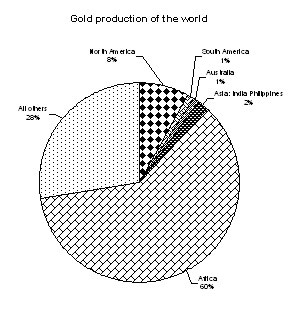
1. This pie-graph stands for ---------
a. the land share of different continents
b. the position of gold production by these continents
c. the possession of gold by these continents
2. The largest producer of gold is ---------
a. Africa
b. North America
c. Kolar gold field
3. Gold producing countries of Asia mentioned are ------
a. North America
b. India
c. India, Philippines.
4. The gold production of all the other countries except Africa is ------
a. 60%
b. 40%
c. 27.5%
5. The Third largest gold producing continent is -----
a. Asia
b. North America
c. South America.
QUESTIONNAIRE - IV
Listening Test
CONVERSATIONS
1. Listen to the following dialogue and answer the questions that follow each:
(Between an English scholar and a prudent boat - man in a boat while crossing rough waters)
Scholar : Is it going to be very rough?
Boatman : Don't ask me nothing about it.
Scholar : Have you never studied English grammar?
Boatman : No.
Scholar : In that case, half your life has been wasted
Boatman : Have you ever learned to swim?
Scholar : No.
Boatman : In that case, master, all your life has been wasted because the boat is damaged by the rough waters and we are going to sink.
Questions
1. The Scholar found out that the boatman Knew little English grammar by the latter's
a. pronunciation
b. expression of ideas
c. use of double negatives to express concurrence
d. use of double negatives to express a denial
2. The boatman seemed to -----
a. worry about his bad grammar
b. respect the scholar for his wisdom
c. worry about the safety of his boat
d. be troubled by nothing
3. The Scholar had wasted all his life by -----
a. a. not learning how to swim
b. learning only grammar
c. not knowing how to move with other
d. not learning how to soil a boat
4. The danger that the scholar had to face was -------
a. to sink in the rough coaters
b. to fight with the boat man
c. to row the boat for many hours
d. to jump into the rough waters.
2. Listen to the following news items and answer the questions that follow:
India today successfully test-fired the 250 km extended range versions of the lethal Prithvi missile, now being developed for the Air Force from the Interim Test Range at Chandipur on sea in Orissa.
1. The Prithvi missile is meant for ---- purpose
a. testing
b. civil
c. spying
d. attacking
2. It was test - fired at -----
a. Sriharikota
b. Thumba
c. Chandipur
d. New Delhi.
3. Lethal means -----
a. giving instruction
b. warning to enemy
c. causing death
d. borrowing missile
3. Listen to the announcement carefully and then answer the questions that follow.
Announcement
Attention please. 2627, the intercity express from Coimbatore to Bangalore via Dharmapuri will start from plat form number 2 right shortly at 14 hours and 15 minutes.
Questions:
1. Where can one hear this kind of announcement?
2. State the train number announced?
3. Mention the platform number from which the train starts?
4. When will the train starts?
5. What is the name of train?
4. You will hear 5 sentences read out once write down right or wrong depending on the grammar of the sentences.
1. One of my sisters are doctor.
2. He have been working in a college since 1998.
3. They are going to Delhi to meet the prime minister neat week.
4. Although he is rich, he is humble
5. She go to temple daily.
5. Trace out the word which is odd in the following group of words in pronunciation.
1. caught, taught, ought, fought, doubt
2. brake, ache, shake, streak, break
3. care, near, wear, tear, fear
4. shower, power, cover, pour, hour
6. You will hear the following 10 sentences read out once in each sentence, the speaker will use one of the underlined words. listen carefully and encircle the word you hear.
1. I wonder why he hit / hid the dog.
2. He used to keep bills / pills in that book.
3. He saw a large whale / veil.
4. Let's go and hook at the cards / guards.
5. No one expected her to faint / paint like that.
6. Put all these things in the back / bag.
7. They need at least two more logs / locks.
8. You need a Longer robe I rope than that
9. Don't disturb her while she is praying / playing.
7. You will hear 10 words. Pair will be read out once decide whether the two words one the same (s) are different (D) in pronunciation. Write S or D in the space against the number of the set.
1. sip/ship
2. sip/ship
3. was/wash
4. fish/pices
5. nice/neice
8. Listen to the recording and write down what you here heard on the tape.
a) numbers
1. Forty
2. Fifteen
3. Three thousand four hundred and eighty
4. Twenty
5. Three hundred and eighty
b) Telephone numbers
1. Two four double two three zero two
2. Two five eight two nine three
3. Five six three eight zero one.
4. Three one four three nine double two.
5. Three one four two eight double one.
c. Years
1. Nineteen seventy - five
2. Two thousand - two
3. Nineteen forty - eight
4. Fifteen seventy - five
5. Two thousand twenty five.
d. days
1. The fourteenth of July
2. The second of October
3. The twenty - third of March
4. April the tenth
5. The fourth of October.
CLICK HERE FOR PRINTER-FRIENDLY VERSION.
SPEAKING STRATEGIES TO OVERCOME COMMUNICATION DIFFICULTIES IN THE TARGET LANGUAGE SITUATION - BANGLADESHIS IN NEW ZEALAND | AMRITA PRITAM - THE BLACK ROSE | PRACTICING LITERARY TRANSLATION - A SYMPOSIUM BY MAIL -- THIRD ROUND | RESEARCH IN THE LANGUAGE CLASSROOM- STATE OF THE ART | THE INVISIBLE TREES | A STUDY ON THE LEARNING PROCESS OF ENGLISH BY HIGHER SECONDARY STUDENTS WITH SPECIAL REFERENCE TO DHARMAPURI DISTRICT IN TAMILNADU | LANGUAGE POLICY OF THE INDIAN NATIONAL CONGRESS 1935-1939 - SOWING THE SEEDS OF A POLICY FOR FREE INDIA - And the Anti-Hindi Agitation in the South | HOME PAGE | CONTACT EDITOR
K. Chidambaram, Ph.D.
Department of Linguistics
Bharathiar University, Coimbatore-641 046
Tamilnadu, India
chimsky_k@yahoo.co.in
- Send your articles
as an attachment
to your e-mail to
thirumalai@mn.rr.com. - Please ensure that your name, academic degrees, institutional affiliation and institutional address, and your e-mail address are all given in the first page of your article. Also include a declaration that your article or work submitted for publication in LANGUAGE IN INDIA is an original work by you and that you have duly acknolwedged the work or works of others you either cited or used in writing your articles, etc. Remember that by maintaining academic integrity we not only do the right thing but also help the growth, development and recognition of Indian scholarship.